About GBIF
|
The Global Biodiversity Information Facility (GBIF) is an international network of country and organizational Participants that exists to enable free and open access to biodiversity data from all sources and to support biodiversity science, environmental research, and evidence based decision-making. GBIF operates as a federated system of distributed data publishing efforts, coordinated through a global informatics infrastructure and collaborative network. In this module, you will learn more about GBIF. |
What is GBIF?
|
Can you imagine how much knowledge could be generated, if people could find and use the Earth’s biodiversity data, in an organized and accessible way? This video (03:19) was originally co-produced in Spanish by SiB Colombia and GBIF Spain, both national nodes of GBIF, and Go Visual with co-financing from GBIF Spain and the Alexander von Humboldt Biological Resources Research Institute (IAvH), the host institution of SiB Colombia. If you are unable to watch the embedded Vimeo video, you can download it locally (MP4 - 39.5 MB). |
| If you see the CC symbol on a video, you can click it to enable closed captioning/subtitles in English or other available languages. |
Introduction to GBIF
|
In this video (07:40), Kyle Copas, GBIF Head of Communications, provides a brief introduction to GBIF—who we are, what we do, and why we do it. If you are unable to watch the embedded Vimeo video, you can download it locally (MP4 - 35.8 MB). |
Presentation transcript
Click to expand
Slide 1 - Introduction to GBIF
Hi! My name is Kyle Copas, and I’m head of communications at GBIF, the Global Biodiversity Information Facility. I’m pleased to offer this brief introduction to GBIF—who we are, what we do, and why we do it—in hope of providing some context for your training course and encourage you to apply the skills you will acquire to promote GBIF’s vision for “A world in which the best possible biodiversity data underpins research, policy and decisions.”
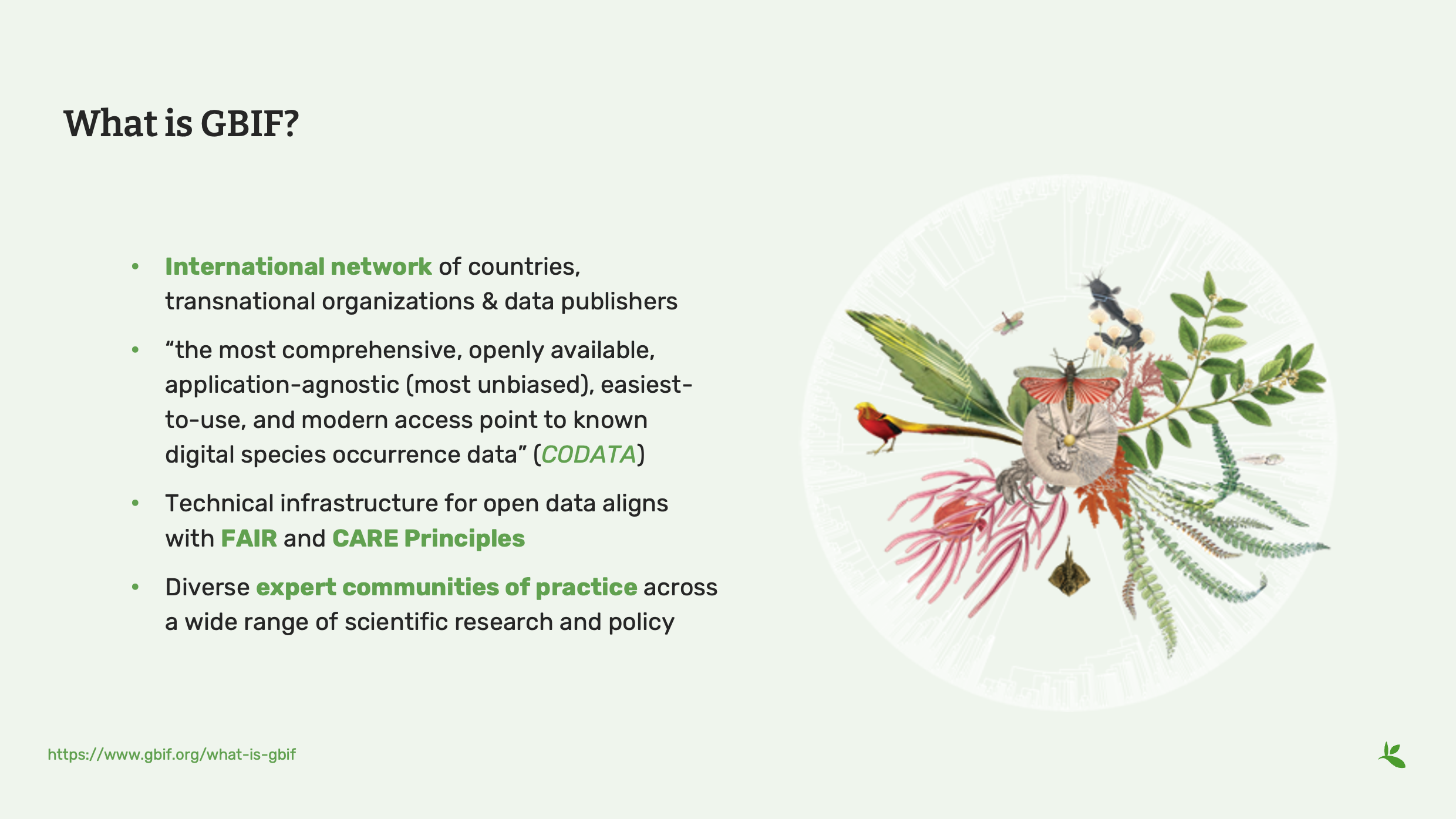
Slide 2 - What is GBIF?
So what is GBIF? We are an international network and data infrastructure, whose purpose is to provide anyone, anywhere, free and open access to data about all types of life on earth. This data provides an essential source of evidence for open science that is used across science and policy, supported and advanced by a worldwide community of experts, partners and collaborators.
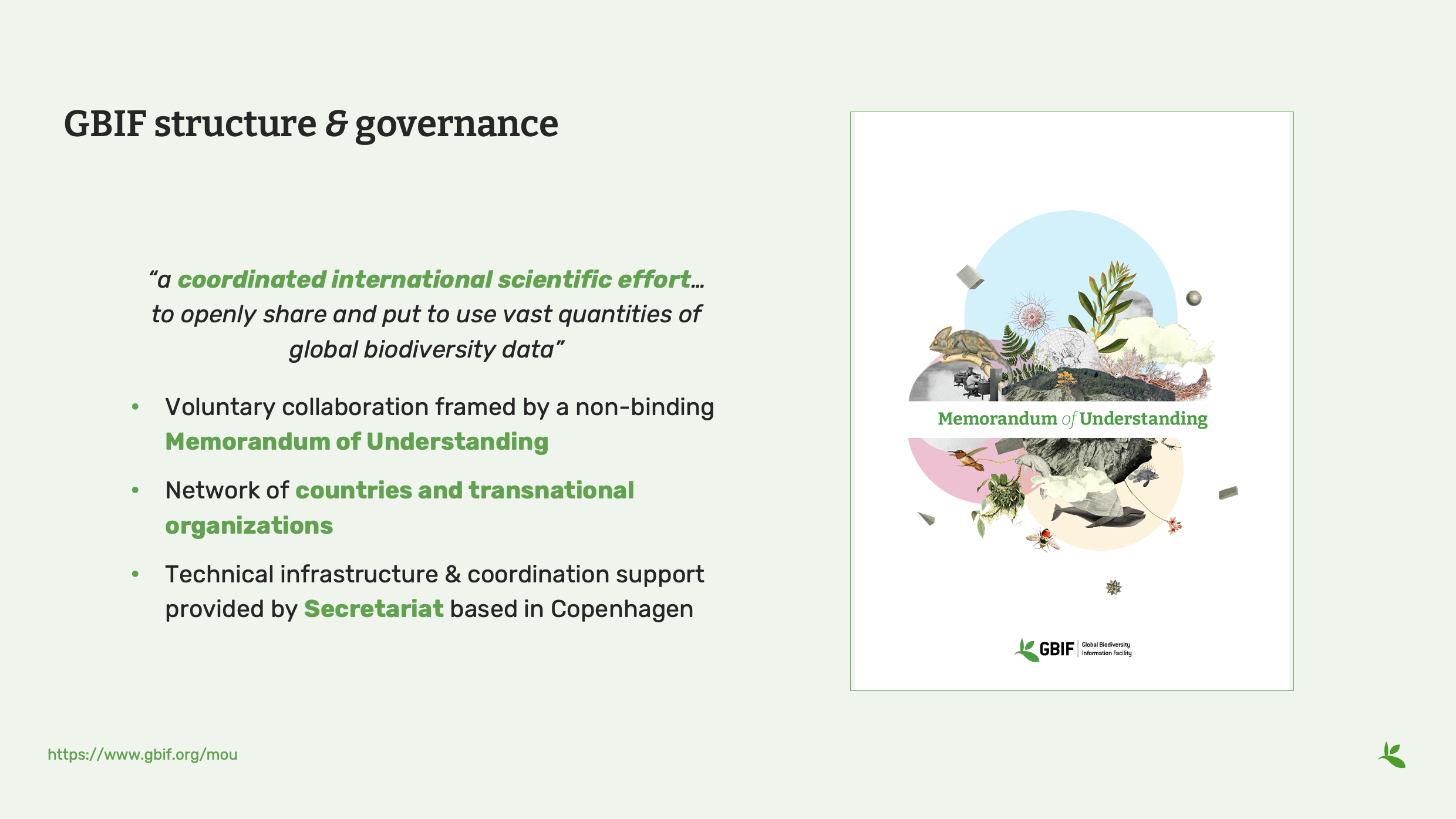
Slide 3 - GBIF governance and structure
Established in 2001, GBIF operates on the basis of a voluntary Memorandum of Understanding between the governments and transnational organizations that collaborate as GBIF’s formal Participants. The MOU sets out the basic governance and principles for a coordinated international scientific effort to mobilize the data, skills and technologies needed to make comprehensive biodiversity information freely available for science and decision-making. Under the MoU, Participants agree to establish a formal delegation that represents them in GBIF’s governance and also to set up a node, which serves as the focal point for coordinating data sharing and use in their country or organization. The GBIF Secretariat based in Copenhagen, Denmark, manages the technical infrastructure and supports collaborations that keep GBIF going and growing as a global community.
Slide 4 - Why do countries join GBIF?
Governments around the world join GBIF to build on and benefit from the community-based tools, standards, and practices developed and supported the network. This provides an efficient and effective means for Participants to build capacity and address data needs around biodiversity. GBIF helps its participants increase the returns on investment in research, data collection and digitization, create and coordinate partnerships aligned with national efforts, and guide efforts to provide data needed to fulfil national policy goals and global commitments.
Slide 5 - Governance and structure overview
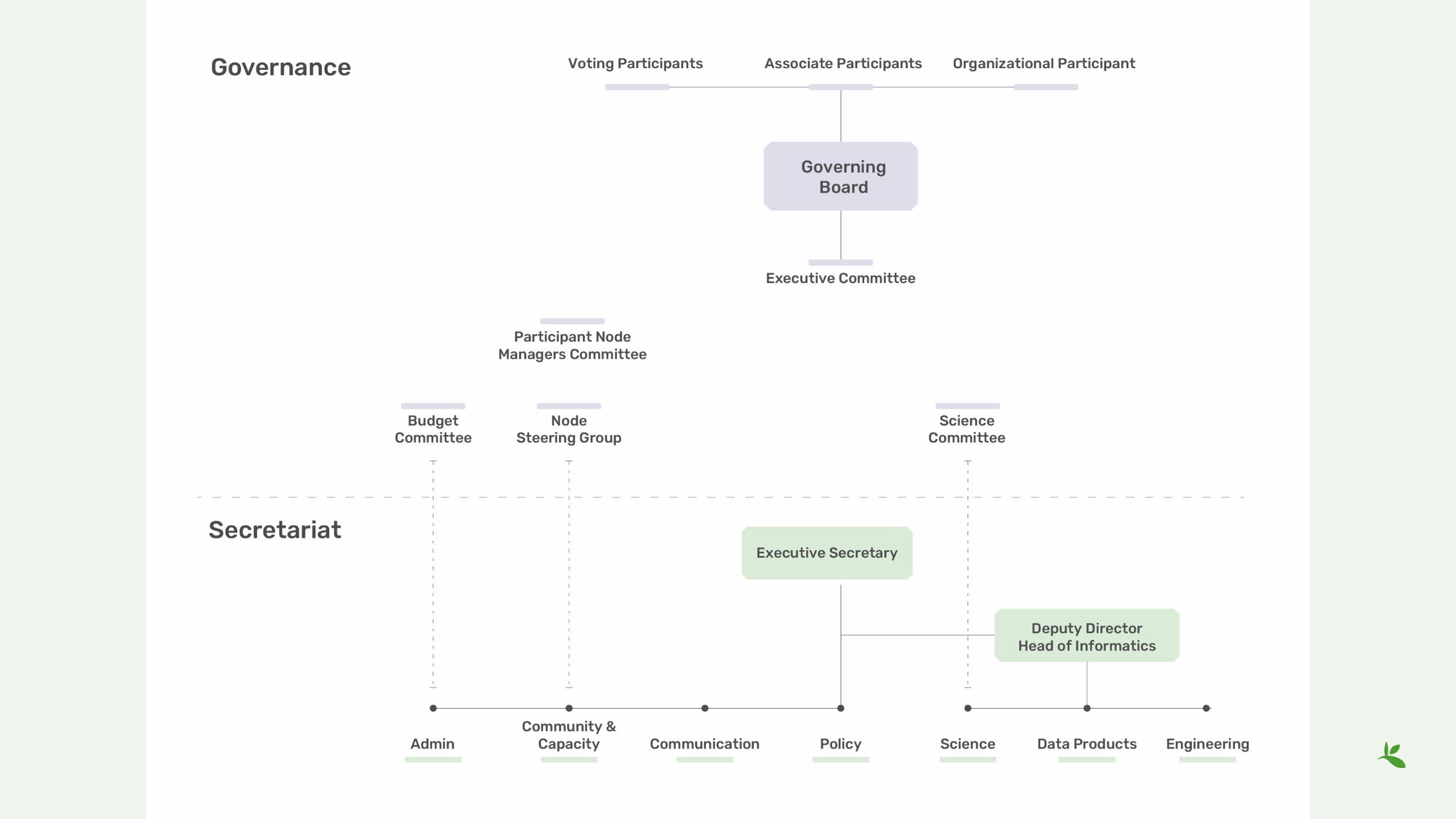
The GBIF governing board meets annually to approve a work programme and make decisions that guide the direction of the network. Board members consist of Participant heads of delegation who represent their countries and organizations. Only Voting Participant Countries that make financial contributions to GBIF’s annual budget have the right to vote. Associate Country Participants do not yet make financial contributions and can maintain this temporary status for up to five years, while Associate Organizational Participants are not required to make financial contributions. While Associate Participants cannot vote, delegations from all Participants take part in Governing Board discussions, endorse data publishers, and collaborate in meetings, programmes and other network activities. In between governing board meetings, and under the direction of an elected board chair, the elected members of standing committees for budget, science, nodes and the executive provide oversight and decision-making on operational activities led by the respective teams in the Secretariat.
Slide 6 - What is a GBIF Participant node?
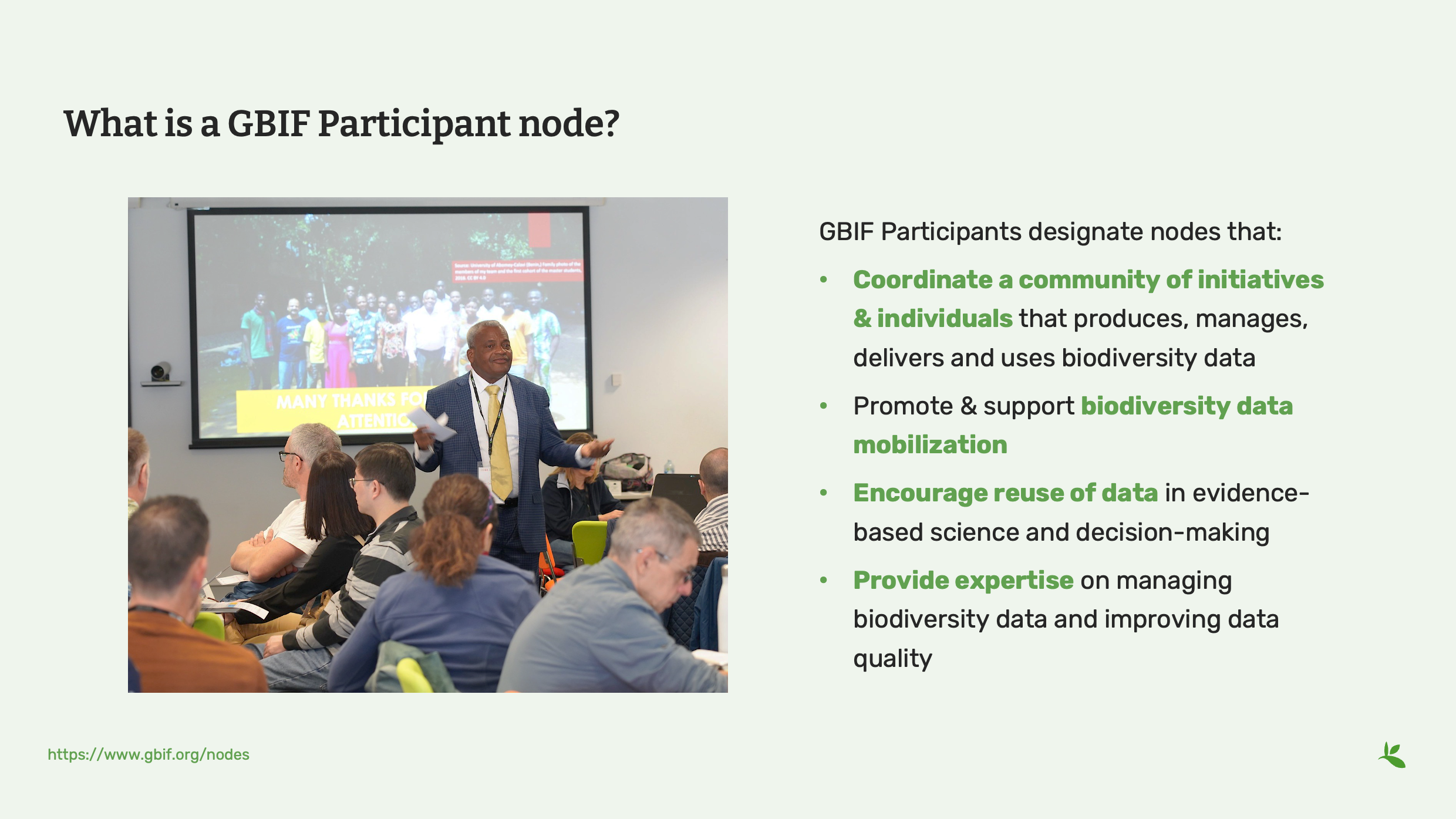
Participant nodes act as focal points for coordinating networks of people and institutions that share and use biodiversity data in their countries and organizations. Supported by their organizational arrangements and GBIF’s common set of informatics solutions, nodes work to improve the availability and quality of biodiversity data. Effective nodes serve as knowledge hubs for both biodiversity data and wider related activities, guiding their audiences toward relevant sources of data and sharing expertise on open data and open science, data standards and digitization, and other biodiversity tools and initiatives.
Slide 7 - Providing biodiversity evidence for research and policy
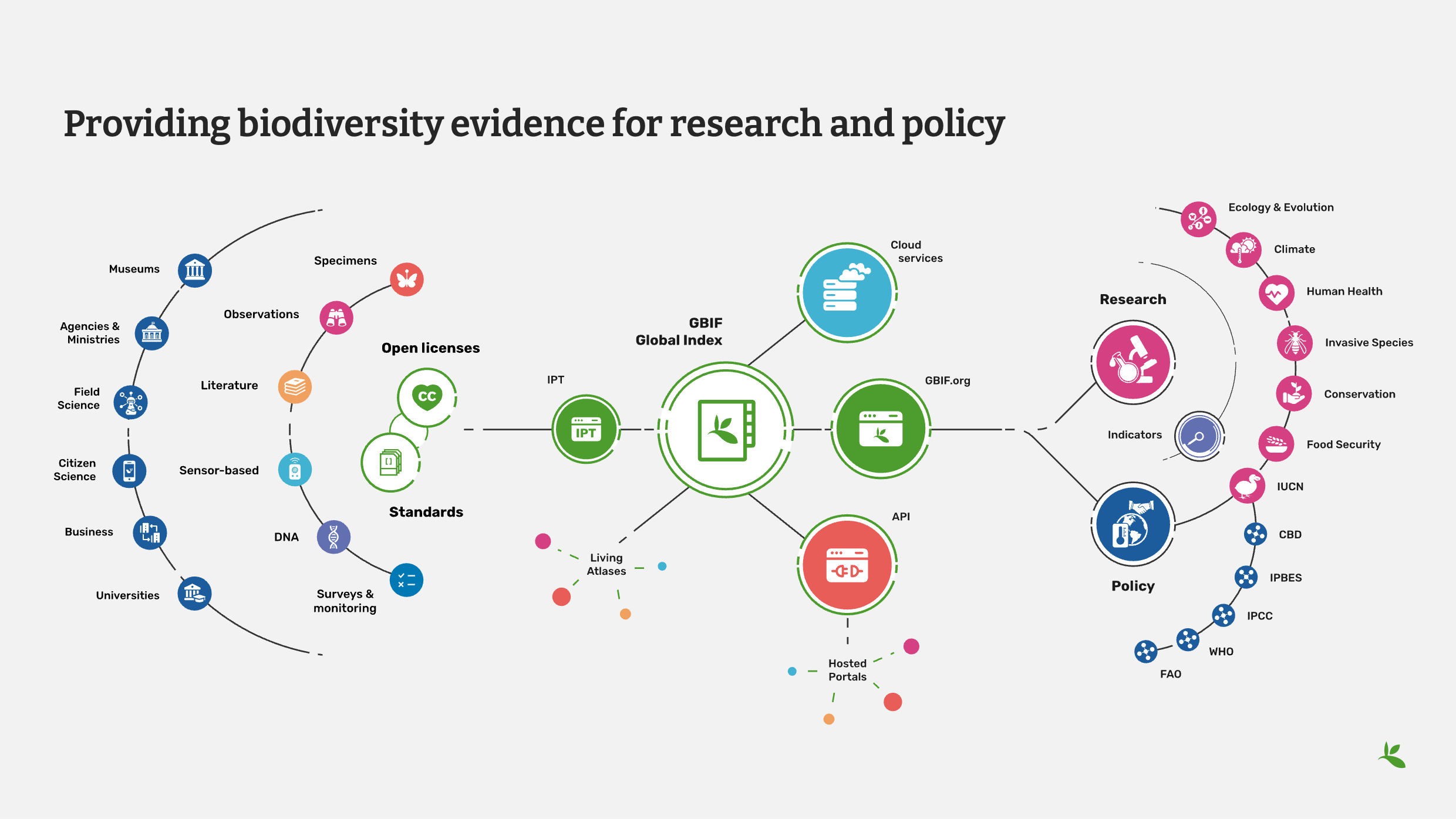
This diagramme charts the flows and processes by which GBIF brings together data from disparate sources and thousands of institutions using shared tools, common data standards and open licences. The underlying evidence can take many different forms—from museum specimens and field observations from surveys and monitoring programmes, including citizen science projects, to sensor-based sources like camera traps, acoustic recorders, and barcodes sampled from environmental DNA. Taken together, these combined sources provide a more complete view of where and when species have been observed. Users access the resulting index through various methods and formats, which they then apply across a full spectrum of biodiversity-related research and policy.
Slide 8 - GBIF is used across all domains and disciplines of science
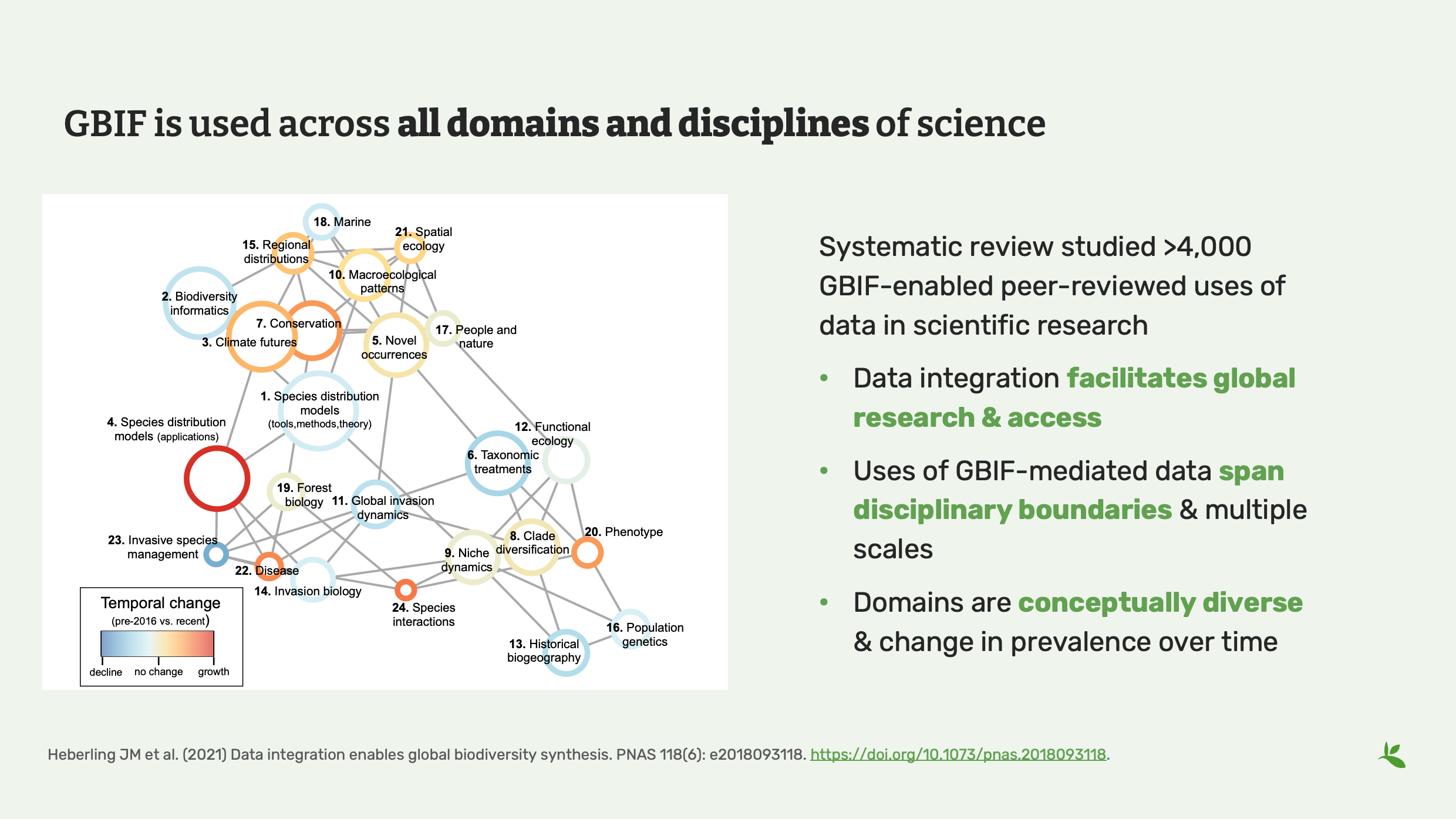
Today, GBIF is a mature network and infrastructure used across all domains and disciplines of science. The data that the network integrates not only facilitates global research and access, but also enables researchers to explore both basic and applied questions at taxonomic, temporal and spatial scales that would be otherwise impossible.
Heberling JM et al. (2021) Data integration enables global biodiversity synthesis. PNAS 118(6): e2018093118. https://doi.org/10.1073/pnas.2018093118.
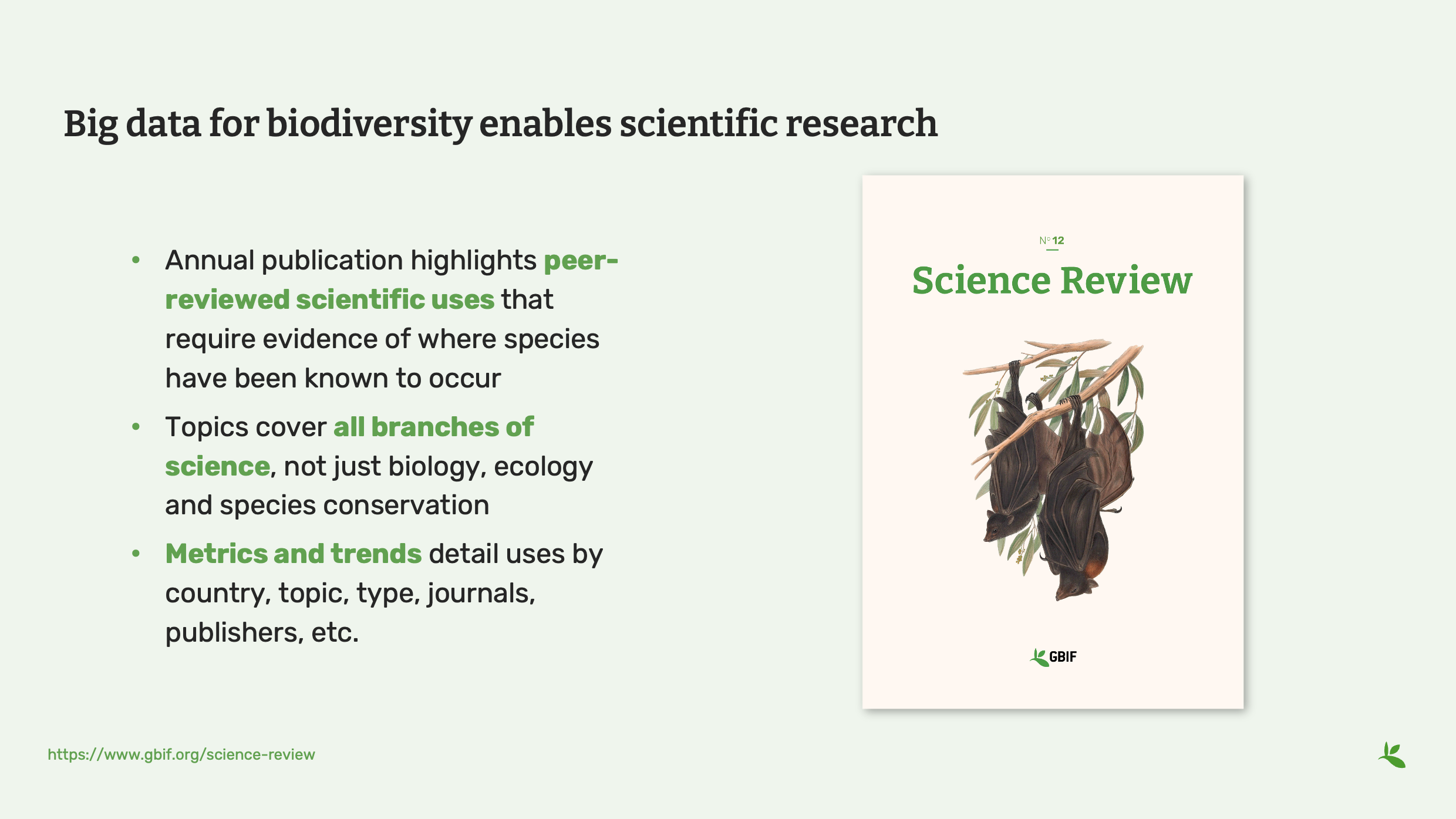
Slide 9 - Big data for biodiversity enables scientific research
The Secretariat maintains a sophisticated citation tracking system to record dozens of journal articles published every week that rely on GBIF-mediated data. Doing so allows GBIF to credit data publishers and to highlight important and illustrative applications of the data in its annual https://www.gbif.org/science-review [Science Review^]. The examples contained in each issue—which also appear online throughout the year—provide a convenient way to understand how data is used in both basic and applied research.
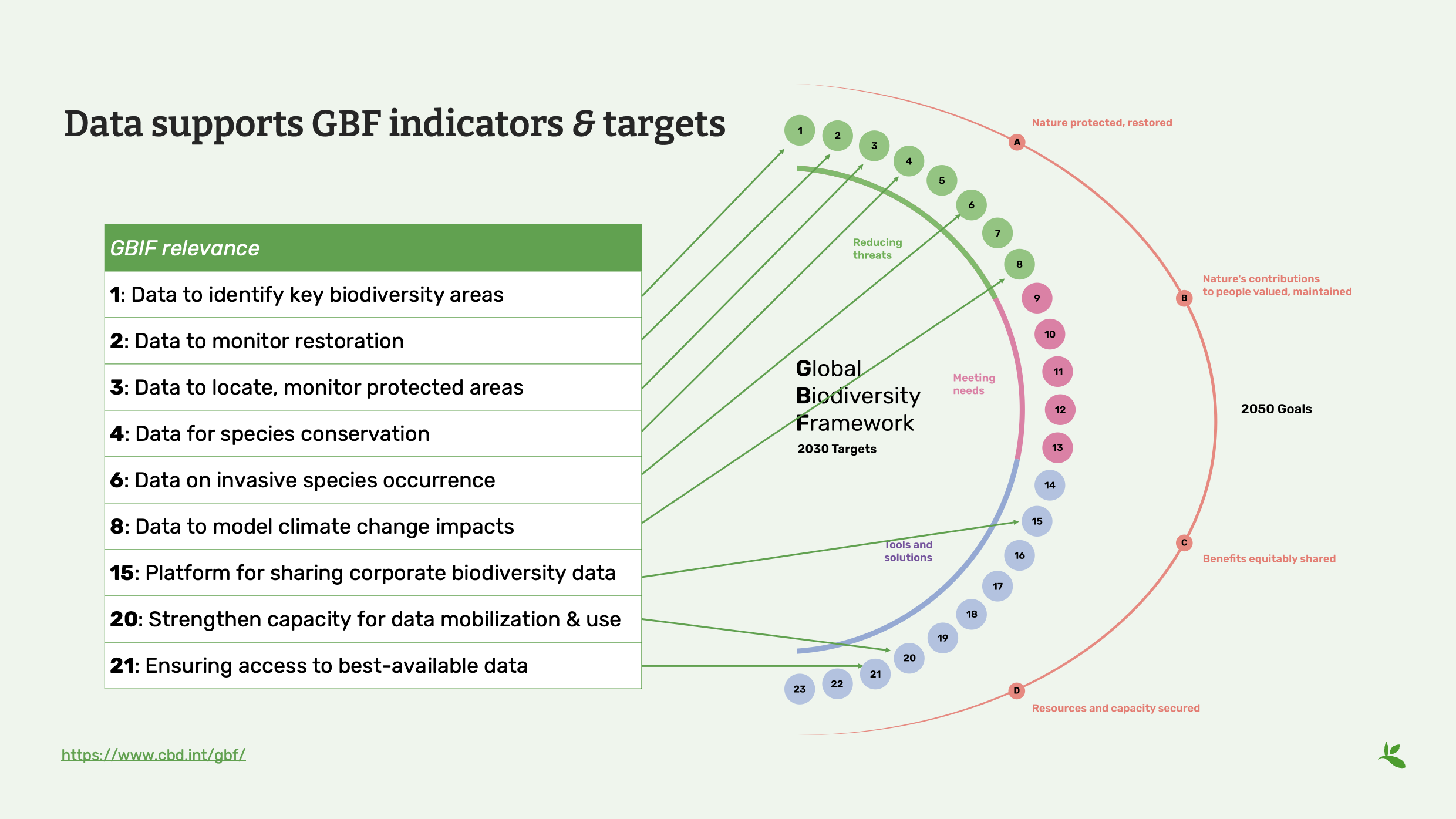
Slide 10 - Data supports GBF indicators & targets
GBIF-mediated data is also an essential input for biodiversity-related policy. Thousands of IUCN Red List assessments, which analyse extinction risks to species, cite occurrence data from GBIF. The same data serves both directly and indirectly as a foundation for metrics and indicators that chart progress toward international targets commitments such as the Kunming-Montreal Global Biodiversity Framework.
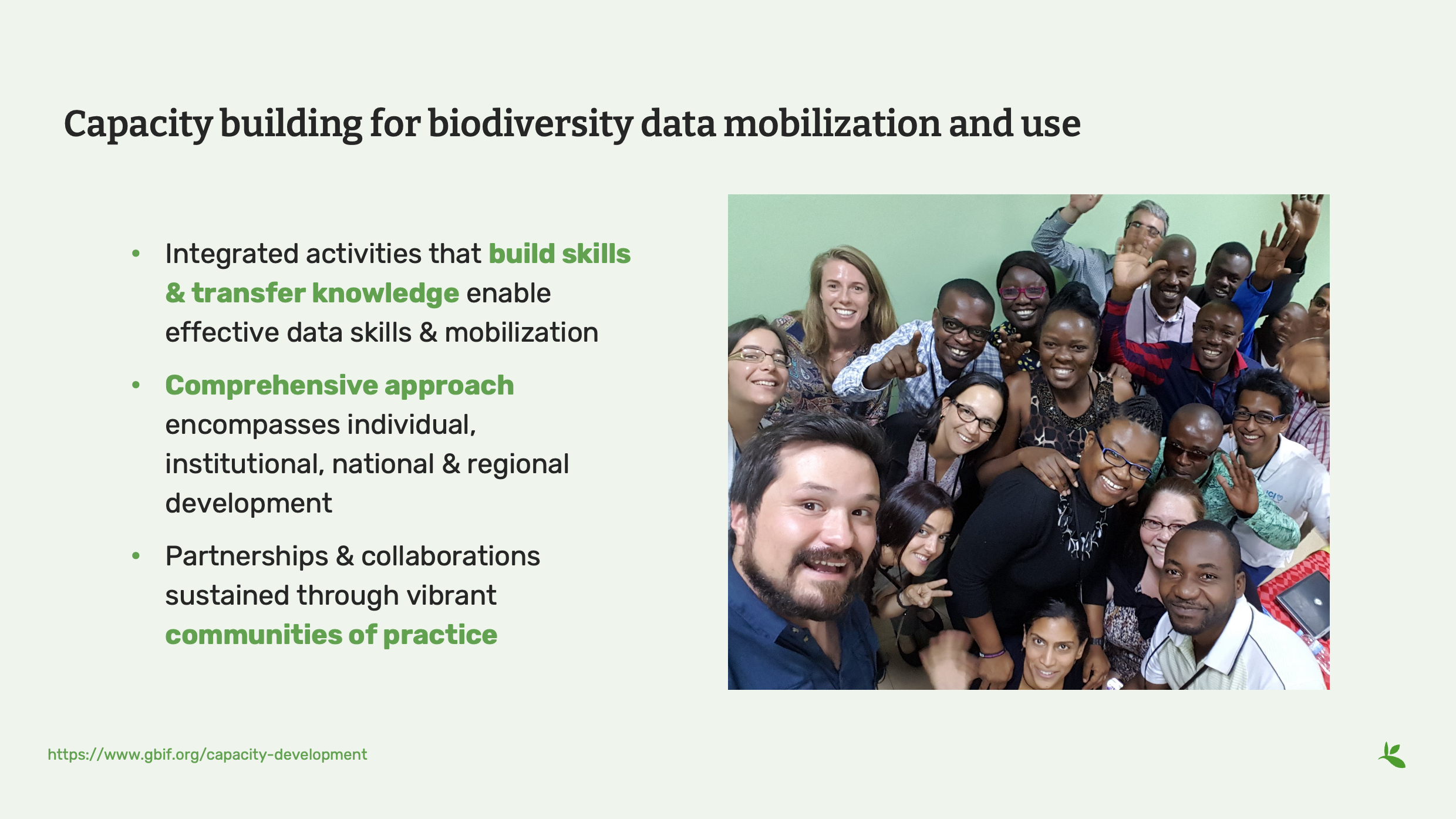
Slide 11 - Capacity building for biodiversity data mobilization and use
While GBIF delivers many technical solutions, its global community is equally essential, with each individual committed to collaborating and developing skills and best practices for managing, sharing and using biodiversity data. GBIF communities of practice generate, adapt, share and improve freely available tools, guidance documentation, and other learning resources, and then extend their reach further by contributing volunteer translations in multiple languages. Experienced practitioners from GBIF’s nodes and publishers serve as mentors and trainers in courses like the one you’re following now, which lie at the heart of GBIF’s work. Today’s trainees soon become tomorrow’s mentors, growing the network through a host of programmes, partnerships and collaborations at many scales.
Slide 12 - Conclusion
So thanks, best of luck and welcome to the GBIF community—and good luck!
This video is part of a series of presentations developed for the Introduction to GBIF course. It was created and narrated by me, Kyle Copas. If you have any questions on the course content, you can reach out at training@gbif.org.
GBIF for Science
|
In this video (07:52), Dmitry Schigel, GBIF Lead Scientific Officer, illustrates GBIF’s work in building the evidence to advance scientific research and understanding of global biodiversity. If you are unable to watch the embedded Vimeo video, you can download it locally (MP4 - 39.4 MB). |
Presentation transcript
Click to expand
Slide 1 - GBIF for Science
This presentation illustrates GBIF’s work in building the evidence to advance scientific research and understanding of global biodiversity.
Slide 2 - Providing biodiversity evidence for research and policy
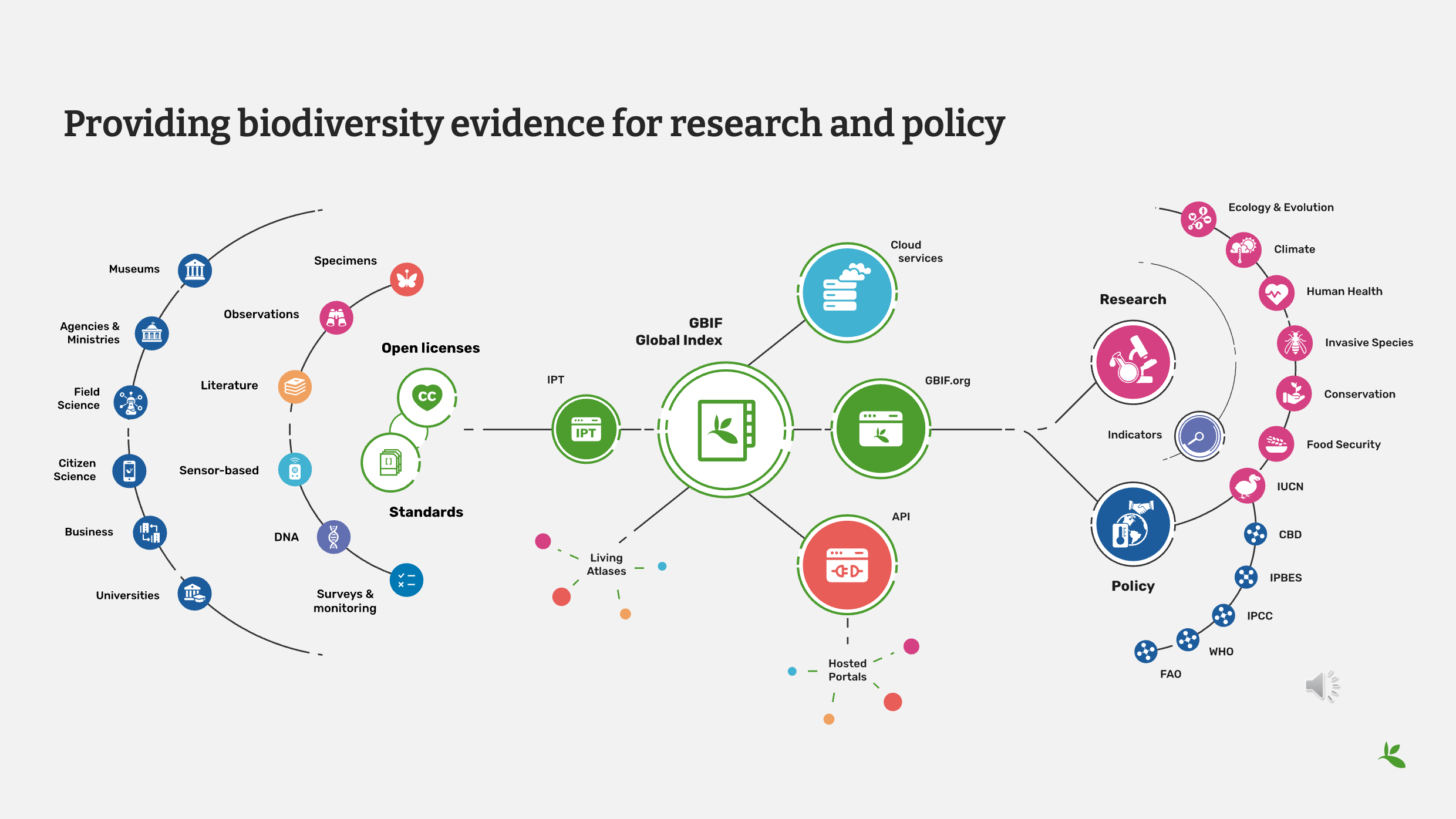
Let’s take a look at GBIF from the science point of view. Let’s work though this left to right.
On the left, academic organizations such as museums and universities, as well as, governmental agencies and non-governmental organizations, businesses and amateur communities, all can register as data holders in GBIF and share biodiversity data that are borne under their roofs and affiliations.
Primary biodiversity evidence can have physical objects behind it, like samples and specimens, or it could also be virtual recordings by humans or by automated sensors.
Some samples undergo chemical processing to reveal biodiversity signals, for instance, through DNA from soil, water, air, or wood. The same method is widely applied to individual or bulk specimens, and together these form eDNA, barcoding, and metabarcoding body of evidence.
This variety of sources and methods comes together in the central index at GBIF – this index makes searches, filters and machine queries work across all the datasets shared with GBIF.
On the right side, you see the meaning of GBIF’s existence: GBIF provides efficiency and time saving for data discovery and data access – but we do not resolve data heterogeneity for you. Like with any other internet search, your science needs – on the right in magenta – or, perhaps, your policy needs, in blue, dictate which data records will be fit for your use.
So here biodiversity science happens on on both sides – on the left, among the data publishers, and on the right – with the users. Biodiversity informatics, computer science with their technical competencies bring the two sides together.
Slide 3 - Datasets: attribution, credit and affiliation
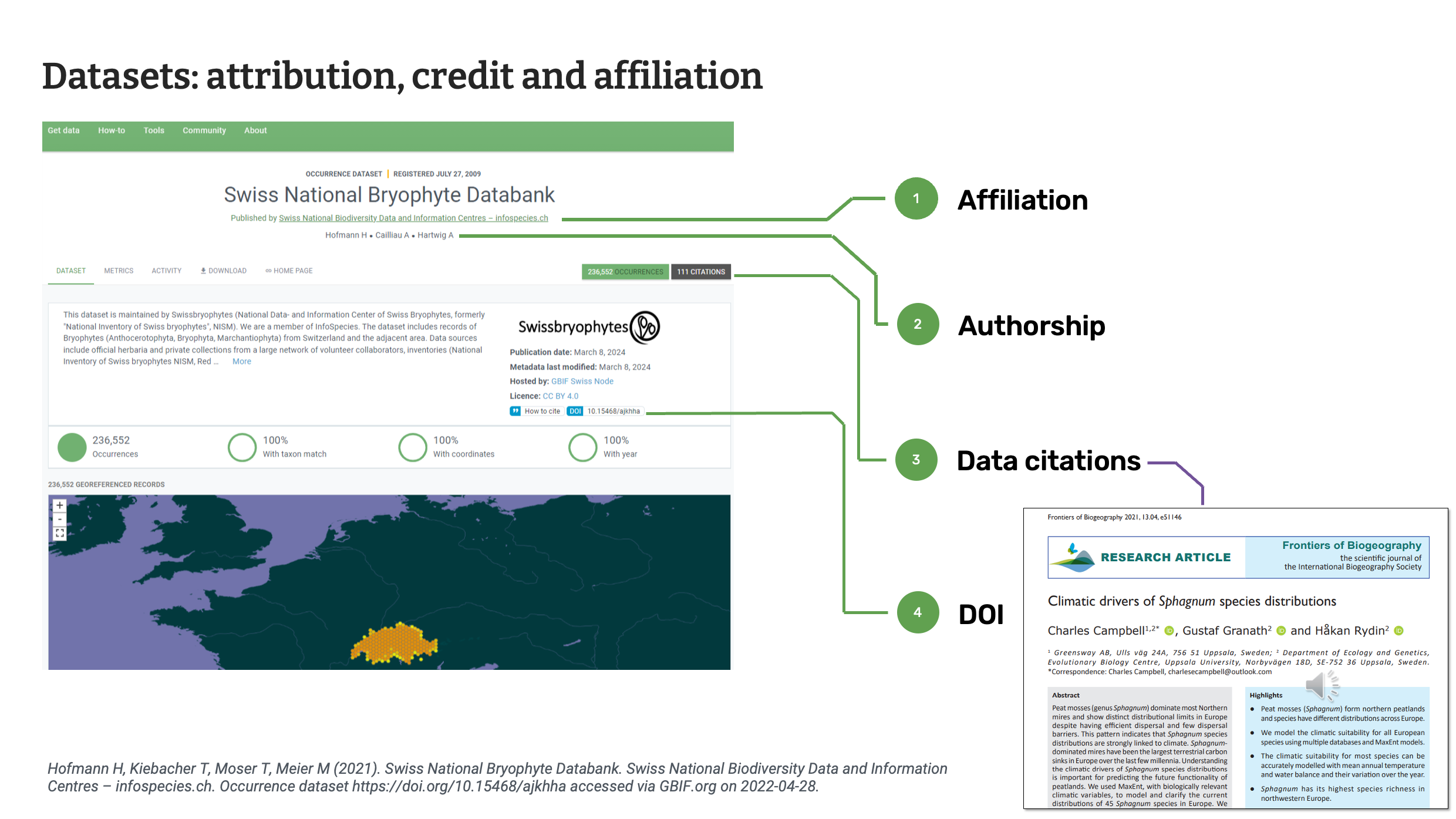
For anyone in research and academia, the dataset page at GBIF will have familiar elements which focus on credit and attribution:
First, is the dataset’s organizational affiliation – which is also a link leading to publisher’s page – in GBIF, datasets are shared by organizations.
Next – are the dataset’s authors in a few key roles – the dataset originators, the creative authors of the recorded biodiversity evidence, and the metadata authors – whose role is to ensure that digital representation and description of the dataset at GBIF is accurate.
Third – every dataset page where at least one record was cited at least once displays an ever-growing number and links to research papers which are powered by this dataset’s use.
The fourth and final element highlighted here – is the dataset’s DOI, the unique digital object identifier which enables what we call literature tracking. Anytime data is used from a dataset, the DOI of the dataset is meant to be cited by the users of the data.
In this particular example, a dataset on bryophytes, mosses from Switzerland, has been used in a study analyzing climate and distribution of Sphagnum mosses by a group of authors based in Sweden. This is only one of over 150 studies that are rooted in this dataset.
Slide 4 - Peer-reviewed publications using GBIF-mediated data
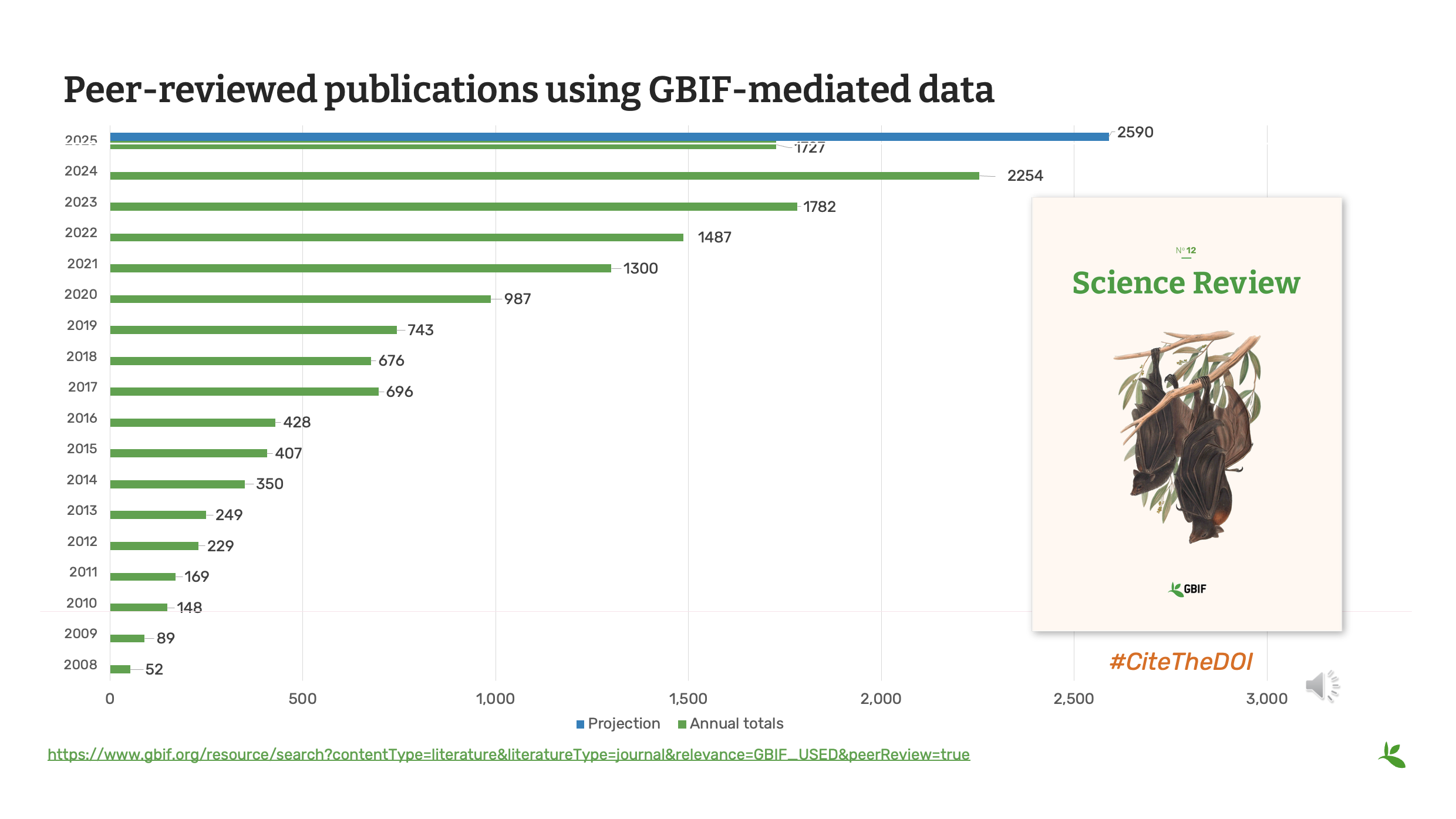
Through the Secretariat’s literature tracking programme, we are able to see that GBIF-mediated data are used in scientific literature at an increasing rate.
The GBIF Science Review highlights an annual selection of key research uses drawn from the literature tracking programme. The peer-reviewed articles summarized in the Review offer a partial but instructive view of the wide range of research investigations that are enhanced and supported by free and open access to biodiversity data from the GBIF network of Participants, nodes and publishers.
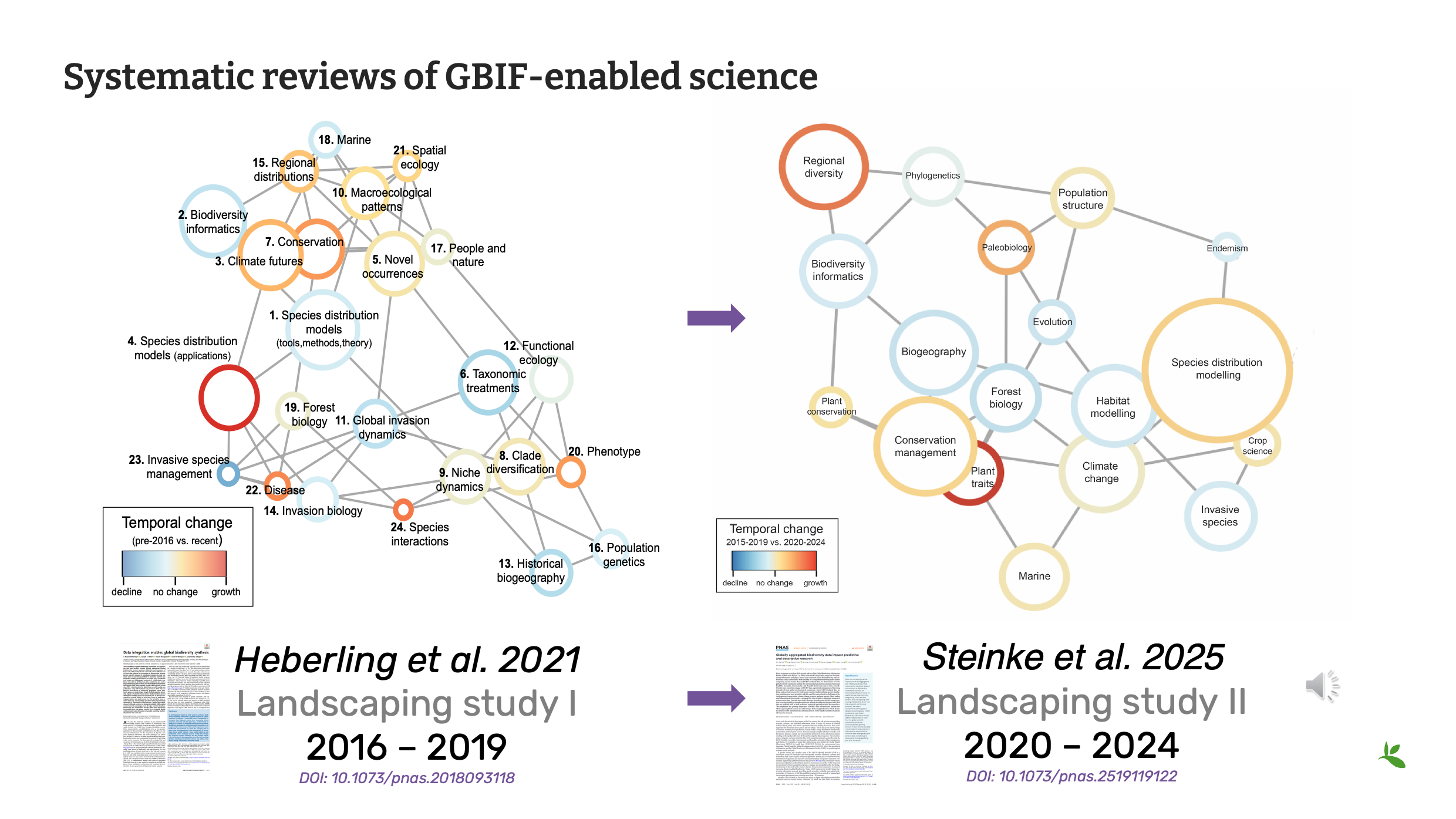
Slide 5 - Systematic reviews of GBIF-enabled science
As more and more researchers cite data using DOIs, GBIF is better able to monitor and to analyze the landscape of GBIF-enabled science. Every five years the corpus of GBIF enabled research is a subject of systematic review, exploring the patterns of GBIF use in research.
On the left, you can see diversity of topics in years 2016 to 2019, the topics becoming hotter and cooler with time, topic connections, and topic sizes, and the picture on the right outlines the thematic relevance landscape of GBIF in more recently from 2020 to 2024.
These studies produce two kinds of important fact-based signals for the network: they outline the evolution of the GBIF data outputs for scientific analyses, and the strategic understanding of GBIF position and trends in supporting science.
https://doi.org/10.1073/pnas.2018093118 Heberling et al. 2021 Data integration enables global biodiversity synthesis 2016 – 2019 DOI: 10.1073/pnas.2018093118
https://doi.org/10.1073/pnas.2519119122 Steinke et al. 2025 Globally aggregated biodiversity data impact predictive and descriptive research 2020 – 2024
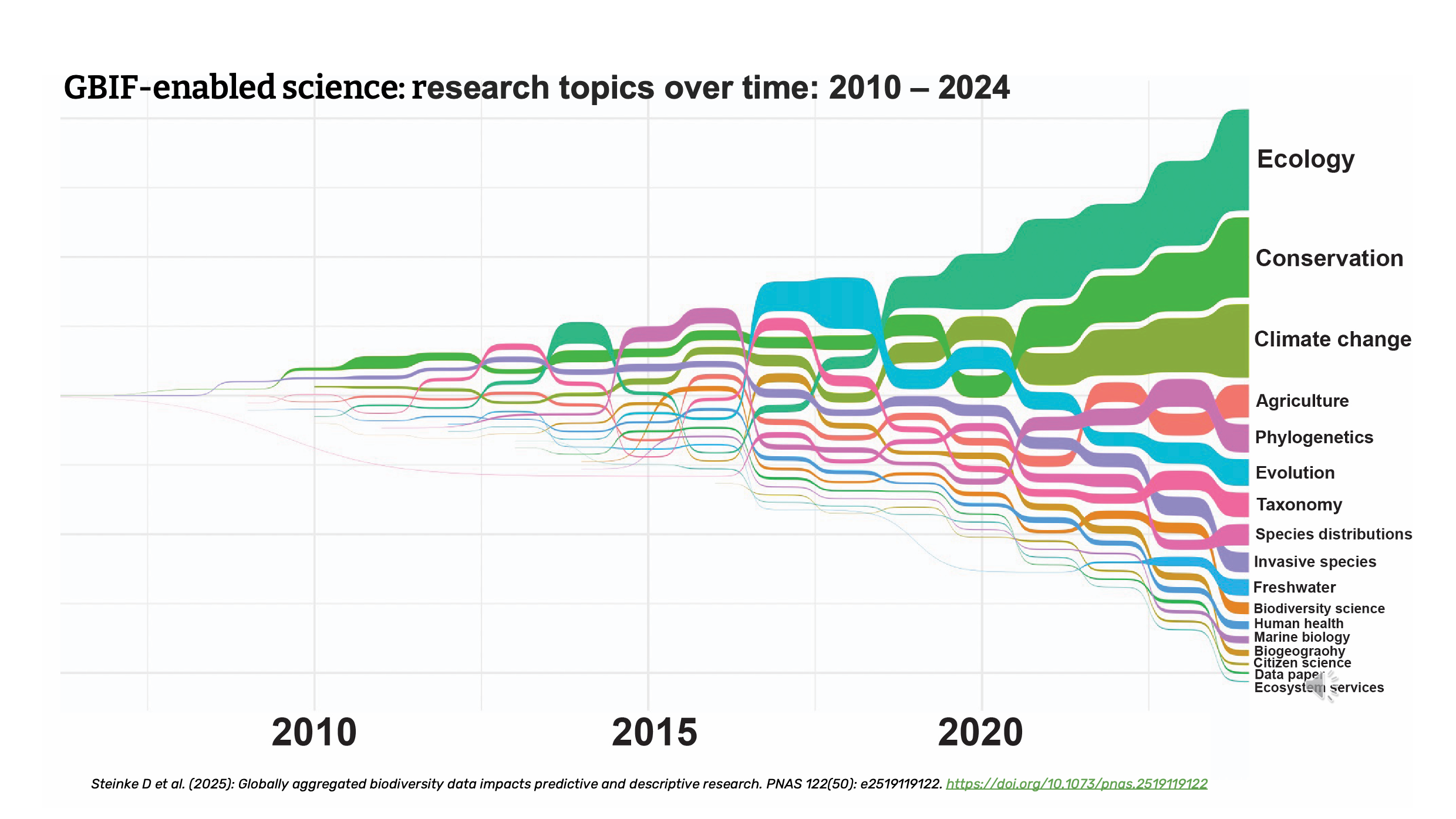
Slide 6 - GBIF-enabled science: research topics over time: 2010 – 2024
What kind of signals and patterns do these systematic reviews reveal? GBIF-powered studies were mostly focuse on ecology in combination with conservation, climate change, agriculture, phylogenetics, evolution, taxonomy, and species distribution. The prevalence of the topics have changed over time — especially ecology in combination with climate change (since 2019), and agriculture (a jump in 2023).
Steinke D et al. (2025): Globally aggregated biodiversity data impacts predictive and descriptive research. PNAS 122(50): e2519119122. https://doi.org/10.1073/pnas.2519119122
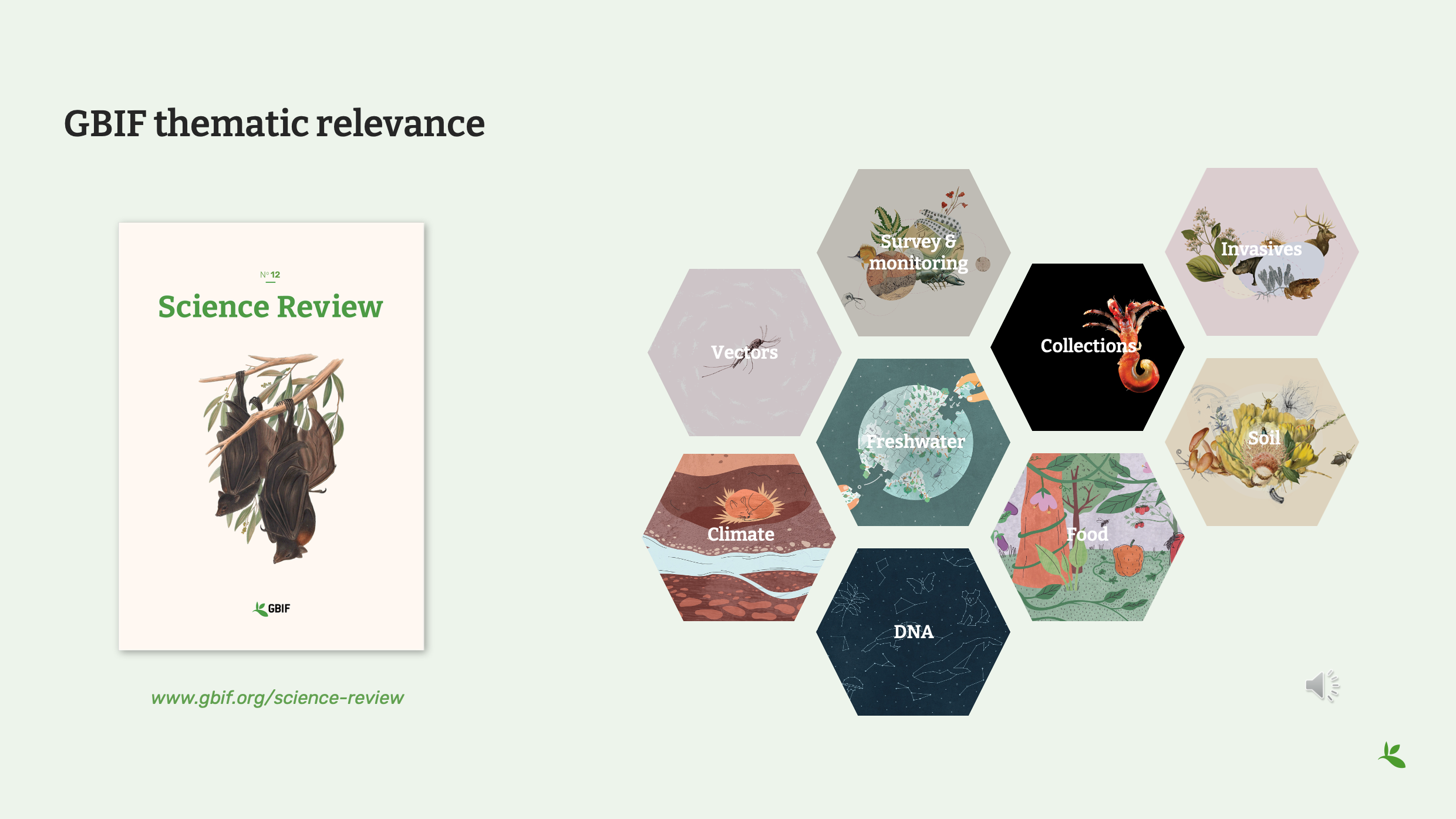
Slide 7 - GBIF thematic relevance
Data shared through GBIF is applied across many disciplines and research traditions. To name just a few:
CONSERVATION, including conservation biology but also science-based management, such as design of the protect areas and assessment of threats to species, by tracking the actual and predicted spread of invasive alien species.
In relation to Agrobiodiversity, GBIF mediated data help exploring distribution of the crop wild relatives.
Another human related sector is HUMAN HEALTH where species that act as vectors, hosts and reservoirs of human diseases are discoverable through GBIF.
As GBIF provides access to both historic and to recent biodiversity data, GBIF powers research on effect of the environmental CHANGE onto species and communities, often using modelling techniques where GBIF mediated data serve as baseline and as inputs.
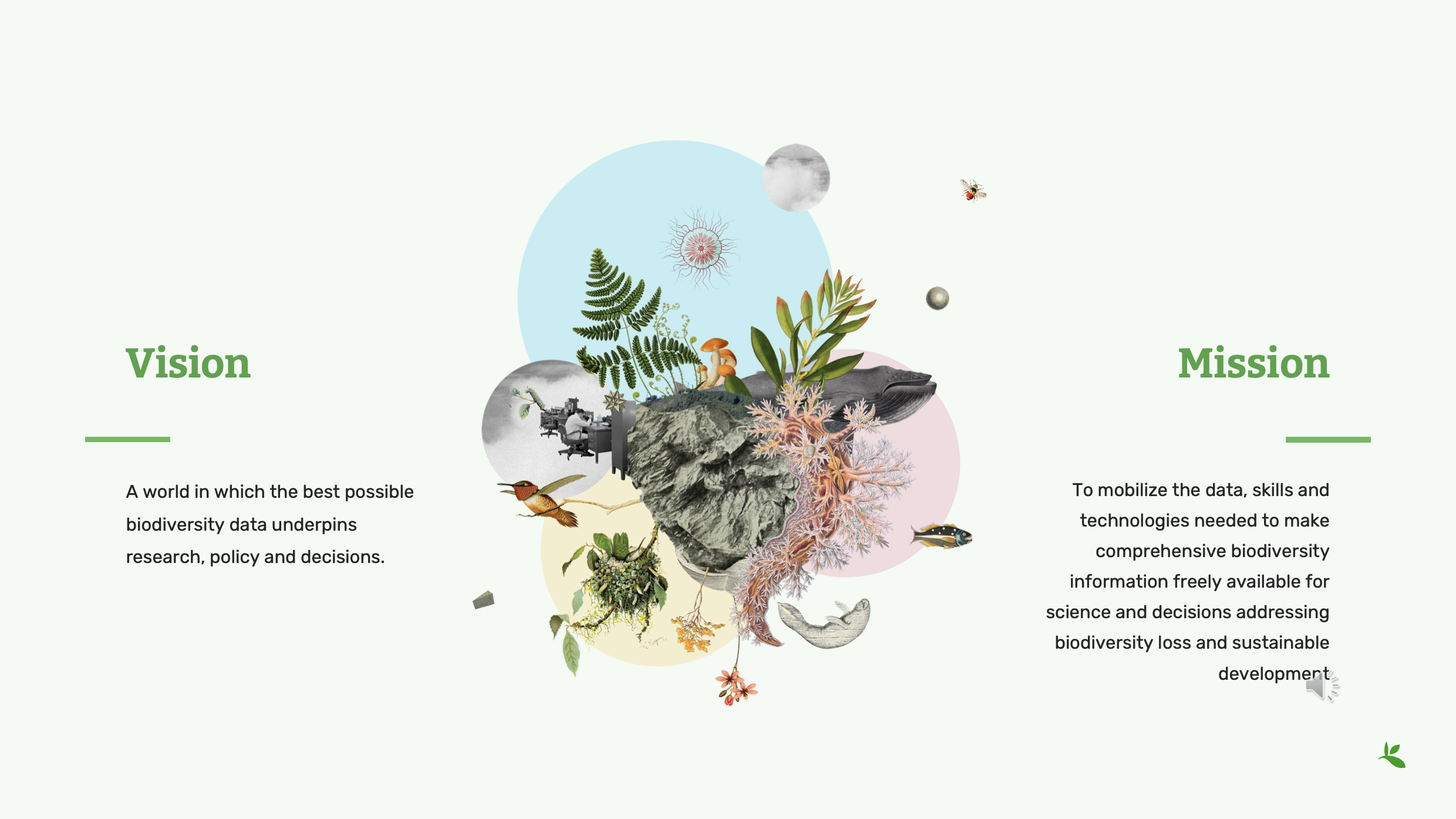
Slide 8 - Mision and Vision
GBIF exists to build the evidence to advance scientific research and to support global understanding of biodiversity. GBIF relevance for science and research is the most visible and the best documented thanks for DOI based literature tracking. GBIF coordinates international scientific efforts of GBIF on its mission of making biodiversity data openly available to all countries and individuals.
Slide 9 - Conclusion
This video is part of a series of presentations developed for the Introduction to GBIF course. It was created and narrated by me, Dmitry Schigel. If you have any questions on the course content, you can reach out at training@gbif.org.
GBIF Participant Nodes
|
In this video (08:05), Mélianie Raymond, GBIF Head of Community and Capacity, explores the important role that nodes play in GBIF. If you are unable to watch the embedded Vimeo video, you can download it locally (MP4 - 48.5 MB). |
Presentation transcript
Click to expand
Slide 1 - The role of nodes in GBIF
In this video, we’ll explore the important role that nodes play in GBIF—the Global Biodiversity Information Facility.
GBIF is both a data infrastructure and an international network that exists to enable free and open access to biodiversity data from all sources.
Here, we’ll focus on one key part of this network: the role of GBIF Participant nodes.
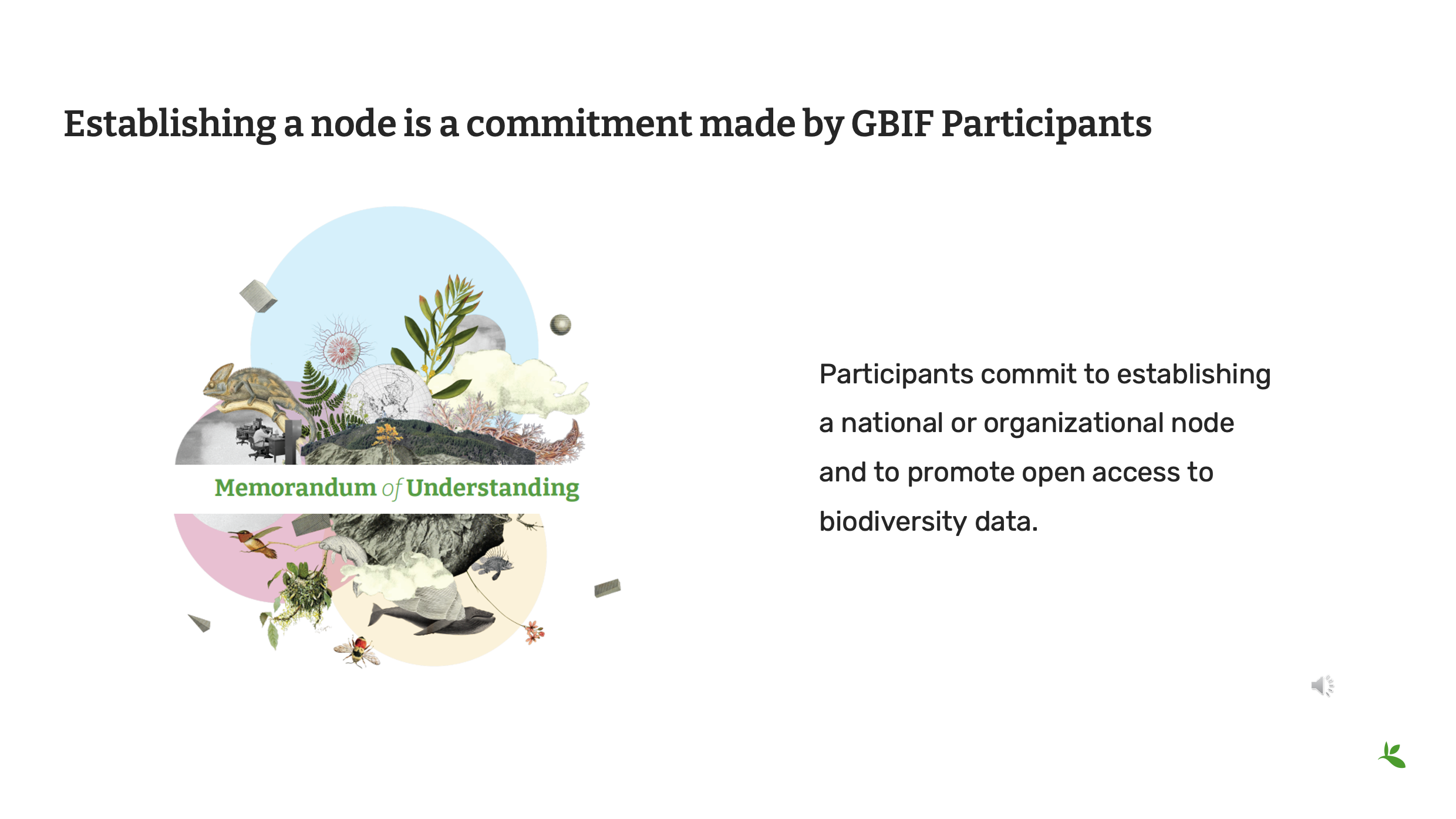
Slide 2 - Establishing a node is a commitment made by GBIF Participants
GBIF is an intergovernmental initiative and its members—formally known as Participants consist of countries, economies, and international organizations working together to promote open access to biodiversity data.
To join, Participants sign a Memorandum of Understanding, confirming their commitment to share biodiversity data openly.
In signing the MOU, each Participant also commits to establishing a national or organizational node.
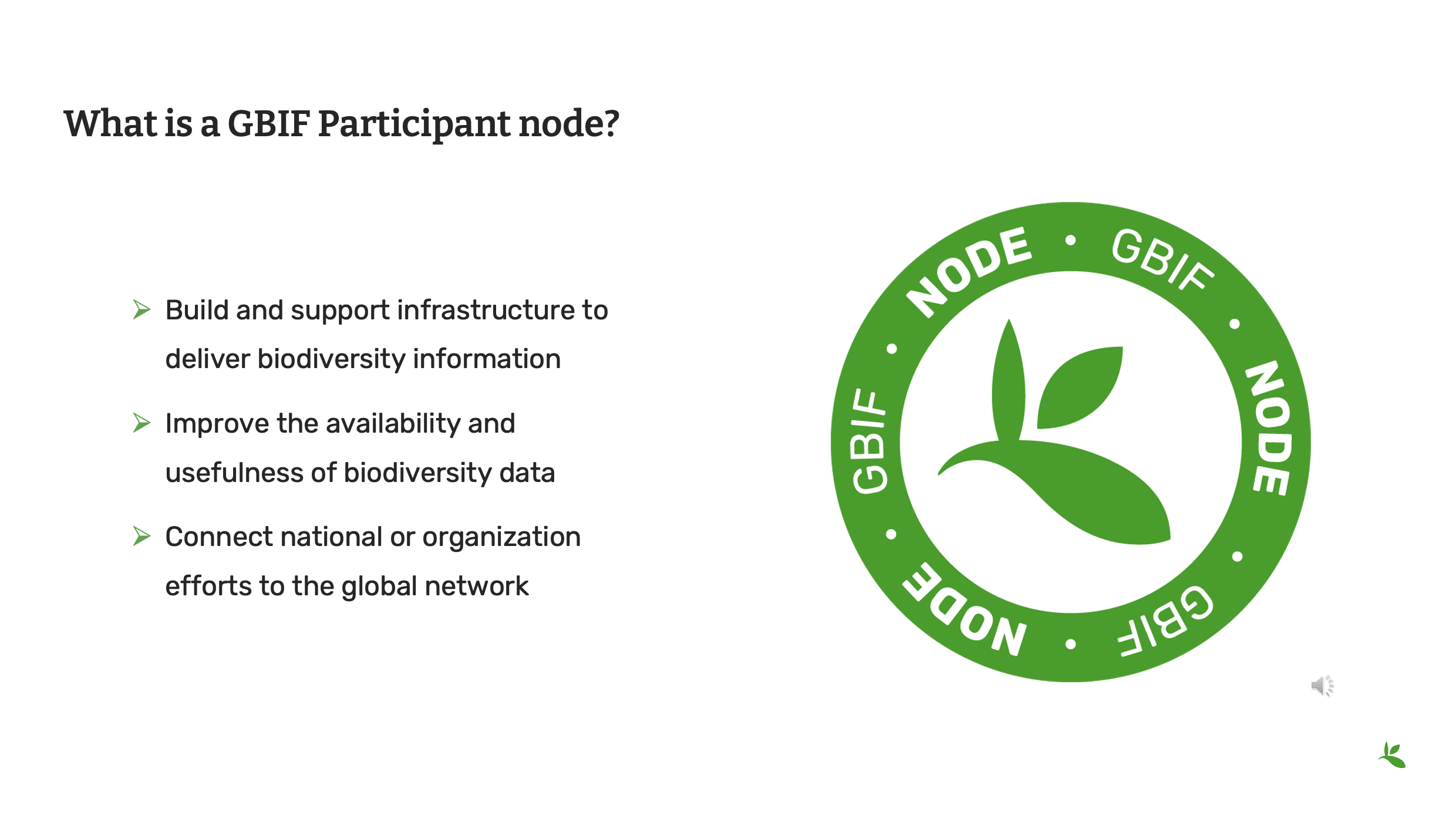
Slide 3 - What is a GBIF Participant node?
A node is a team designated by a country or organization participating in GBIF. Its role is to coordinate a network of people and institutions that produce, manage, and use biodiversity data.
Together, they build and support the infrastructure needed to deliver biodiversity information.
Nodes work to improve both the availability and the usefulness of biodiversity data—for research, policy, and decision-making.
And by participating in GBIF, they connect their national or organizational efforts to a global network.
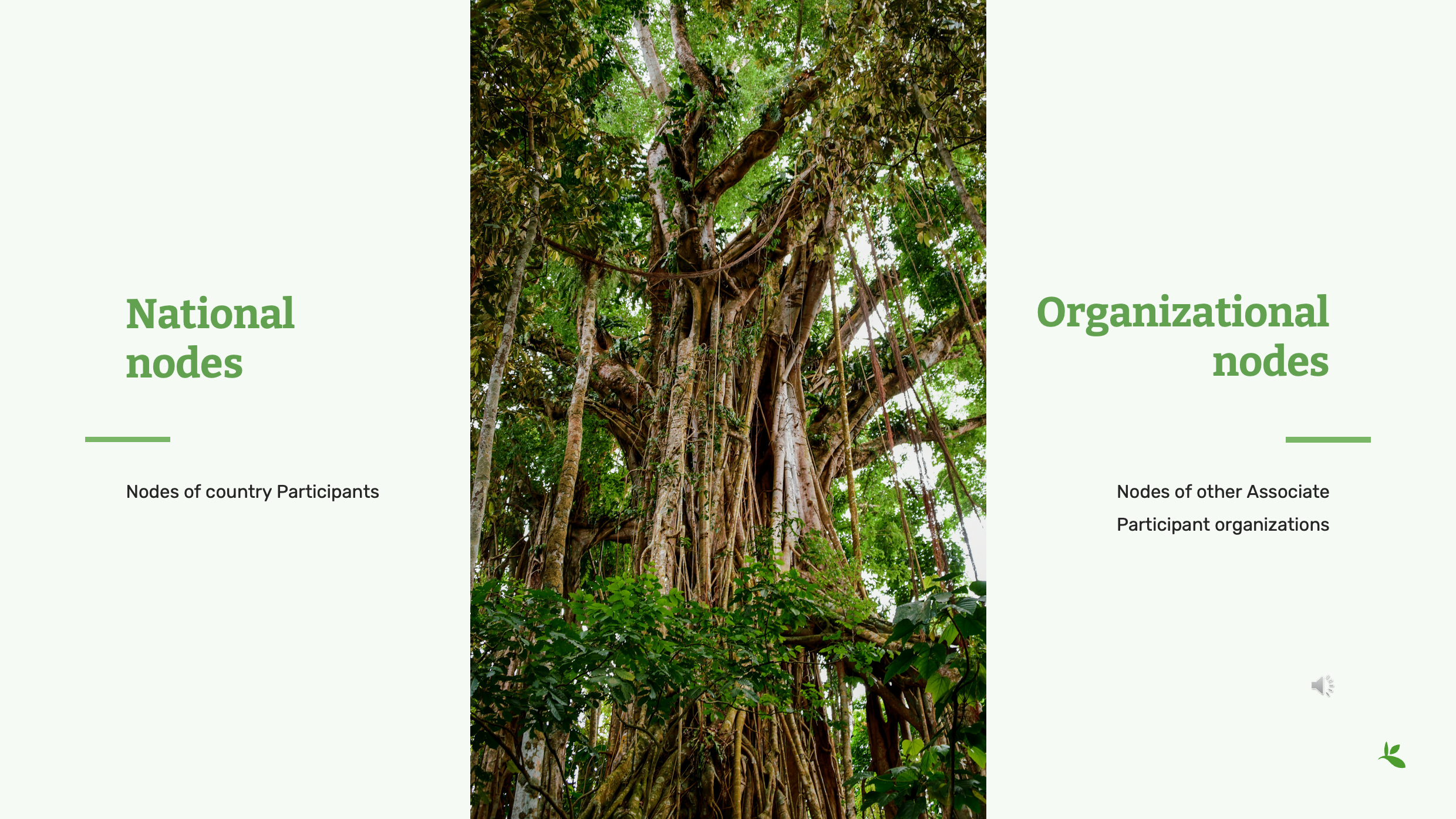
Slide 4 - National and organizational nodes
GBIF nodes fall into two main categories: national and organizational.
National nodes are established by countries. They coordinate biodiversity data sharing at the national level, often under a formal mandate and governance structure, such as a board or steering committee.
This allows data holders, researchers, policymakers, and other partners to work together and set priorities for how the country participates in the GBIF network.
Organizational nodes, on the other hand, are established by the international organizations that participate in GBIF.
They often focus on specific themes or regions, and help extend the reach of the GBIF network.
These two types of nodes complement each other, strengthening collaboration across countries, regions, and thematic areas.
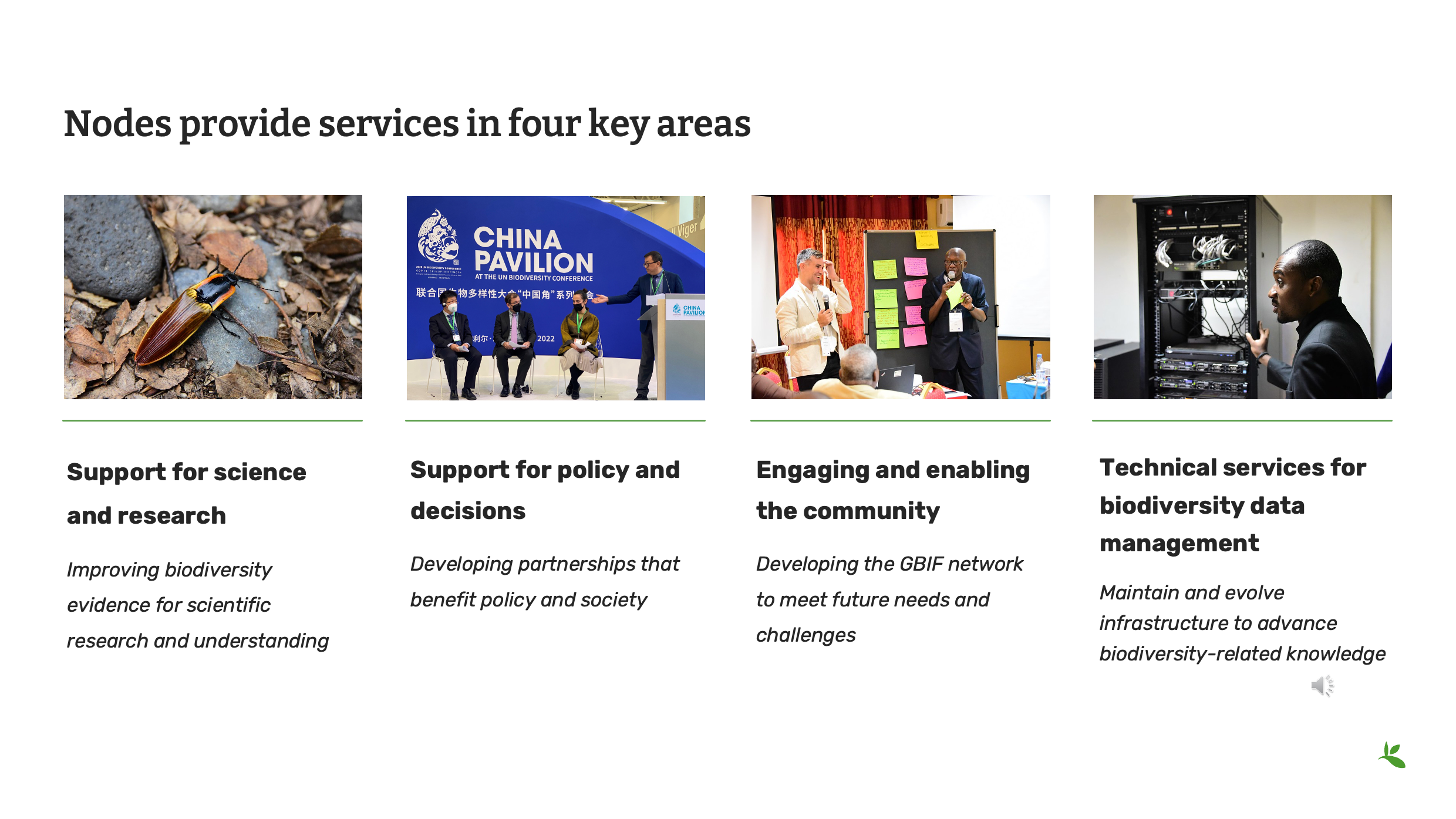
Slide 5 - Nodes provide services in four key areas
Broadly, the services and responsibilities of all nodes can be grouped into four main categories:
-
Support for science and research
-
Support for policy and decisions
-
Engaging and enabling the community
-
Technical services for biodiversity data management
We will now look at the benefits that nodes provide in each of these areas.
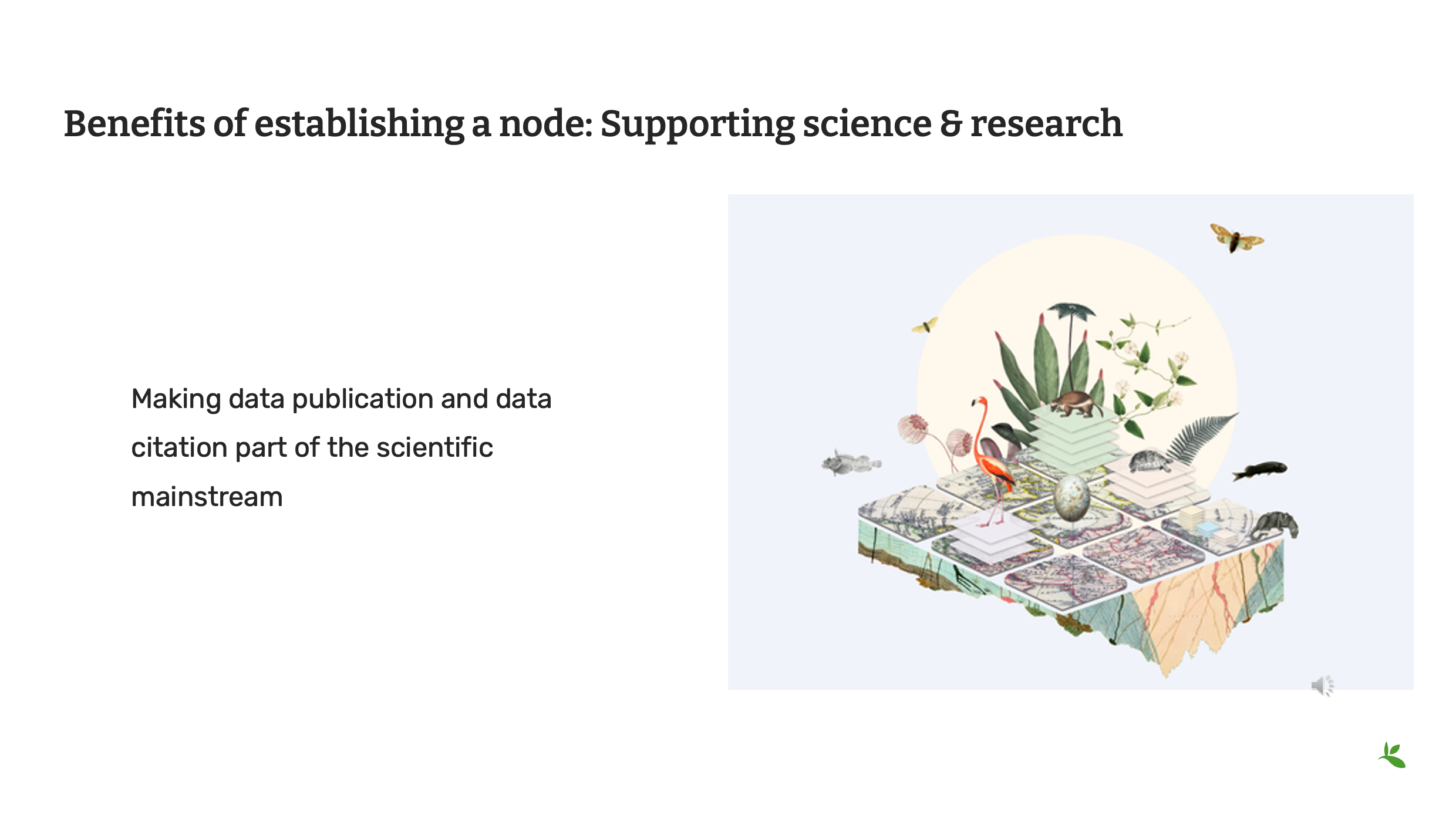
Slide 6 - Benefits of establishing a node: Supporting science & research
Nodes help Participants get more value from their investments in biodiversity research and data collection—past, present, and future.
They support biodiversity data holders in publishing and sharing data using common standards, making it easier to discover, combine, and reuse across studies.
They help make the publication of primary data - and the citation of its reuse - part of the scientific mainstream.
This supports both basic and applied research, and advances our understanding of biodiversity at local, national, and global scales.
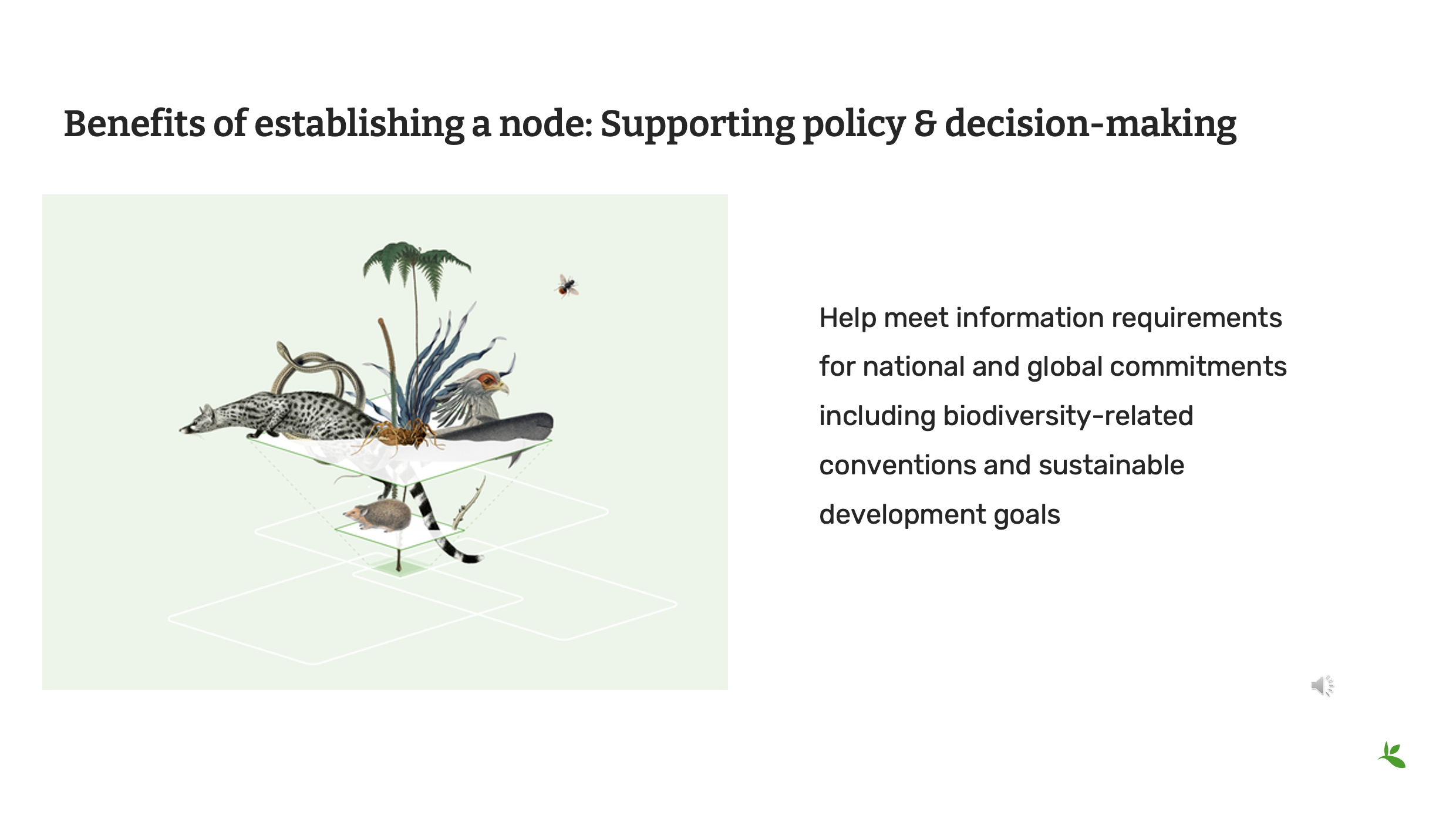
Slide 7 - Benefits of establishing a node: Supporting policy & decision-making
Nodes promote open data practices and help establish the data flows that allow biodiversity data to inform policy and decision-making.
This includes supporting information needs for biodiversity strategies, conventions, and sustainable development goals.
Participant nodes and biodiversity information facilities are therefore instrumental in helping Participants achieve their own biodiversity data-related goals and targets.
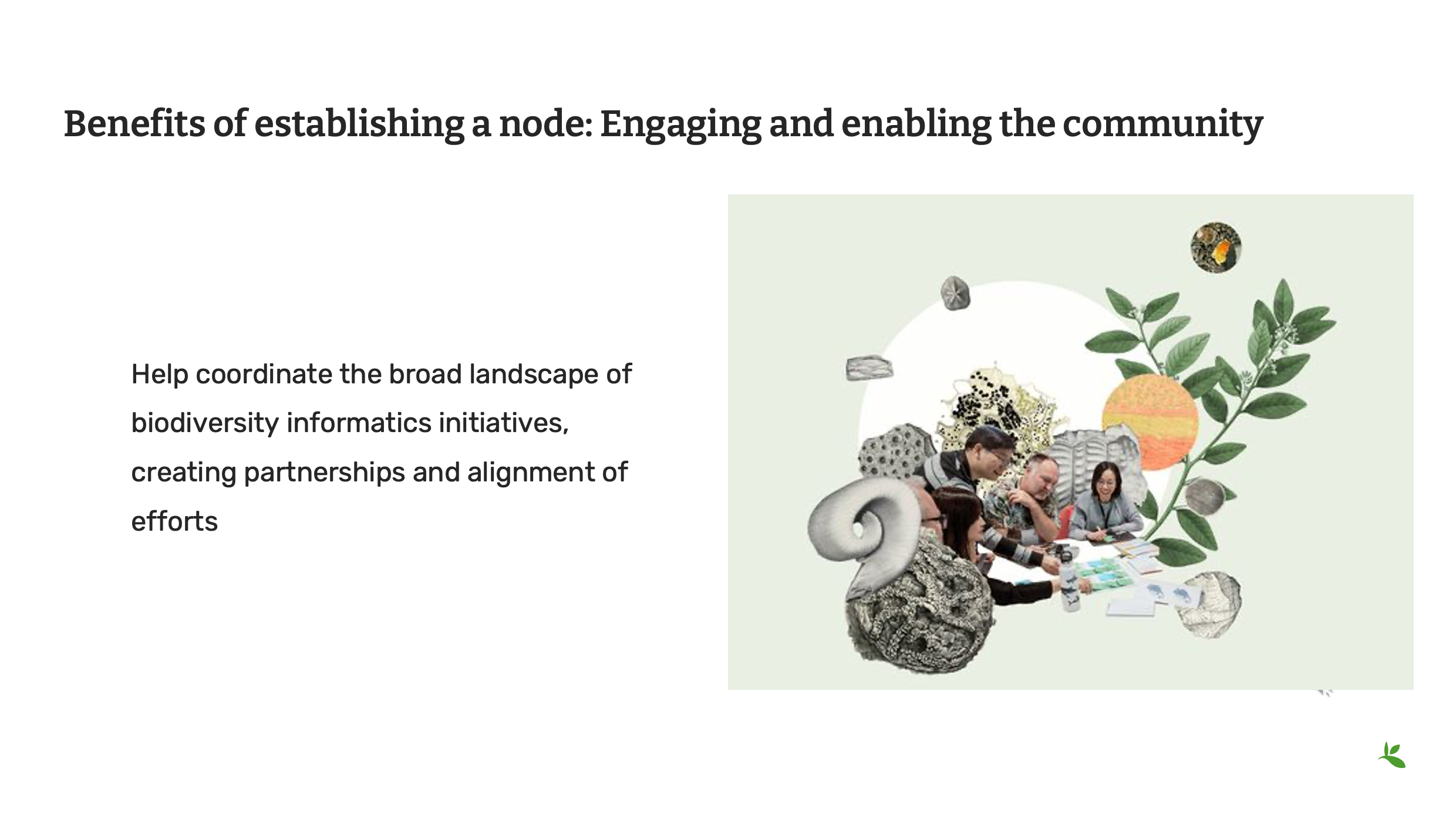
Slide 8 - Benefits of establishing a node: Engaging and enabling the community
Nodes play a key role in building and supporting a strong biodiversity data community.
Through training and outreach, nodes help grow the network and develop skills across the community.
Nodes also connect with other nodes to share knowledge and experience. This increases the efficiency of establishing biodiversity data sharing networks.
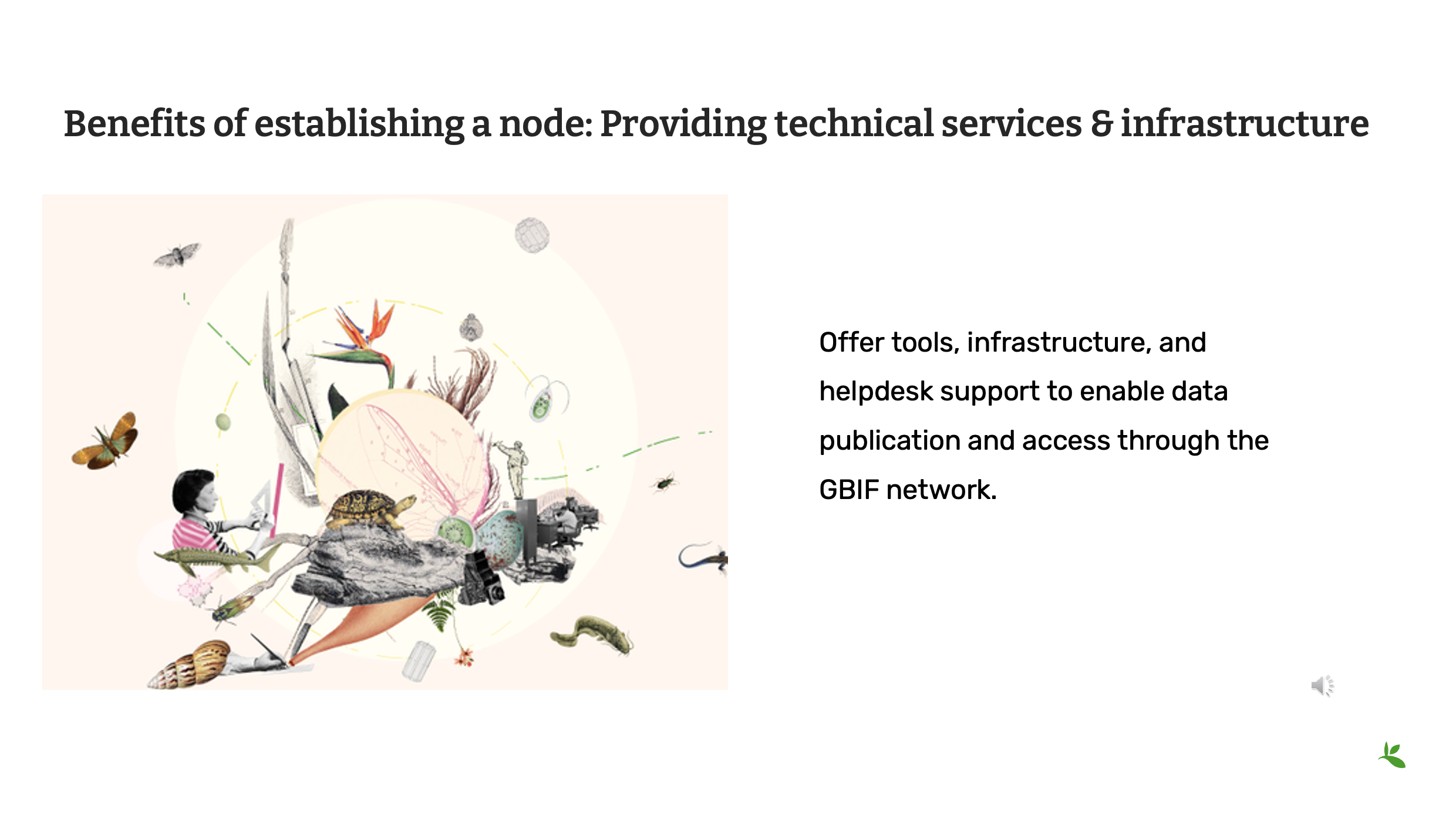
Slide 9 - Benefits of establishing a node: Providing technical services & infrastructure
Finally, nodes provide the technical foundation for managing and sharing biodiversity data.
They offer tools, infrastructure, and helpdesk support to enable data publication and access.
By making the connection to GBIF, nodes enable the integration of data mobilized their networks with relevant data published by other countries and organizations.
Data mobilized to serve national or organizational needs therefore also become available for reuse by the broader international audience. This raises the visibility of the Participant’s data publishing institutions and mobilization efforts.
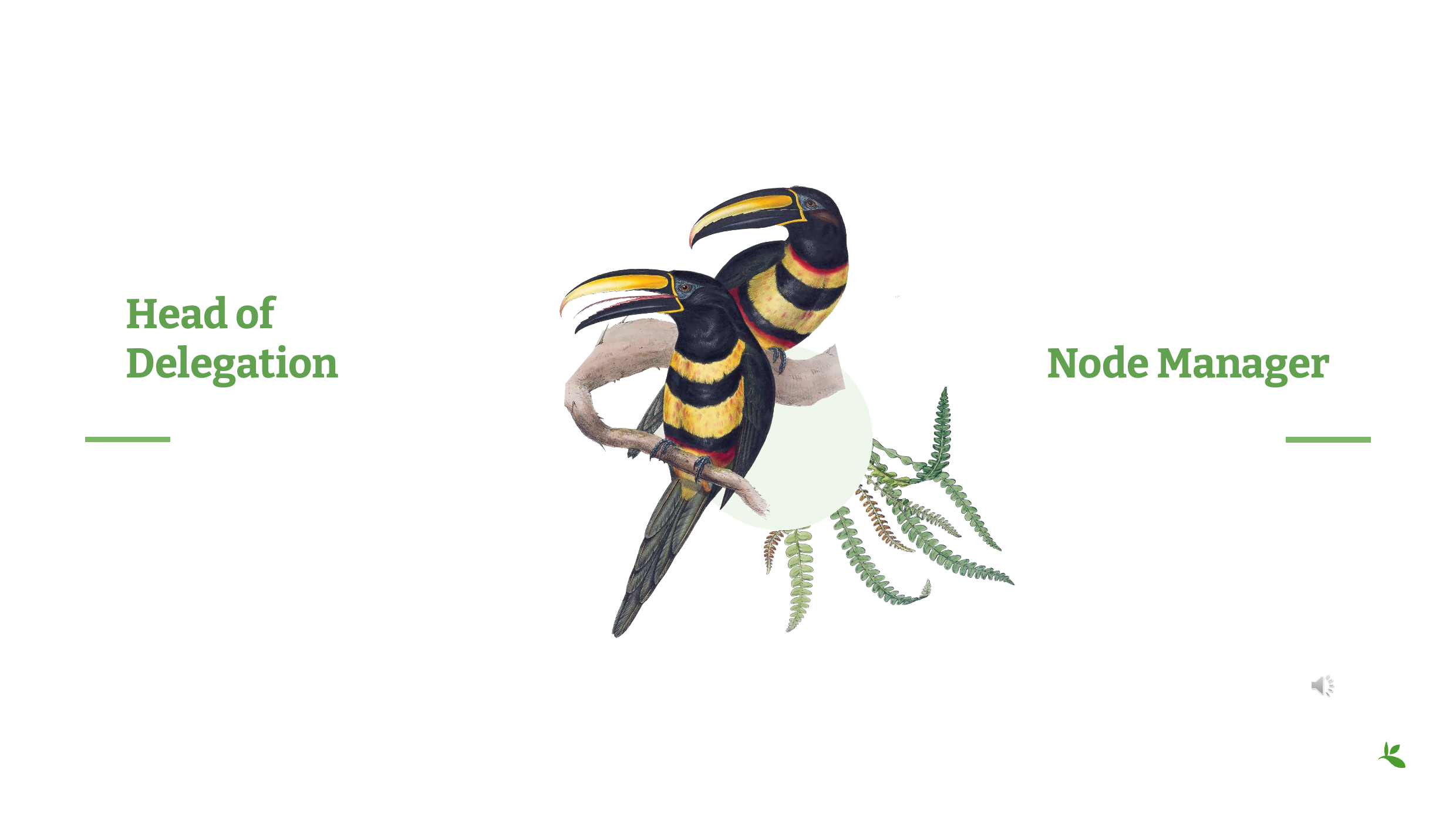
Slide 10 - Participant roles
Two main roles are assigned when a Participant joins GBIF: the Head of Delegation and the node manager.
The Head of Delegation represents the country, economy or organization on the GBIF Governing Board, and acts as the Participant’s primary focal point for all GBIF-related activity.
The node manager leads the operational activities of the country or organization in coordinating the mobilization and use of open-access biodiversity data, and also represents the Participant on the GBIF Participant Node Managers Committee.
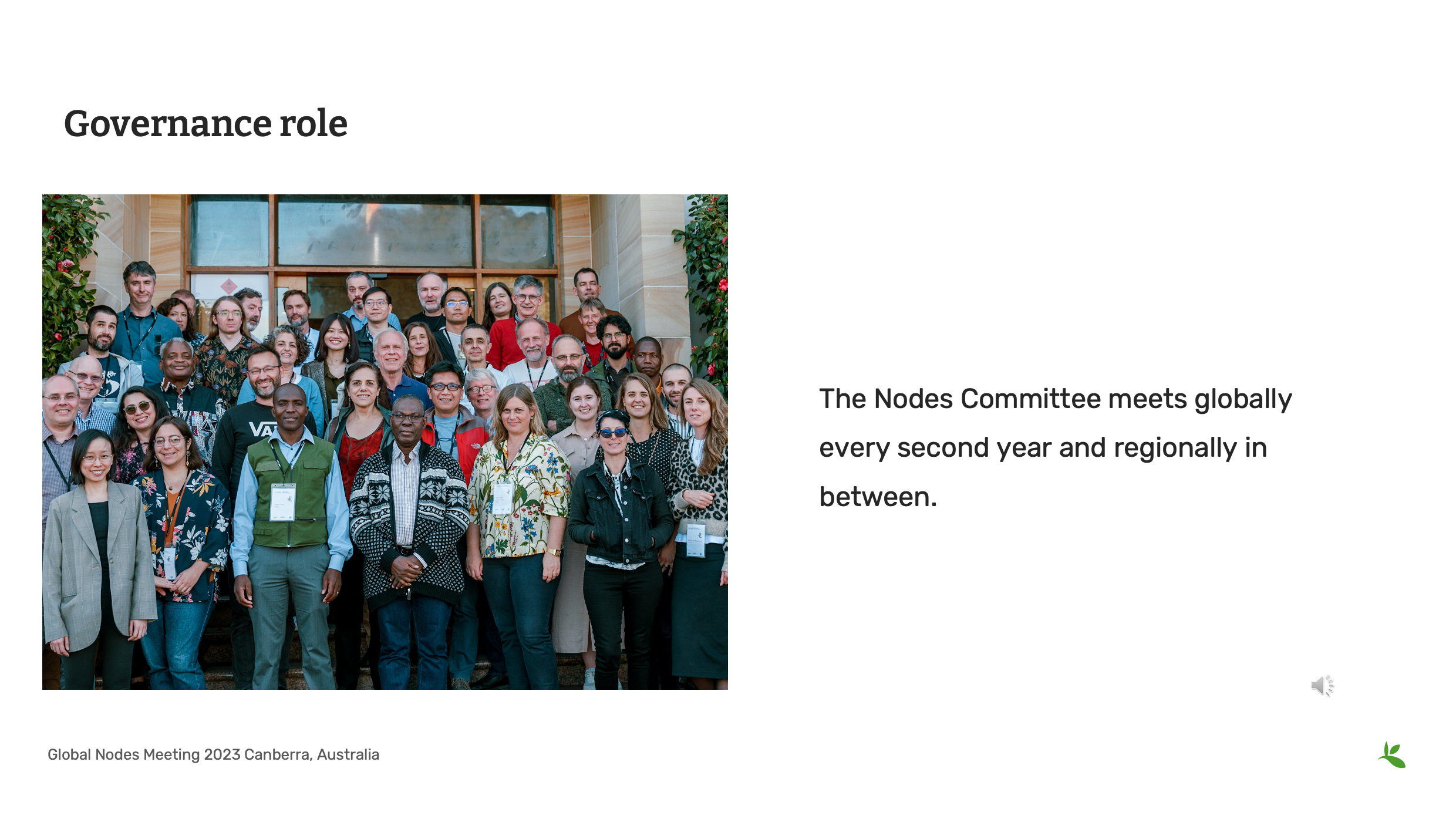
Slide 11 - Governance role
Nodes therefore also play a role in GBIF’s governance.
The Nodes Committee, which brings together node managers from across the network, provides guidance to the governing board on the implementation of GBIF’s work.
This committee also provides a space for nodes to share experiences, develop best practices, and strengthen collaboration.
The Nodes committee meets in a global nodes meeting every second year. Regional nodes meetings are organized in years in between the global meetings. These dynamic meetings help keep the network connected and aligned.
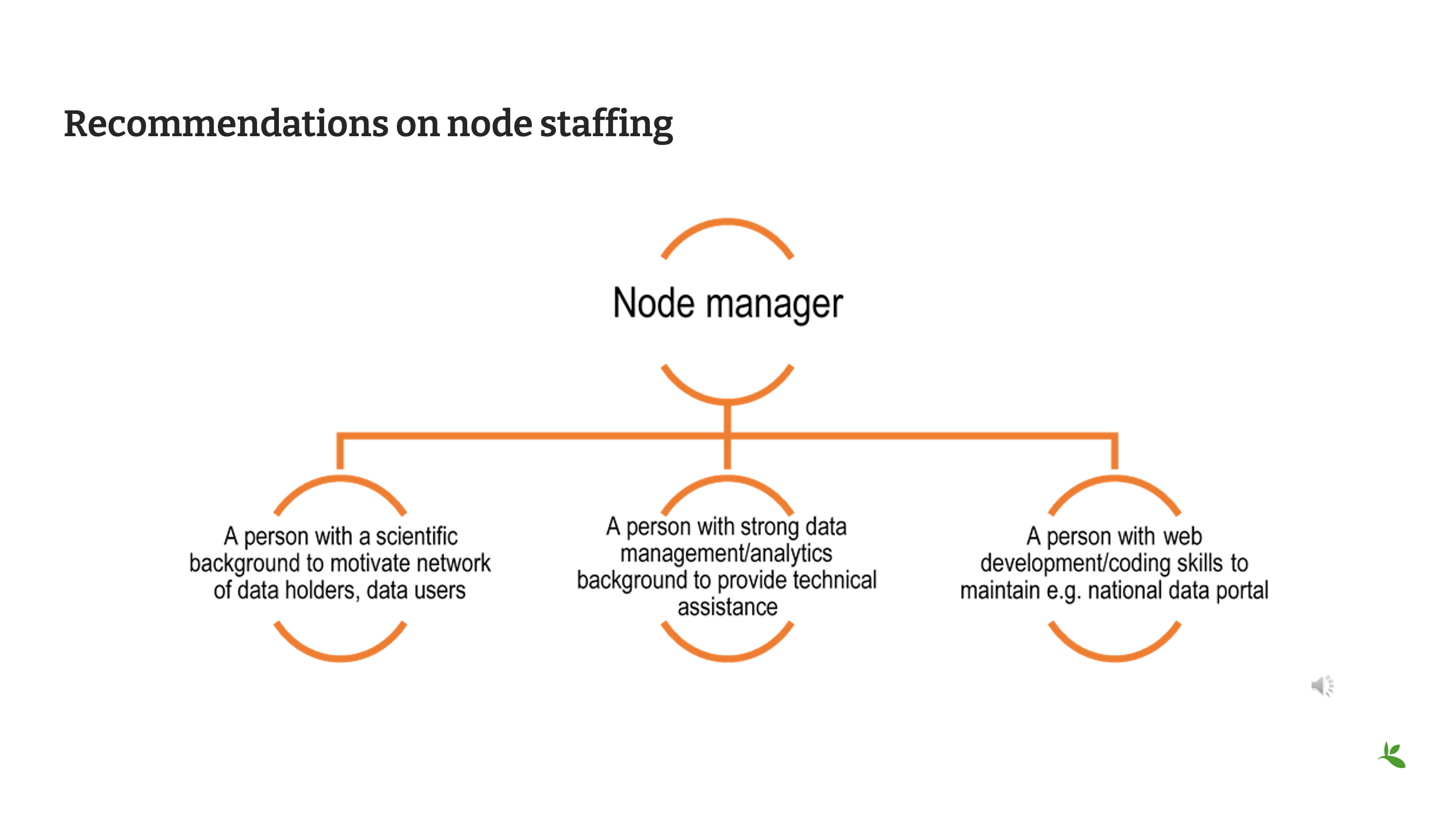
Slide 12 - Recommendations on node staffing
Running a node requires a broad mix of skills.
GBIF’s guidance on establishing an effective Participant node includes suggestions on staff roles within nodes, which includes a minimum of four roles as you see here.
The node manager will lead the team and will serve as the main point of contact with the GBIF network and Secretariat, including participation in the Node Managers’ Committee.
Nodes also benefit from a scientific expert who understands research communities and can motivate and communicate with data holders and users.
Nodes also need a person with skills in data management, to provide technical assistance and maintain databases
And finally, a person with an informatics background to develop and maintain the infrastructure needed for publishing and accessing biodiversity data.
Deciding how to staff a node will, of course, depend on its expected roles, the level of financial support and the hosting agreement or institutional location of the node.
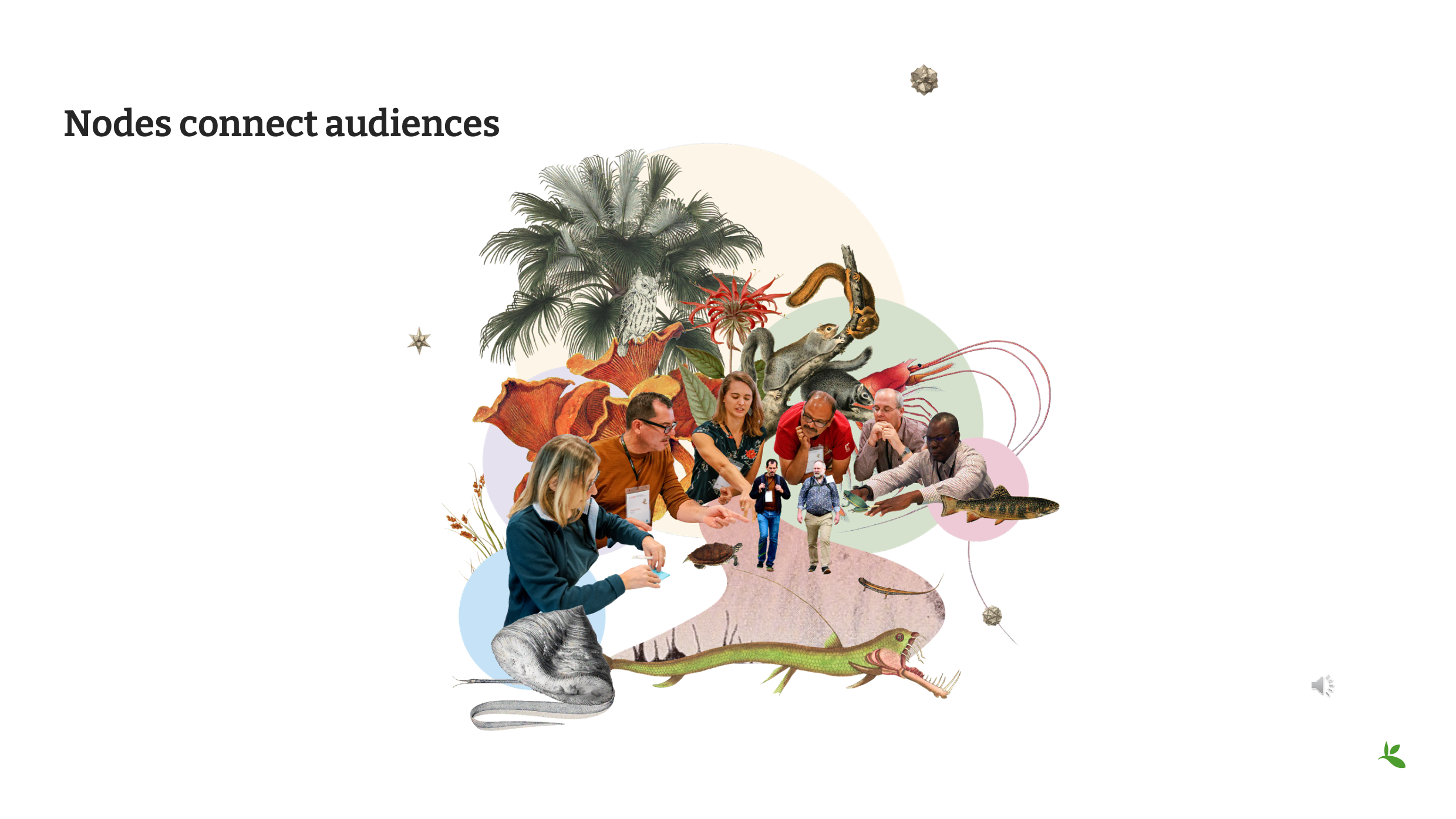
Slide 13 - Nodes connect audiences
In summary, Nodes play an essential role in GBIF’s network and governance.
They connect GBIF’s audiences: people, data, and systems—linking local efforts to a global network.
By supporting data sharing, collaboration, and capacity development, nodes enable both national and international communities to contribute to and benefit from participation in the GBIF network.
Slide 14 - Conclusion
This video is part of a series of presentations developed for the Introduction to GBIF course. It was created and narrated by me, Melianie Raymond. If you have any questions on the course content, you can reach out at training@gbif.org.
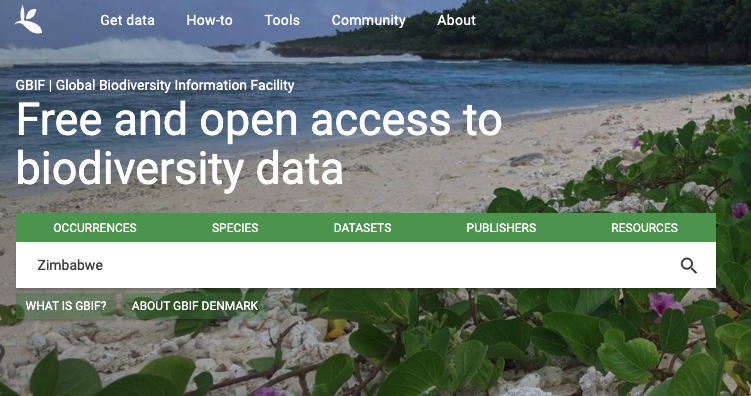
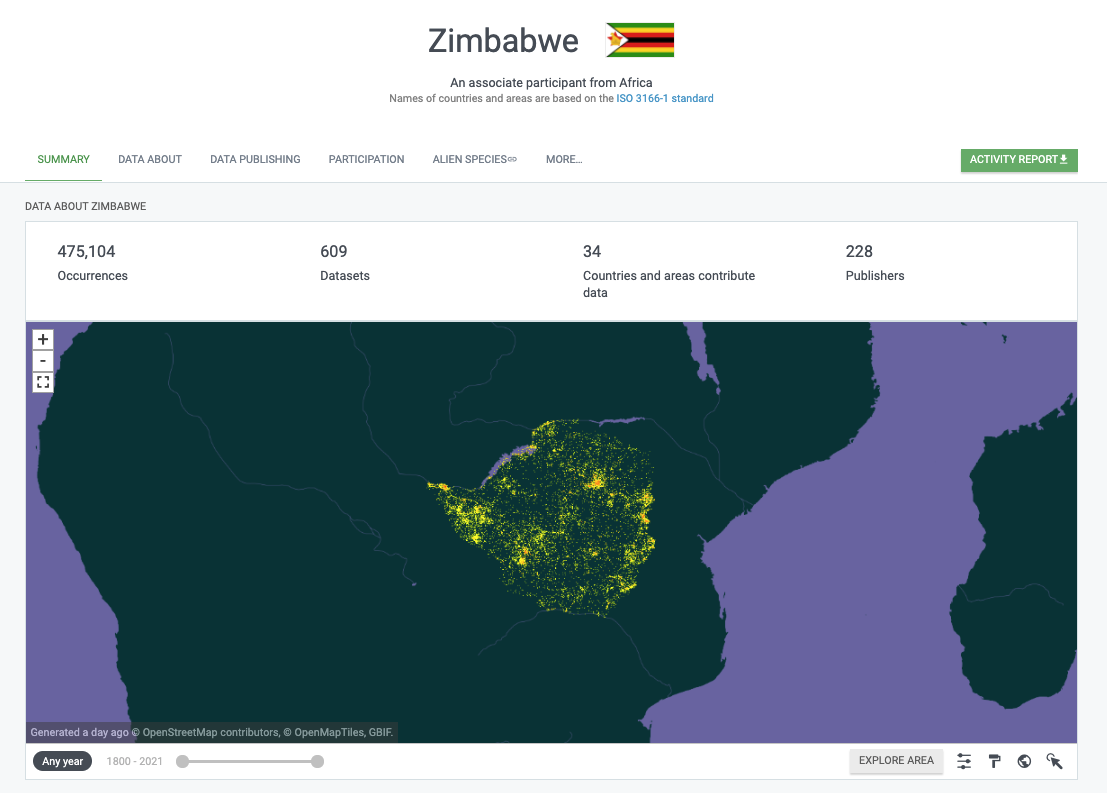
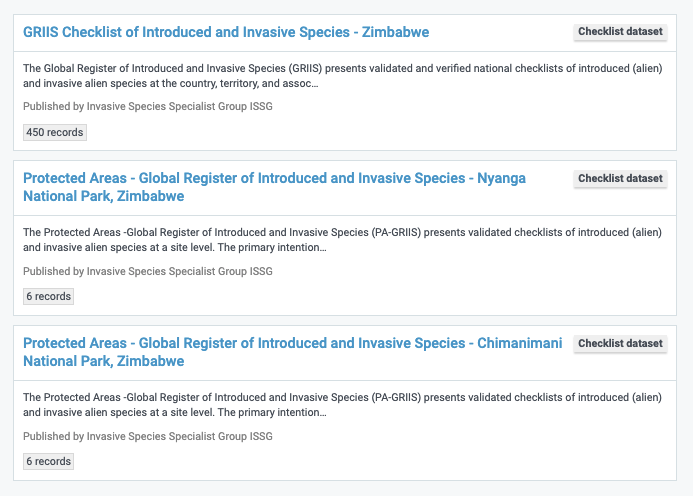
Countries/Economies in GBIF
| Investigate how your country/economy is represented in GBIF |
Review
|
Quiz yourself on the concepts covered in this module. There may be multiple correct answers for some questions. You can read more about the answers in the Solutions Appendix. |