Community of practice
| In this module, you will learn about GBIF’s community of practice, capacity enhancement and funding opportunities and how to stay connected with GBIF. |
Community of practice
|
In this video (05:33), Mélianie Raymond, GBIF Head of Community and Capacity, describes the key ways that volunteers contribute to the GBIF community of practice. If you are unable to watch the embedded Vimeo video, you can download it locally (MP4 - 45 MB). |
Presentation transcript
Click to expand
Slide 1 - Contributing to GBIF’s community of practice
In this video, I will explain how a growing community of volunteers contributes to capacity development in the GBIF network, and how you can get involved in these efforts to enable free and open access to biodiversity data from all sources.
Slide 2 - GBIF’s community of practice
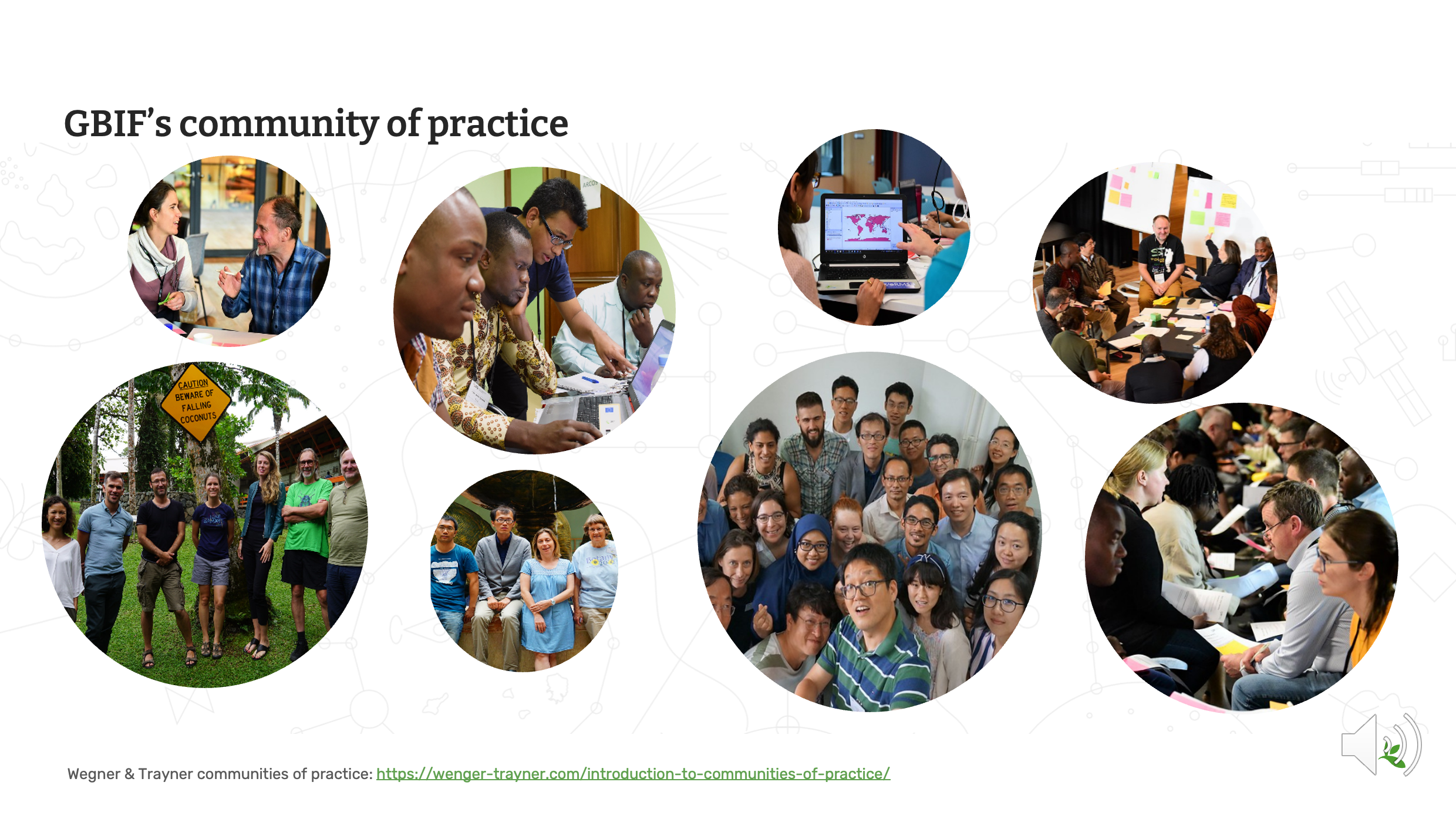
In addition to the formal network of GBIF Participants, a much larger network of individuals and institutions is involved in GBIF activities – both within and beyond GBIF’s formal Participant countries. These individuals are involved in activities ranging from publishing biodiversity data, to using GBIF-mediated data in research, to helping to improve data quality, and to supporting others in learning how to benefit from GBIF.
These individuals form GBIF’s community of practice.
Communities of practice are described by sociologists, Wegner and Trayner, as “groups of people who share a concern or a passion for something they do and learn how to do it better as they interact regularly.”
The GBIF community of practice has emerged from the global network of biodiversity practitioners due to their willingness to collaborate, share knowledge, tools and standards, and support each other in progressing towards the common goal of open biodiversity data contributing to research, nature conservation and sustainable development.
This community has played a key role from the very beginning, even in the origins of GBIF.
The GBIF Secretariat has a role in supporting the interactions between the members of the community of practice and encouraging its development and growth.
Slide 3 - Volunteers
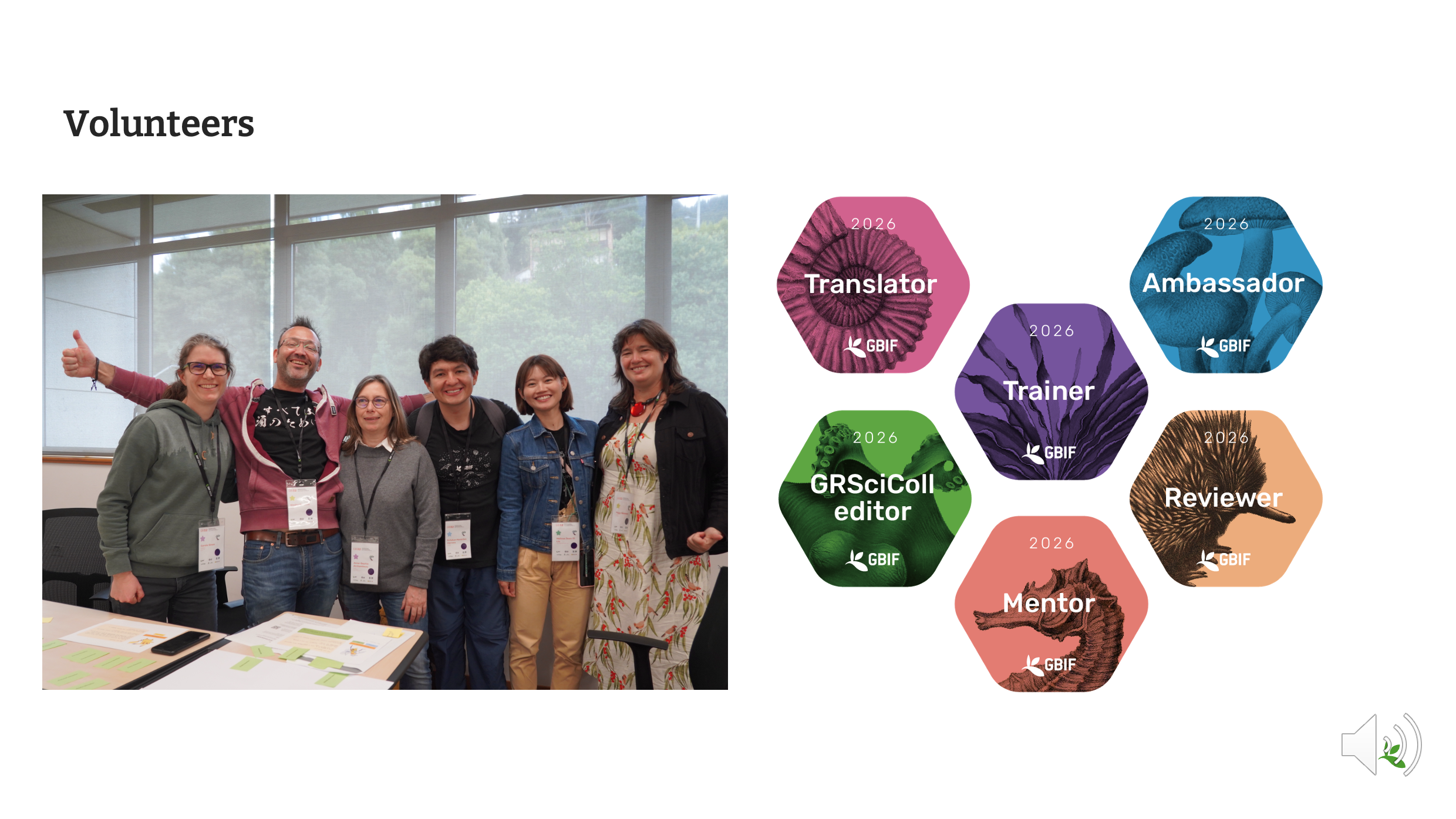
We have categorized the different roles that individuals play in the community.
This video will look at four different ways in which you can volunteer to share your expertise to strengthen the GBIF community of practice, as either a mentor, trainer, translator or biodiversity open data ambassador. These roles are not mutually exclusive. Many people contribute through several of these roles at the same time.
Slide 4 - Mentors
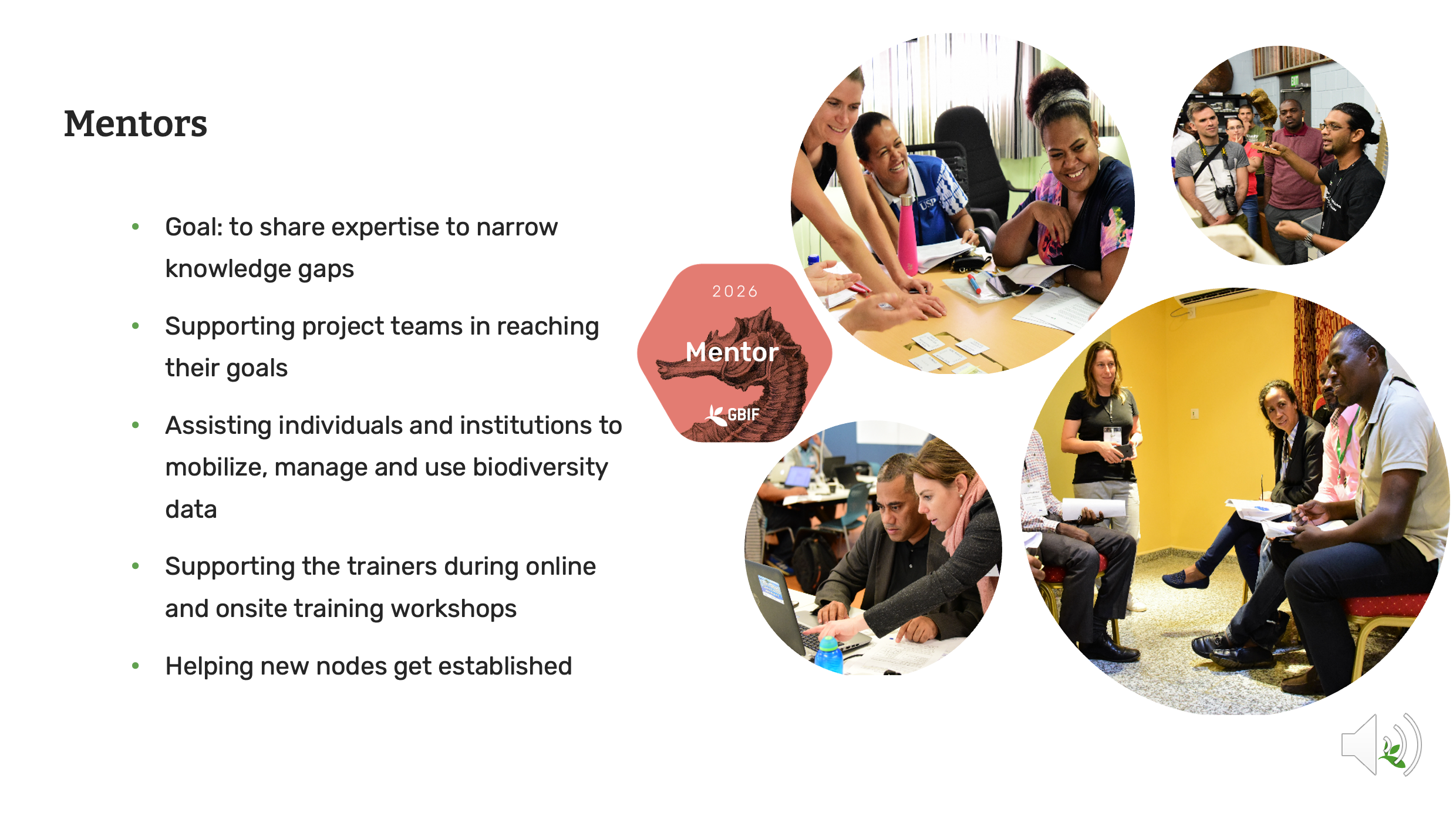
Volunteer mentors are members of the GBIF community that have expertise in areas covering data mobilization, data management, data analysis and use and node management.
They share their expertise with new members of the community to help narrow knowledge gaps.
Volunteer mentors provide support to teams working on projects funded through programmes such as the Biodiversity Information for Development (BID) programme.
They also support individuals and institutions in the community that need help getting started with data mobilization, data management and data use.
During training workshops, we invite mentors to assist the trainers by working with groups of participants to support them in their learning.
Node manager mentors are experienced members of existing GBIF nodes that provide support to new GBIF nodes in getting established.
Slide 5 - Trainers
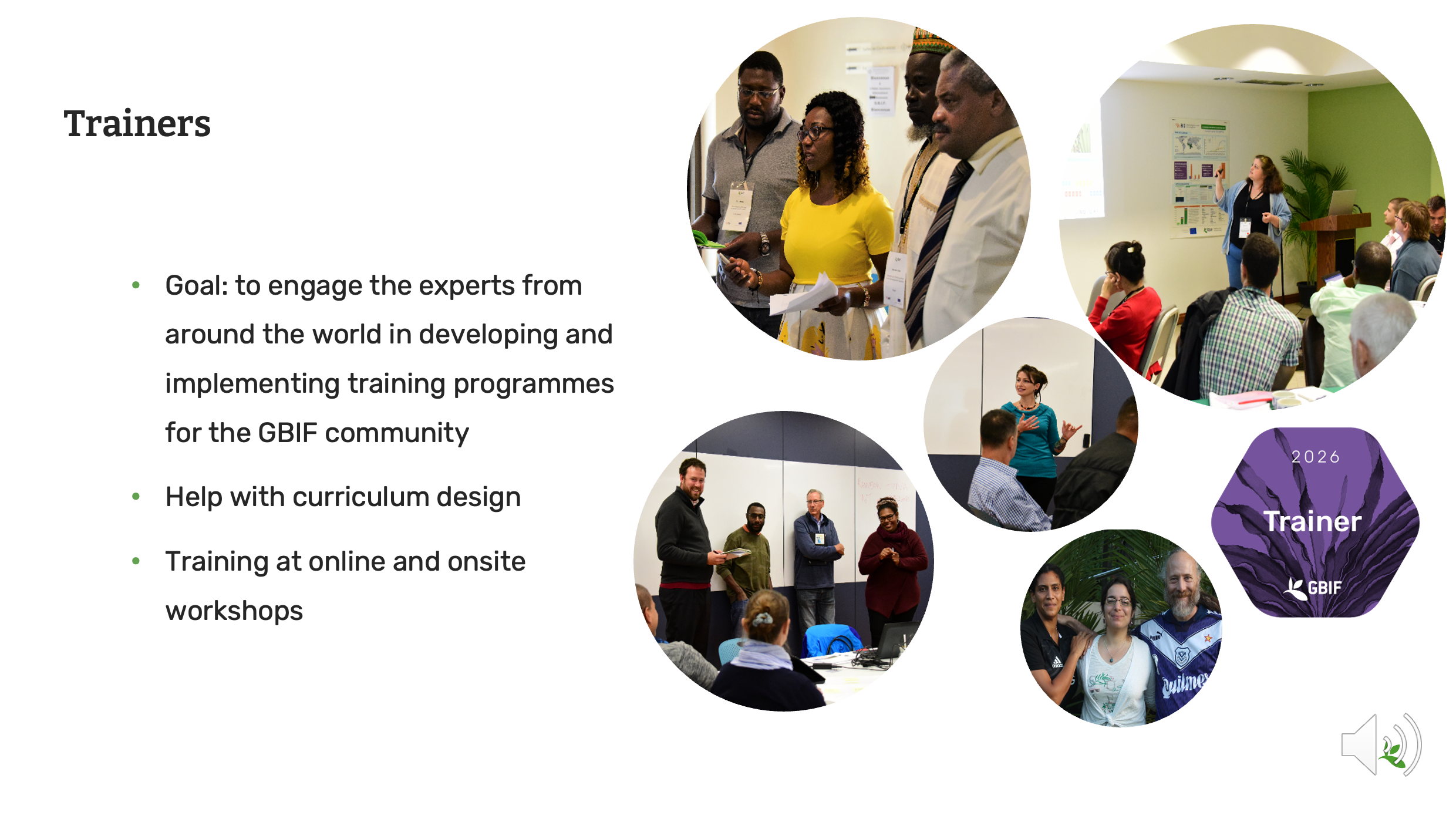
Some volunteer mentors also become trainers, providing training to new members of the GBIF community.
Working with the GBIF Secretariat, trainers help to design reusable training materials and curricula that form the basis of GBIF’s capacity enhancement workshops.
Trainers provide training both onsite and online, and many of their trainees go on to become mentors themselves, and may even act as trainers in replication workshops.
Slide 6 - Ambassadors
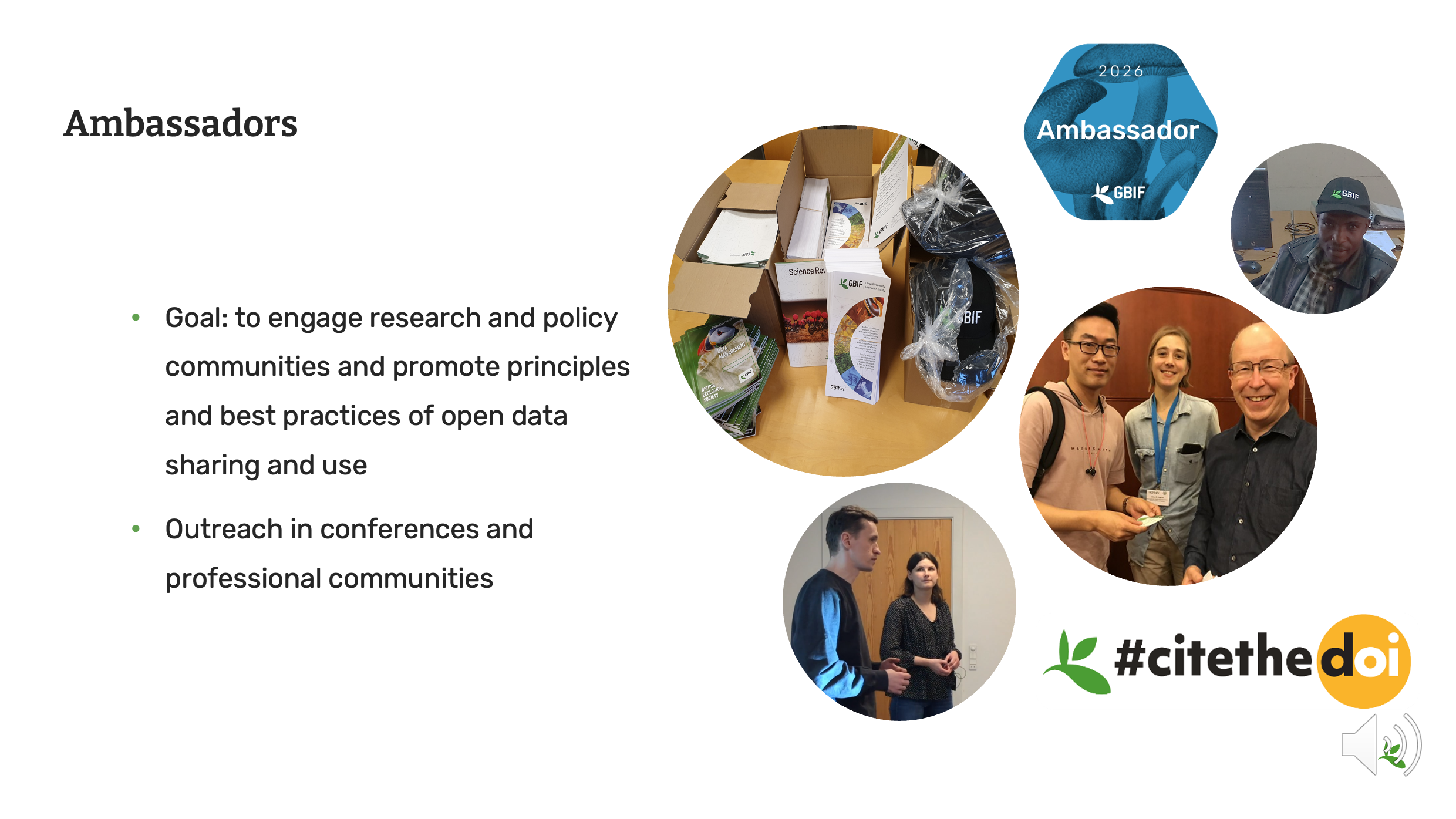
Biodiversity open data ambassadors are biodiversity professionals who help promote the principles and best practices of open data sharing and use within their professional communities.
This includes communicating the benefits and opportunities provided by free and open access to biodiversity data, as well as the importance of responsible use of such data through proper citation and attribution.
Ambassadors can help engage research and policy communities beyond those that can be reached by the GBIF nodes and Secretariat.
The Secretariat supports ambassadors by providing slides and promotional materials for use at conferences, as well as feedback on abstracts and presentations.
Slide 7 - Translators
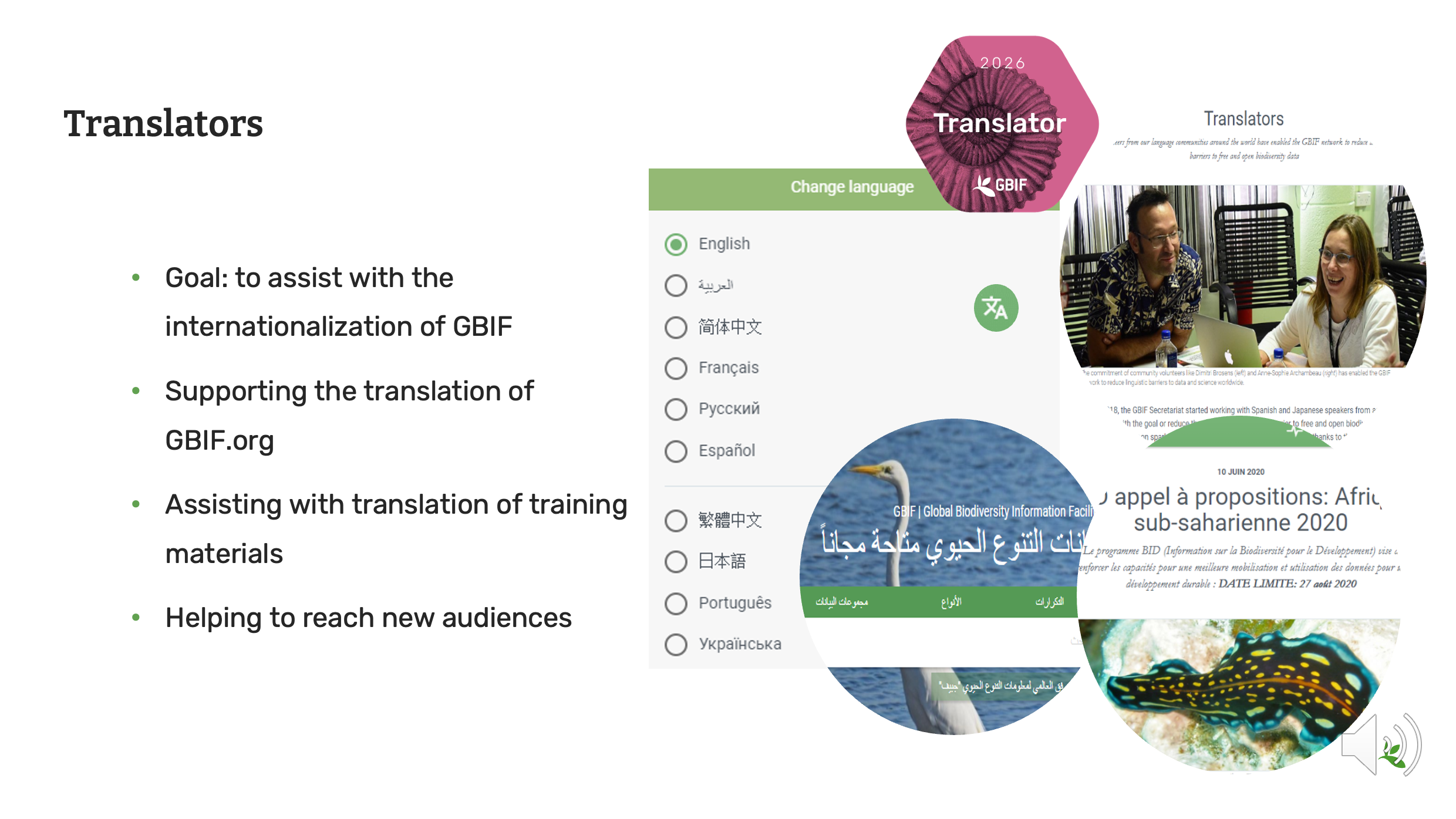
Finally, translators play a role that is essential for engaging GBIF’s global network.
Most of the translation of GBIF’s website and materials is carried out by volunteer translators from the community of practice.
In addition to their language skills, these translators have the domain knowledge that helps them communicate GBIF as effectively as possible across languages, allowing GBIF to reach new audiences.
Slide 8 - Get involved
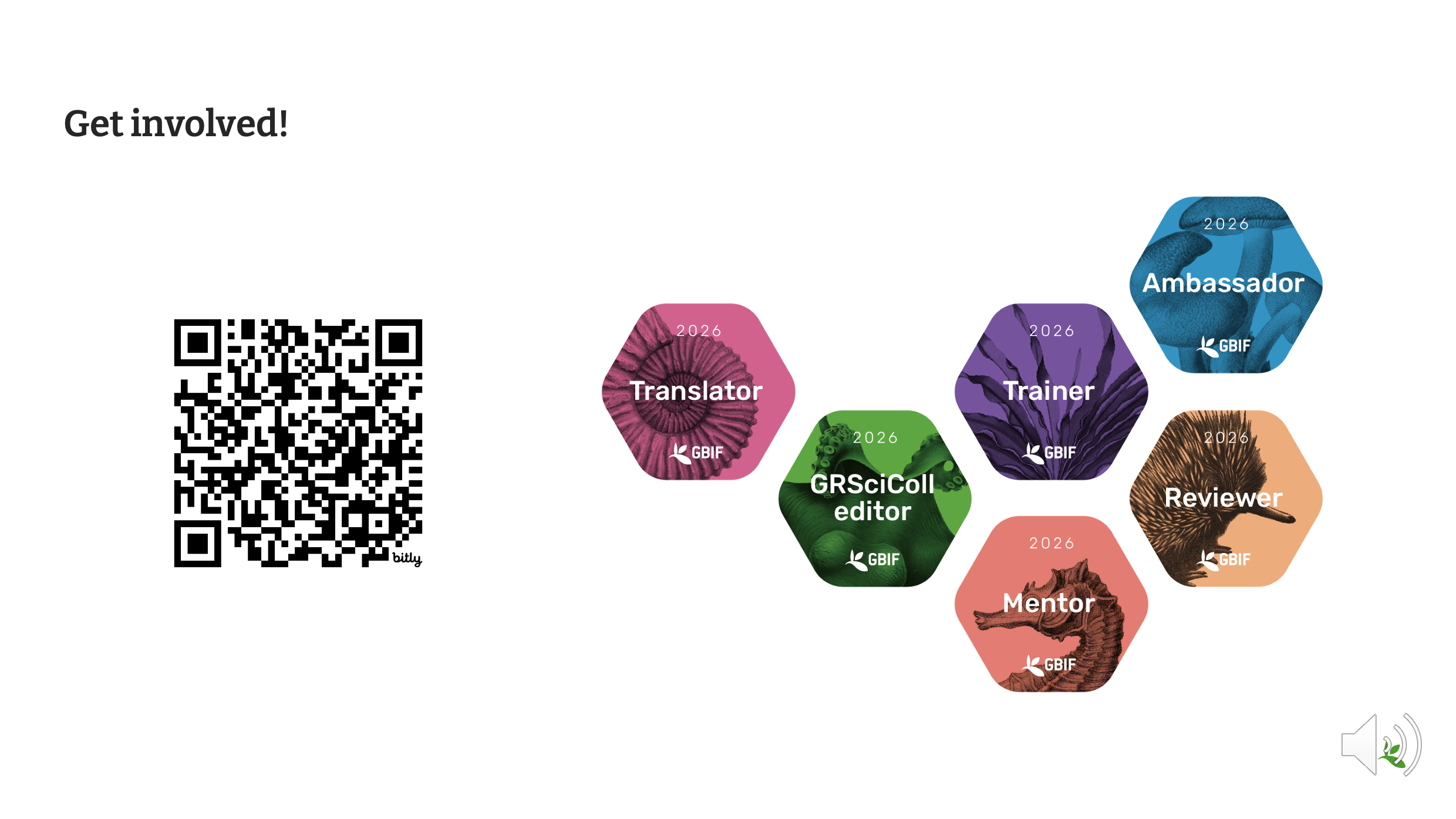
We are pleased to invite you to get involved in GBIF’s community of practice. You can find further information on the GBIF website about how to contribute as a volunteer mentor, biodiversity open data ambassador and translator and you are welcome to contribute in more that one of these roles. The community of practice is your community – please let us know your ideas on how we can develop it further.
Thank you and we look forward to working with you very soon.
Volunteer
We encourage you to consider whether you can contribute to the GBIF community of practice in any of these roles. We would welcome your application.
You are also welcome to contact us at volunteers@gbif.org to discuss how you can contribute.
Capacity enhancement and funding opportunities
GBIF is a growing global network of Participant countries, economies and organizations, each with different priorities and capacity assets and needs. Capacity enhancement is recognized as essential to underpin the sustainable performance of the GBIF Participant network and all its members, independent of their level of development.
Broadly speaking, much of GBIF’s work contributes to capacity enhancement. The Participant nodes ensure capacity development at the national level, often providing training for individuals and institutions within their networks. Collaboration between Participants through GBIF’s governance structures enables further international and regional exchange and partnerships.
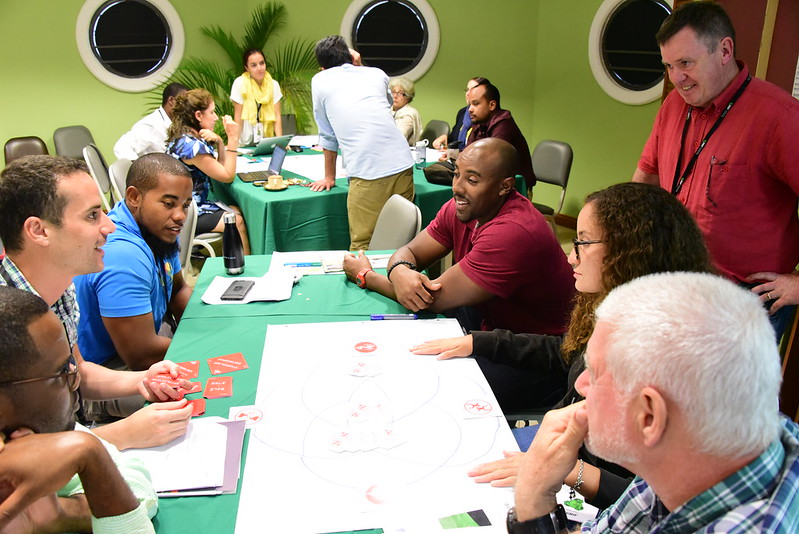
The GBIF Secretariat supports the work of the network, which contributes to capacity development, in particular by coordinating activities, engaging volunteers in the community of practice and supporting the development of core training materials. The Secretariat’s role in capacity enhancement activities leans more toward facilitation than implementation: providing guidance, documenting best practices, collating training material, coordinating activities, and creating or aligning opportunities. The Secretariat plays a further role in enhancing capacity by providing funding opportunities for collaborative projects in the network, often with a focus on mobilizing biodiversity data, supporting the use of GBIF-mobilized data and strengthening national biodiversity information facilities.
You can find more information about GBIF’s funding programmes on our website.
Engaging with GBIF
Communication activities play a key role in strengthening and supporting the GBIF network by enhancing visibility, knowledge exchange and engagement across the community. Please stay in contact with GBIF to keep up with events, opportunities, new features and other news.
Newsletter
Subscribe to the GBIF newsletter, a compilation of news, events and opportunities, shared via email every couple of months.
Social media
Follow GBIF across the below social media accounts and feel free to tag these to help amplify activity within your node/network. Examples of activities to promote on social media and to tag GBIF include trainings, events, celebratory posts, new datasets mobilized to GBIF and data use examples.
-
LinkedIn: @gbif
-
Facebook: @gbifnews
-
Mastodon: @biodiversity.social/@gbif
-
Bluesky: @gbif.org
Events
Regular events include sessions of the Data Use Club, the Technical Support Hour for nodes and other webinars covering topics of interest for the wider GBIF community.
You can keep track of events relevant to the network in the GBIF events calendar. If you are arranging or have knowledge an event that is relevant and open to the GBIF community (i.e. is not a closed event), please notify the GBIF Secretariat to have your event included on the events calendar.
Review
|
Quiz yourself on the concepts covered in this module. There may be multiple correct answers for some questions. You can read more about the answers in the Solutions Appendix. |