Capture de données
|
Dans ce module, vous découvrirez le concept de normes, et plus particulièrement la norme Darwin Core et ses composantes. Vous découvrirez également les différents types de données primaires sur la biodiversité et comment partager au mieux ces informations au sein du GBIF. Enfin, vous passerez en revue les principes de qualité des données dans le contexte de la capture des données et vous en apprendrez davantage sur la qualité et la cohérence des données (en particulier sur des sujets tels que le géoréférencement, les dates, les noms et la vérification croisée des taxons). |
Standards and Darwin Core
|
Dans cette vidéo (23:25), vous découvrirez comment vous utilisez des normes au quotidien. Vous serez ensuite initiés aux Normes d’Information sur la Biodiversité, notamment aux Normes Darwin Core, que vous utiliserez tout au long de ce cours. Les sous-titres ne sont pas disponibles pour cette vidéo. Si vous ne pouvez pas regarder la vidéo intégrée, vous pouvez la télécharger localement (MP4 - 71.5 Mo) Si vous préférez lire, vous trouverez la transcription sous la vidéo intégrée. |
Transcription de la présentation
Cliquez pour développer
Diapositive 1 - Normes et Darwin Core
Dans cette présentation, nous vous présenterons les normes de données relatives à la biodiversité. Nous nous concentrerons plus particulièrement sur la norme Darwin Core.
Diapositive 2 - Normes : Mettons-nous d’accord pour être d’accord
L’ingénieur et industriel W. Edwards Deming a dit :
« La standardisation ne signifie pas que nous portions tous des vêtements de la même couleur et du même tissage, que nous mangions des sandwichs standardisés ou que nous vivions dans des pièces standardisées avec un mobilier standardisé. Des maisons d’une variété infinie de styles sont construites avec quelques types de briques, du bois de dimensions standardisées, et des canalisations d’eau et de chauffage ainsi que des accessoires aux dimensions standardisées ».
Ce qu’il essayait de dire, c’est que la standardisation ne nous empêche pas d’être créatifs. Il nous montrait aussi que les normes sont déjà omniprésentes dans notre quotidien.
Au fil de cette formation, nous définirons le terme "norme" et examinerons comment nous interagissons quotidiennement avec les normes. Nous vous présenterons ensuite les normes d’information sur la biodiversité, notamment la norme Darwin Core que vous utiliserez tout au long de ce cours.
Diapositive 3 - Qu’est-ce qu’une norme ?
Qu’est-ce qu’une norme ?
Dans sa forme la plus simple, c’est :
"Une façon convenue de faire quelque chose."
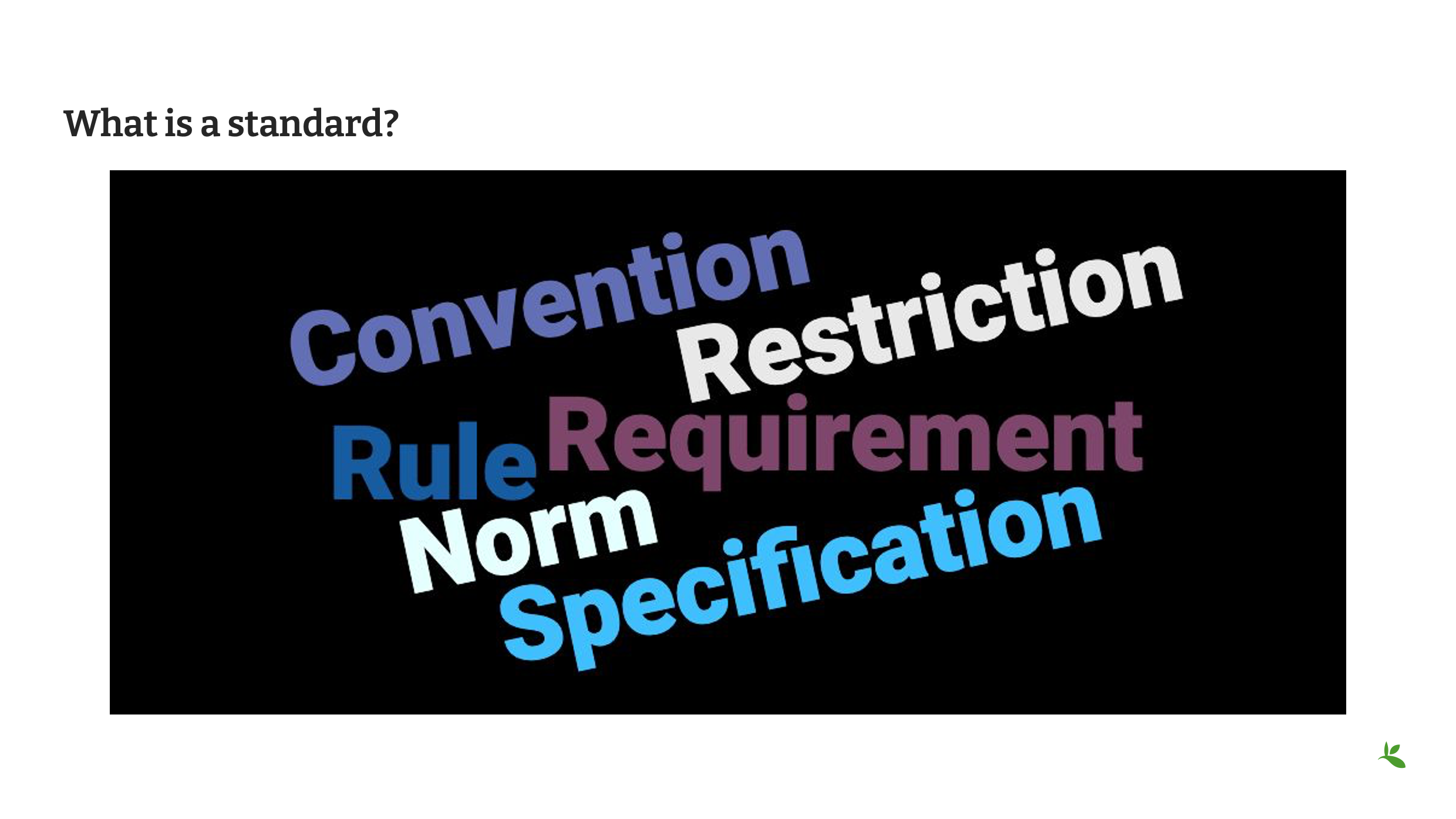
Les normes sont une combinaison de règles, de conventions, de spécifications, d’exigences et de restrictions.
Diapositive 4 - Normes quotidiennes
L’objectif principal des normes est de créer un cadre de « compréhension mutuelle ». Elles doivent apporter de la clarté et faciliter la communication.
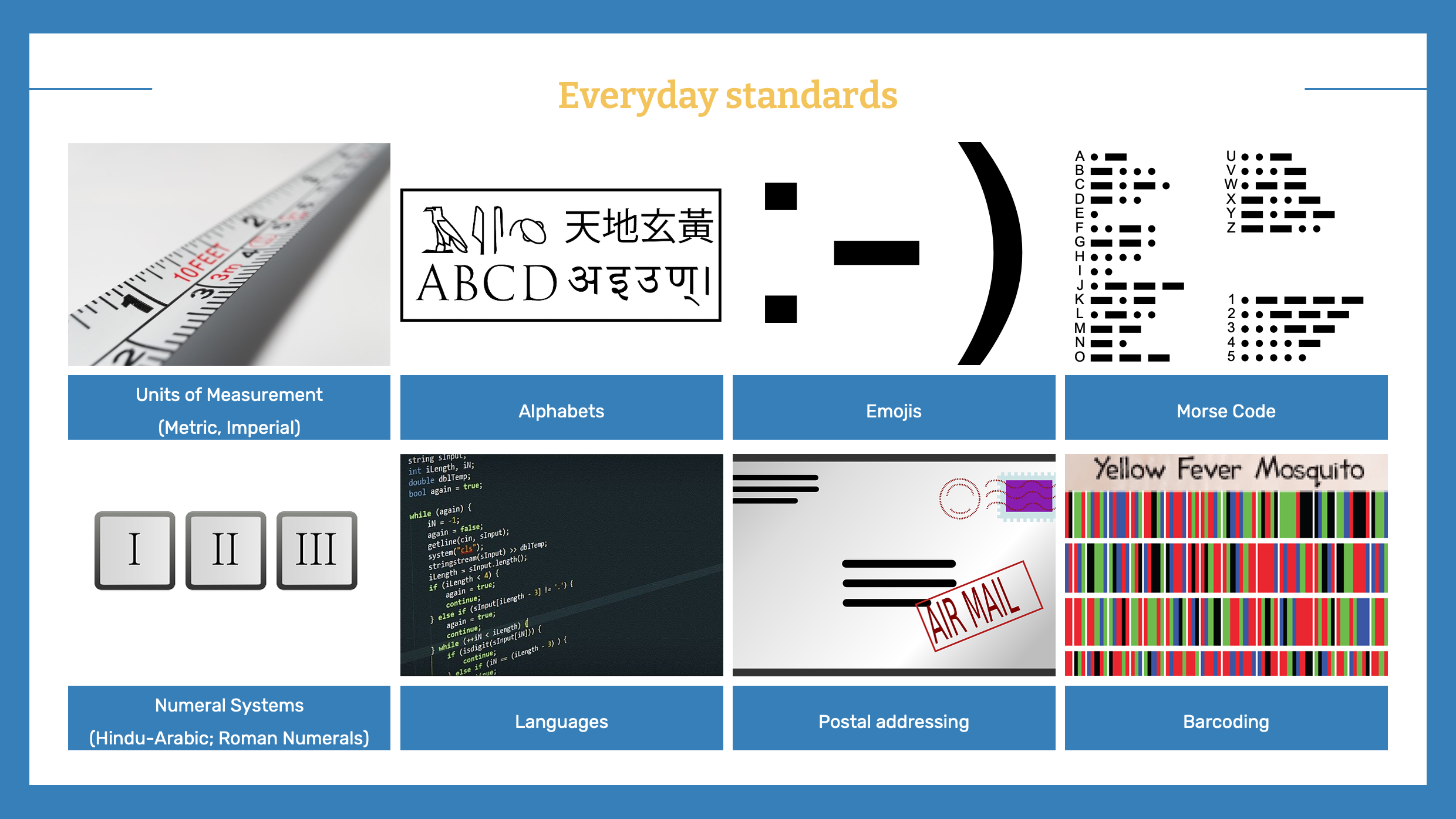
Voici quelques exemples de choses du quotidien qui utilisent des normes pour faciliter la communication d’informations :
-
Unités de mesure
-
Systèmes numériques
-
Alphabets
-
Langues
-
Émojis
-
Adresses postales
-
Code Morse
-
Codes-barres
Image de Mesure par Arek Socha depuis Pixabay https://pixabay.com/photos/measurement-millimeter-centimeter-1476913/ Image de Nombres par Clker-Free-Vector-Images depuis Pixabay https://pixabay.com/vectors/numerals-roman-number-blocks-35937/ Image d’Alphabet par https://en.wikipedia.org/wiki/Alphabet#/media/File:Historical_Writing_Systems_Template_Image.jpg Image de Langues par Christopher Kuszajewski depuis Pixabay https://pixabay.com/photos/source-code-code-programming-c-583537/ Image de Code Morse par https://en.wikipedia.org/wiki/Morse_code#/media/File:International_Morse_Code.svg Image de Courrier par OpenClipart-Vectors depuis Pixabay https://pixabay.com/vectors/airmail-mail-envelope-post-postal-145212/ Image d’Emojis par https://en.wikipedia.org/wiki/Emoticon#/media/File:Emoticon_Smile_Face.svg Image de Code-barre par IBOL https://ibol.org/site/wp-content/uploads/2018/12/bookmark-vectors.png


Diapositive 5 - Norme quotidienne - Un exemple
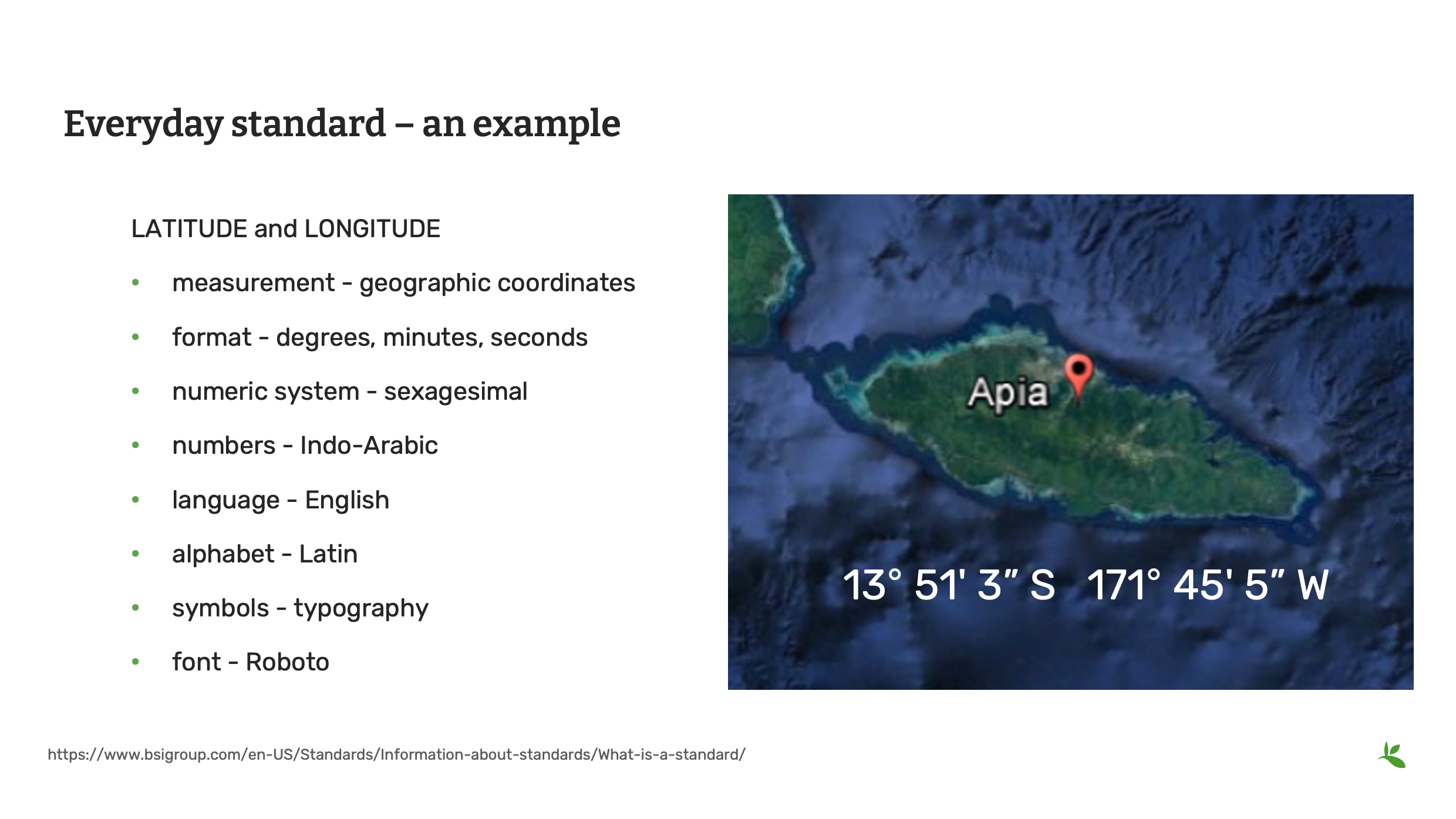
Prenons un exemple très précis et analysons-le. Ici, pour communiquer avec précision et de manière répétable une position sur Terre – une latitude et une longitude – il faut en fait combiner au moins 8 normes.
mesure - format des coordonnées géographiques - système numérique degrés, minutes, secondes - nombres sexagésimaux - langue indo-arabe - alphabet anglais - symboles latins - police de caractères typographiques - Roboto
Diapositive 6 - Règles et restrictions
Les normes permettent de restreindre l’éventail des possibilités. Dans les présentations précédentes sur les fondements du traitement de données, vous avez découvert les types de données, les schémas, les formats et les encodages de caractères. Chacun de ces éléments peut être utilisé pour restreindre l’éventail des possibilités dans le cadre d’une norme.
Les types de données peuvent restreindre les valeurs d’un champ. Ainsi, le texte alphanumérique va dans un champ de texte, les nombres décimaux dans un champ de nombre à virgule flottante. Vrai/Faux dans un booléen.
Un schéma d’encodage peut restreindre la plage de valeurs dans un champ. Par exemple, la liste de valeurs de latitude est possible dans une certaine plage : entre -90 et 90.
Un format peut restreindre la représentation d’une donnée dans un champ. Par exemple, une donnée peut apparaître comme année mois jour, jour mois année, ou mois jour année.
Finalement, le codage des caractères fournit les règles d’interprétation des octets de données. Pour nos besoins, nous utiliserons UTF-8.
Photo : Eurema blanda (Boisduval, 1836) Observé au Nepal par Bird Explorers (http://creativecommons.org/licenses/by-nc/4.0/)
Diapositive 7 - Normes pour le transfert de données
Au cours de cette formation, vous apprendrez à partager vos données. A ce titre, vous rencontrerez des normes de transfert de données.
Un schéma d’application permet de combiner des normes de données dans un but spécifique. Par exemple, utiliser les termes du Darwin Core dans les archives du Darwin Core. Nous allons approfondir ces deux types de schémas dans quelques instants.
Une fois de plus, vous utiliserez un format, mais cette fois le format limite les structures du jeu de données. Un jeu de données peut utiliser csv, xml, json et rdf.
Enfin, vous disposerez d’un protocole de transfert, qui fournit des informations sur la manière et l’endroit où envoyer des informations. Il peut s’agir de http (protocole de transfert hypertexte), ftp (protocole de transfert de fichier) et smtp (protocole simple de transfert de courrier ou, si vous préférez : envoyer du courrier à des personnes).
Image par Gerd Altmann depuis Pixabay https://pixabay.com/illustrations/web-network-computer-digital-5371553/
Diapositive 8 - Normes d’information sur la biodiversité
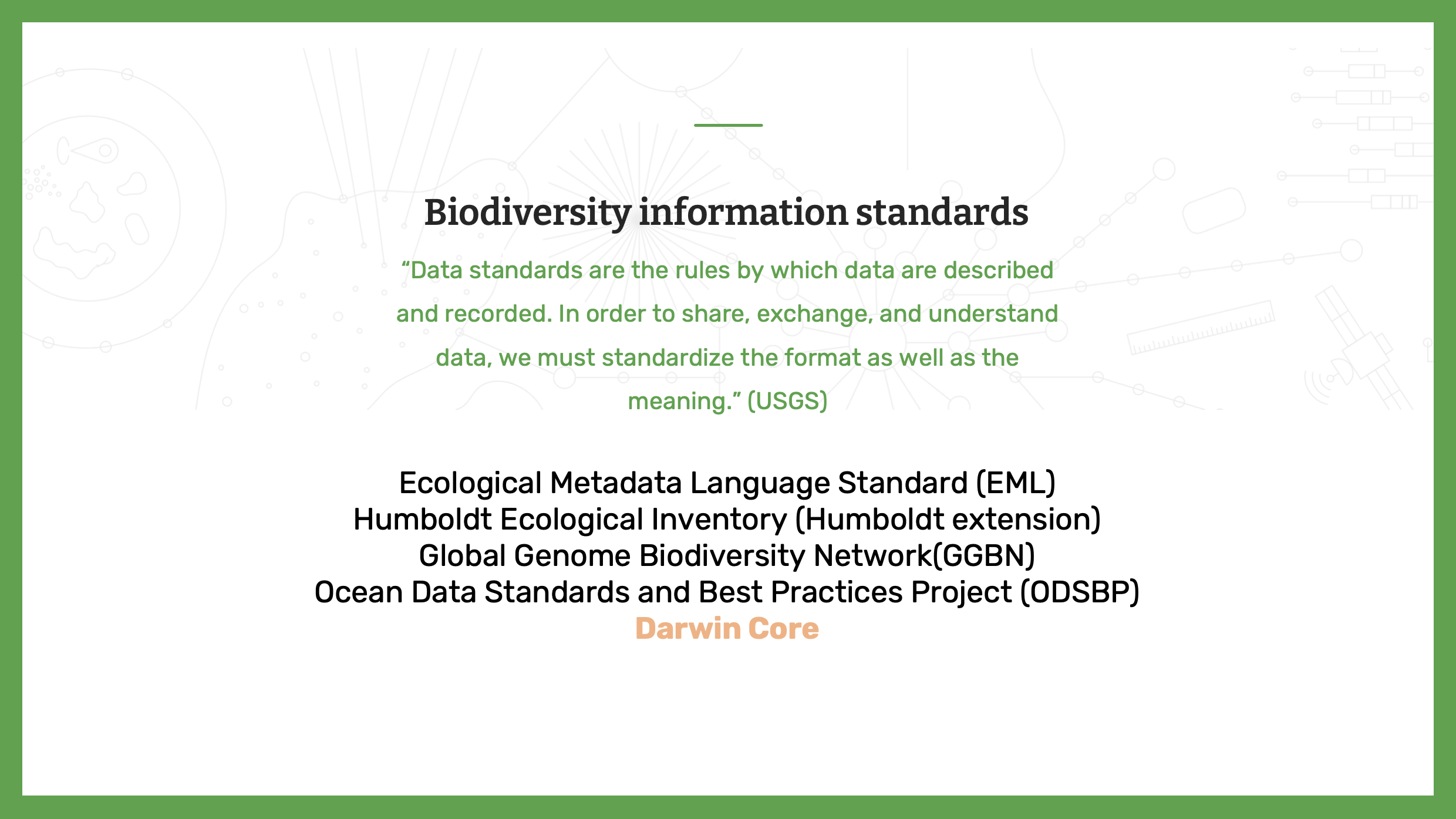
Dans le domaine de l’informatique de la biodiversité, il existe déjà de nombreuses normes qui peuvent vous aider à travailler avec vos données. L’USGS en donne une définition très précise :
"Les normes de données sont les règles selon lesquelles les données sont décrites et enregistrées. Afin de partager, d’échanger et de comprendre les données, nous devons standardiser leur format et leur signification.
Le résultat de l’utilisation de ces normes, lorsque approprié, permet d’augmenter l’intégrité, la précision et la cohérence des données en clarifiant les significations ambiguës et en minimisant les données redondantes.
Celles que vous êtes susceptible de rencontrer ou d’utiliser régulièrement peuvent inclure :
Ecological Metadata Language Standard (EML) Humboldt Ecological Inventory (Humboldt extension) Global Genome Biodiversity Network (GGBN) Ocean Data Standards and Best Practices Project (ODSBP)
Enfin, nous consacrerons le reste de cette discussion au Darwin Core. La norme Darwin Core vous permettra de partager vos jeux de données d’occurrences, taxonomiques et d’événements.
Références : EML - https://knb.ecoinformatics.org/#external//emlparser/docs/index.html Audubon - https://terms.tdwg.org/wiki/Audubon_Core GGBN - http://wiki.ggbn.org/ggbn/GGBN_Data_Standard ODSBP - https://www.iode.org/index.php?option=com_content&view=article&id=369&Itemid=100083 DwC - http://rs.tdwg.org/dwc/
Diapositive 9 - Qu’est-ce que le Darwin Core
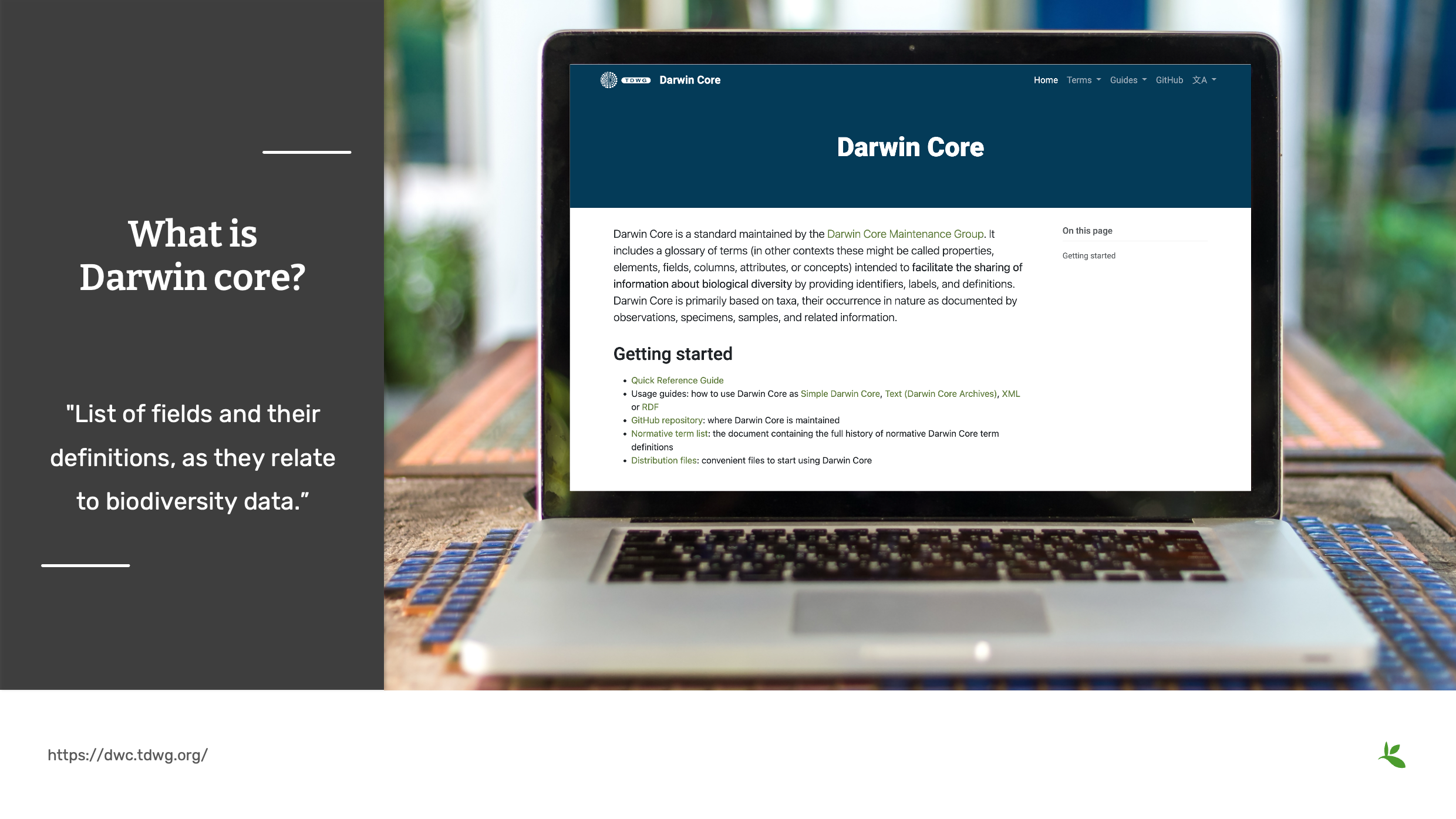
Le Darwin Core est une norme de biodiversité développée par la communauté de l’Informatique de la Biodiversité. Il a été initialement développé sous le Taxonomic Databases Working Group ou T D W G, prononcé TDWG. Ces dernières années, le groupe a été renommé Biodiversity Information Standards. Mais l’acronyme persiste car la communauté est très attachée au nom TDWG.
"La norme comprend un glossaire de termes (dans d’autres contextes, ces termes pourraient être appelés propriétés, éléments, champs, colonnes, attributs ou concepts) destinés à faciliter le partage d’informations sur la diversité biologique en fournissant des identificateurs, des étiquettes et des définitions. Le Darwin Core est principalement basé sur les taxons, leur présence dans la nature telle que documentée par des observations, des spécimens, des échantillons et des informations connexes".
En résumé, le Darwin Core est une
"Liste des champs et de leurs définitions, relatifs aux données sur la biodiversité."
Diapositive 10 - Simple Darwin Core
Au fur et à mesure que nous approfondissons le Darwin Core ou, en abrégé, le DwC, vous apprendrez qu’il s’agit de bien plus que JUSTE une liste de champs. Nous utiliserons le Simple Darwin Core, qui est un sous-ensemble prédéfini de termes d’usage courant dans une grande variété d’applications de biodiversité.
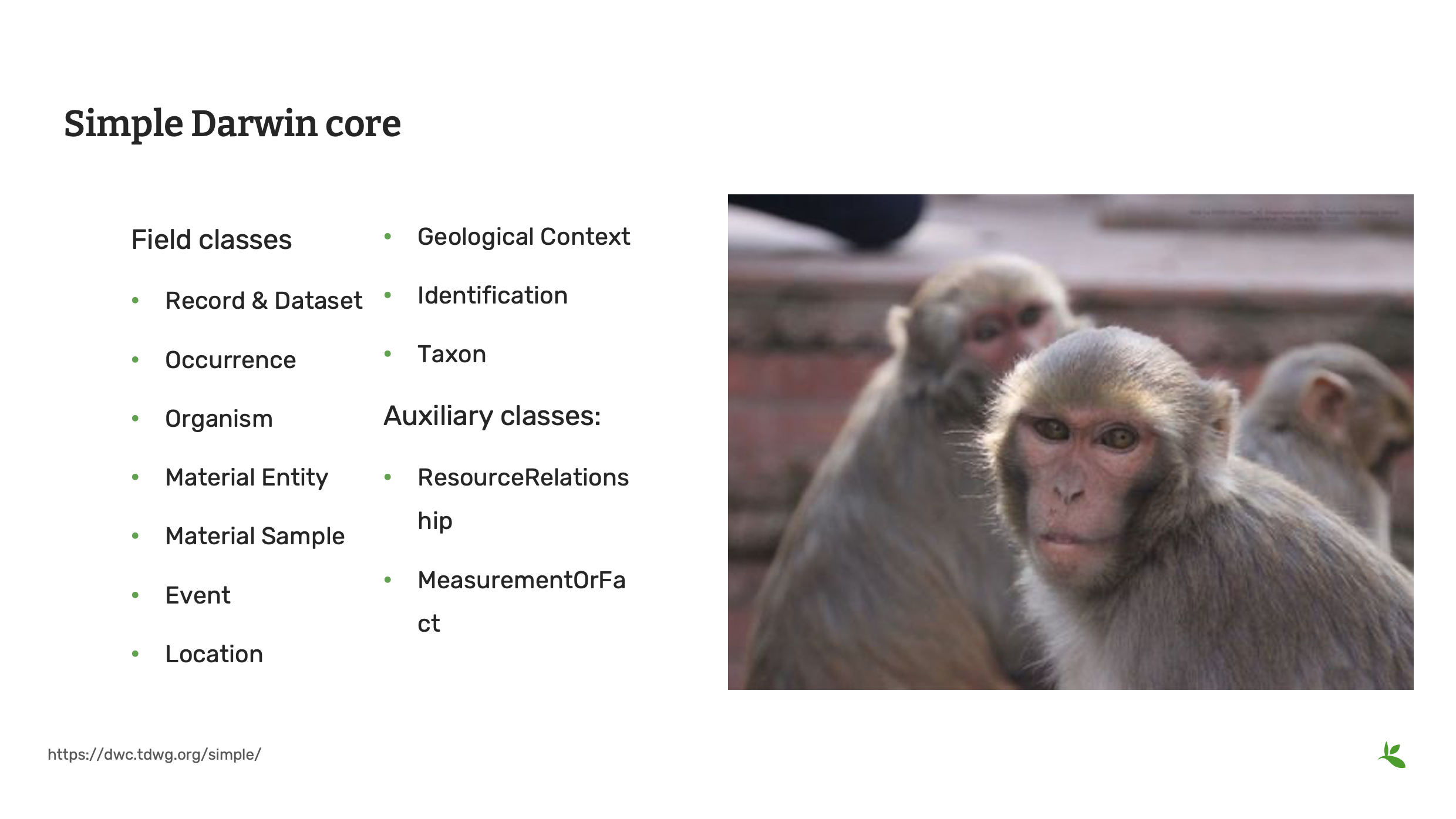
Ce sous-ensemble contient plus de 150 champs, qui sont placés dans un ensemble de classes comprenant :
Enregistrement et Jeux de Données d’Occurrence Organisme Matériel d’Entité Matériel d’Échantillon Événement Lieu Contexte géologique Identification Taxon
De plus, il existe deux classes auxiliaires appelées :
ResourceRelationship MeasurementOrFact
D’après le guide de l’utilisateur du Simple Darwin Core, "le Simple Darwin Core est simple en ce sens qu’il ne suppose (et n’autorise) aucune structure au-delà du concept de lignes et de colonnes, que l’on peut considérer comme des attributs et leurs valeurs, ou des champs et des enregistrements".
Photo : Macaca mulatta (Zimmermann, 1780) Observé au Népal par Vladimir Tkalčić (http://creativecommons.org/licenses/by-nc/4.0/)
Diapositive 11 - Guide de référence rapide du Darwin Core
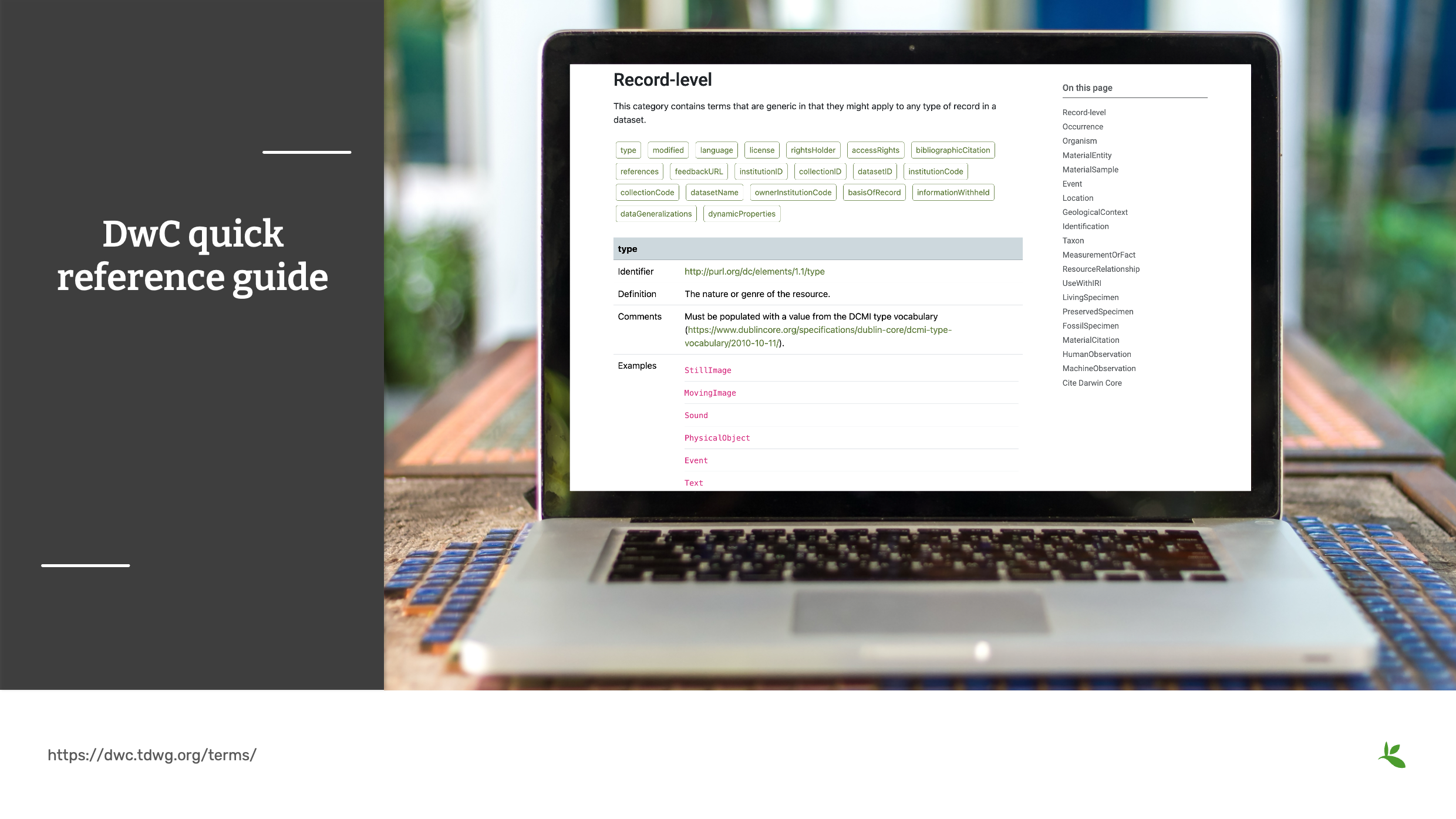
Le guide de référence rapide du DwC deviendra bientôt votre ressource préférée. Cette page fournit une liste de tous les termes actuellement recommandés dans la norme Darwin Core. Les catégories telles que Occurrence ou Event correspondent aux classes Darwin Core qui regroupent d’autres termes.
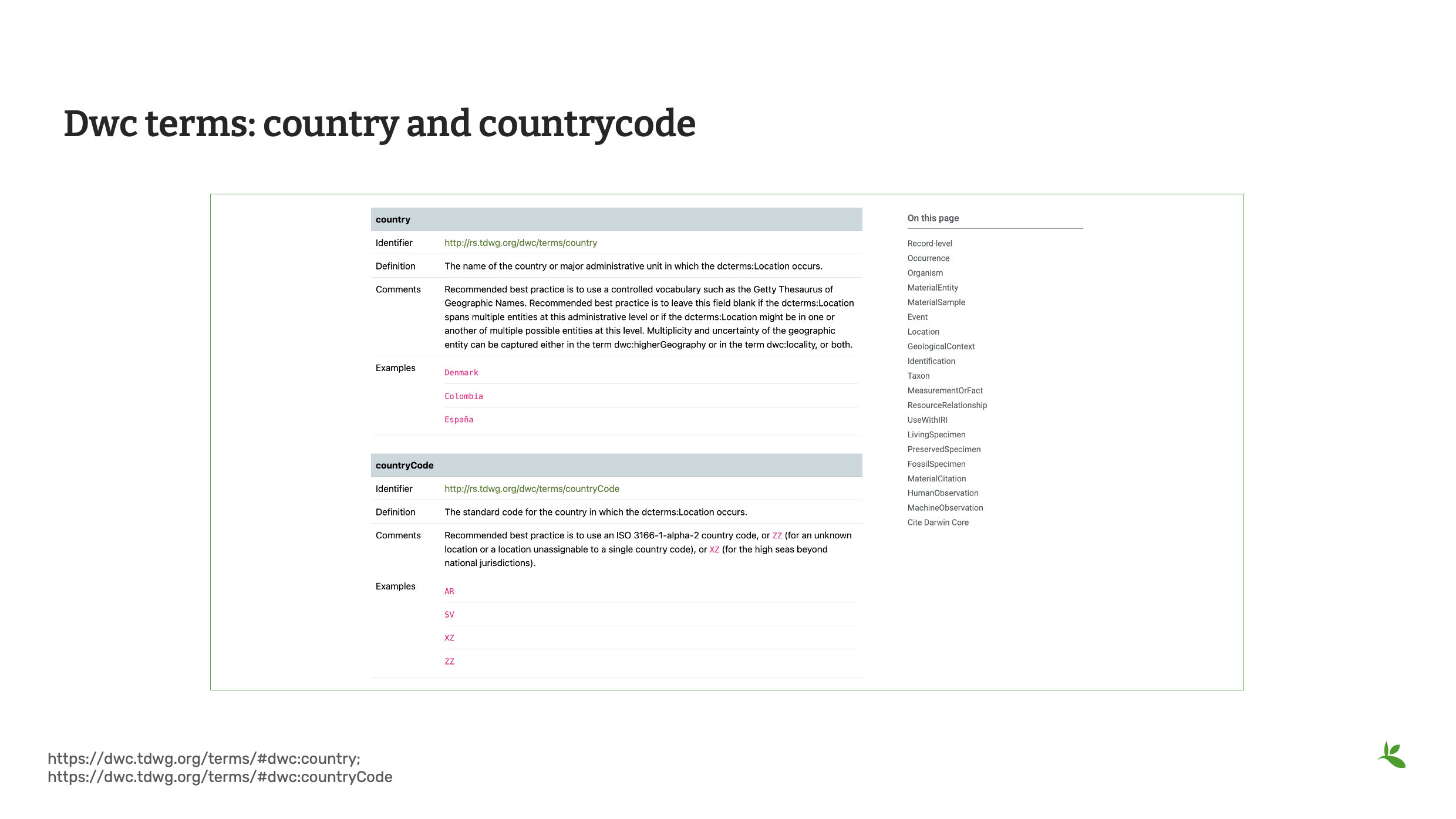
Diapositive 12 - Termes du DwC relatifs au pays et au code de pays
Nous allons maintenant examiner quelques exemples de termes du Darwin Core. Le guide de référence rapide présente chaque terme de manière cohérente avec le nom de l’identifiant, la définition, les commentaires et les exemples. Les premiers termes que nous examinerons sont Country et CountryCode dans la catégorie Location.
En général, les détenteurs de données disposent d’un champ pour le pays dans leurs données sources. Mais souvent, ces données peuvent être assez confuses, avec des fautes d’orthographe, des abréviations et des noms historiques. Il s’agit toutefois de l’un des éléments de données les plus faciles à standardiser. Comme indiqué dans les commentaires, la meilleure pratique recommandée est d’utiliser un vocabulaire contrôlé tel que le Getty Thesaurus of Geographic Names. Un vocabulaire contrôlé impose des restrictions sur les valeurs à utiliser pour ce terme.
CountryCode est un terme qui n’est généralement pas présent dans les données sources. Mais il s’agit là encore d’un champ qui peut facilement être alimenté en données grâce à la recommandation formulée dans les commentaires d’utiliser un code de pays ISO 3166-1-alpha-2.
Le GBIF recommande fortement le partage du champ CountryCode dans les jeux de données d’occurrence. Le partage du champ Country est également encouragé.
Vous en apprendrez davantage sur les exigences et les recommandations du GBIF dans les prochaines sessions.
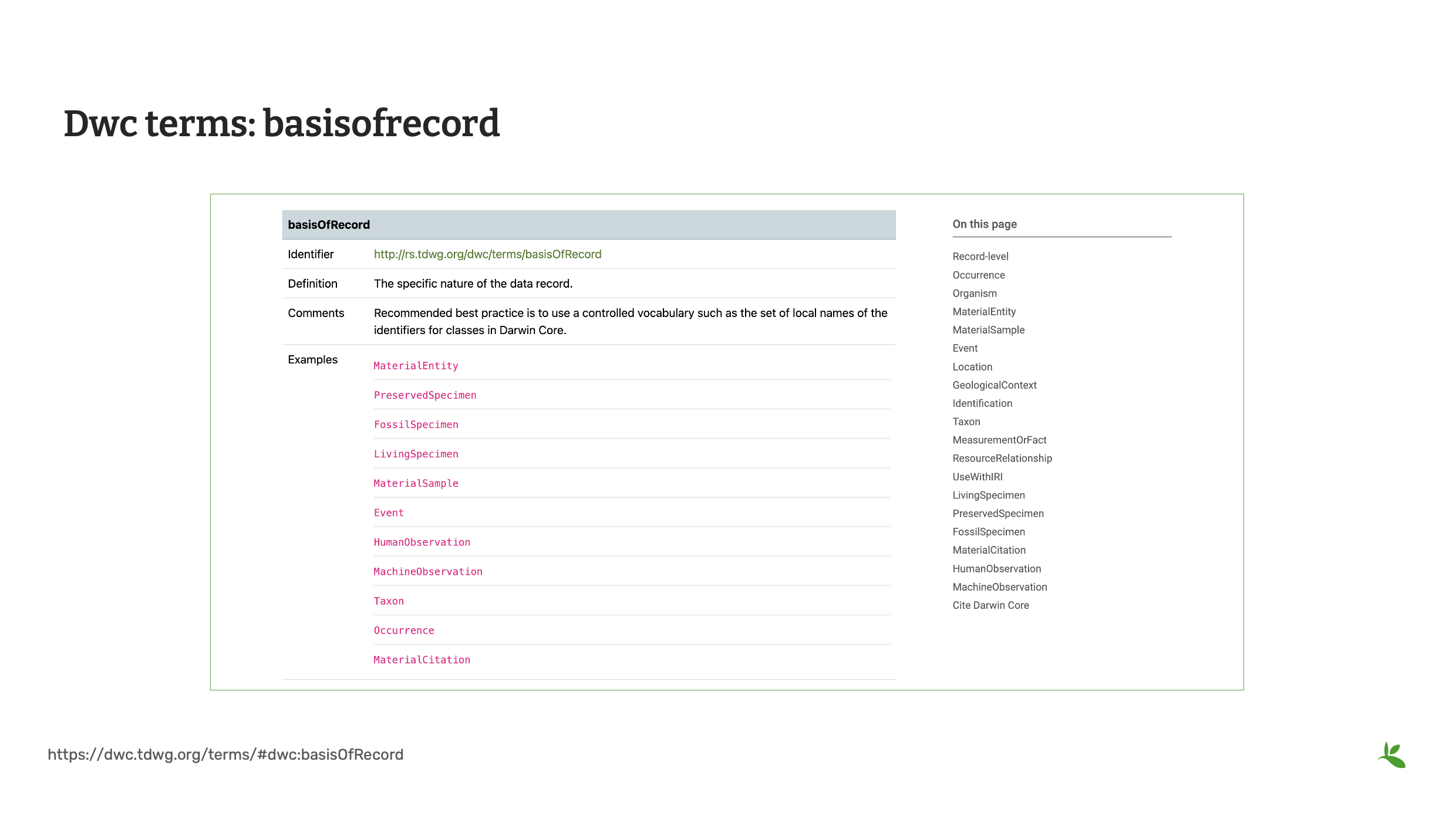
Diapositive 13 - Termes du DwC basisOfRecord
Le terme suivant est basisOfRecord. basisOfRecord définit la nature de chaque enregistrement dans un jeu de données. BasisOfRecord suit un vocabulaire contrôlé. Vous pouvez choisir entre PreservedSpecimen, FossilSpecimen, LivingSpecimen, MaterialSample, Event, HumanObservation, MachineObservation, Taxon ou Occurrence. Le GBIF exige basisOfRecord pour les jeux de données d’occurrences publiés.
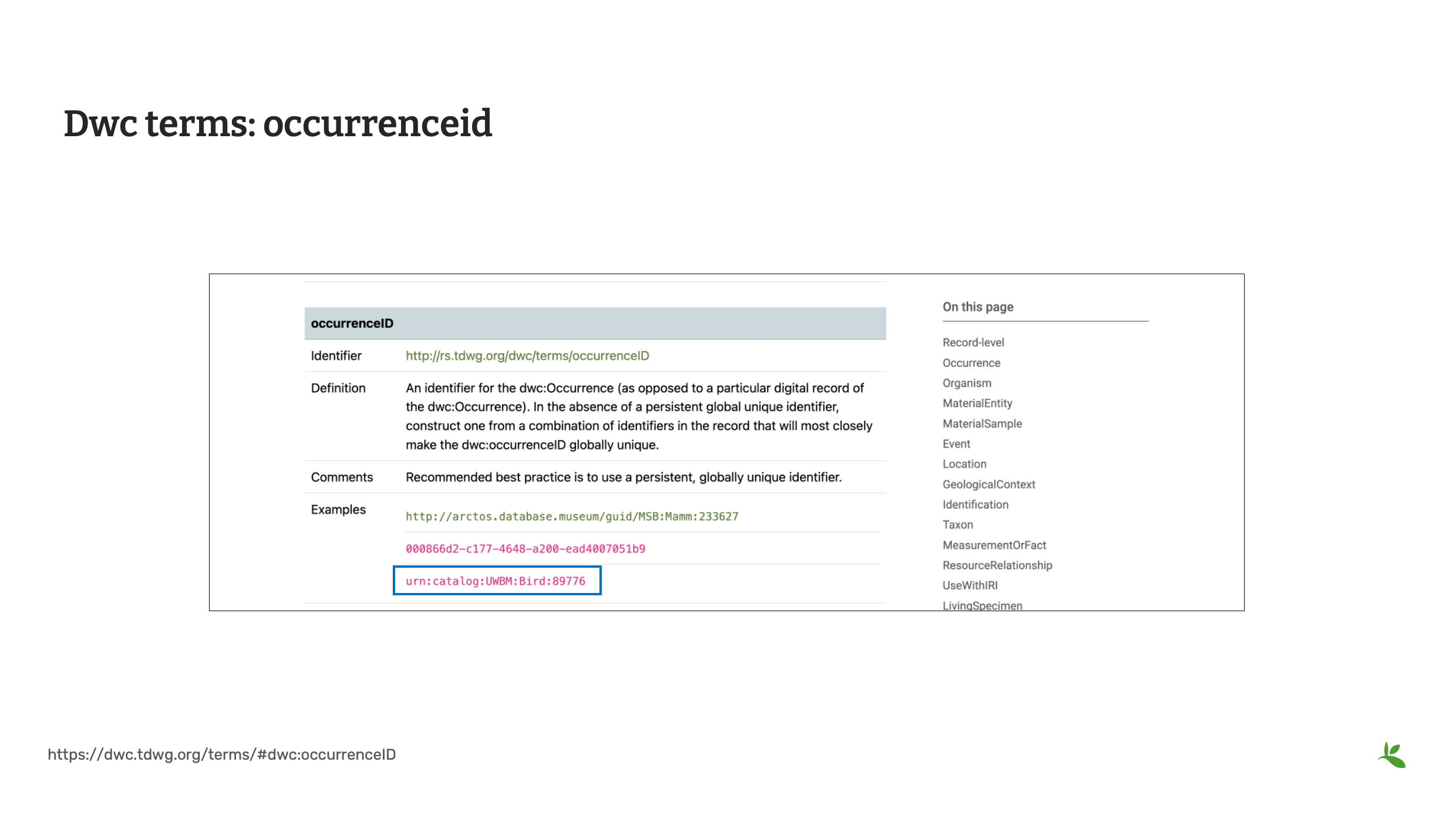
Diapositive 14 - Termes du DwC occurrenceID
Le dernier terme que nous allons examiner est occurrenceID. Lors de la publication d’enregistrements d’occurrence, le GBIF exige un identifiant d’occurrence (occurrenceID). Un occurrenceID est un identifiant pour l’occurrence elle-même, et non pour l’enregistrement numérique de l’occurrence. La meilleure pratique recommandée est d’utiliser un identifiant global unique, également connu sous le nom de GUID. En l’absence de GUID, un identifiant unique peut être composé d’autres identifiants dans le jeu de données. Il existe des outils sur Internet qui peuvent vous aider à générer des GUIDs pour vos enregistrements. Si vous utilisez cette méthode, ces GUIDs devraient devenir un champ permanent dans vos données sources identifiant chaque enregistrement. Pour l’exercice réalisé dans ce cours, vous créerez un occurrenceID avec un format similaire au troisième exemple dans la boîte bleue.
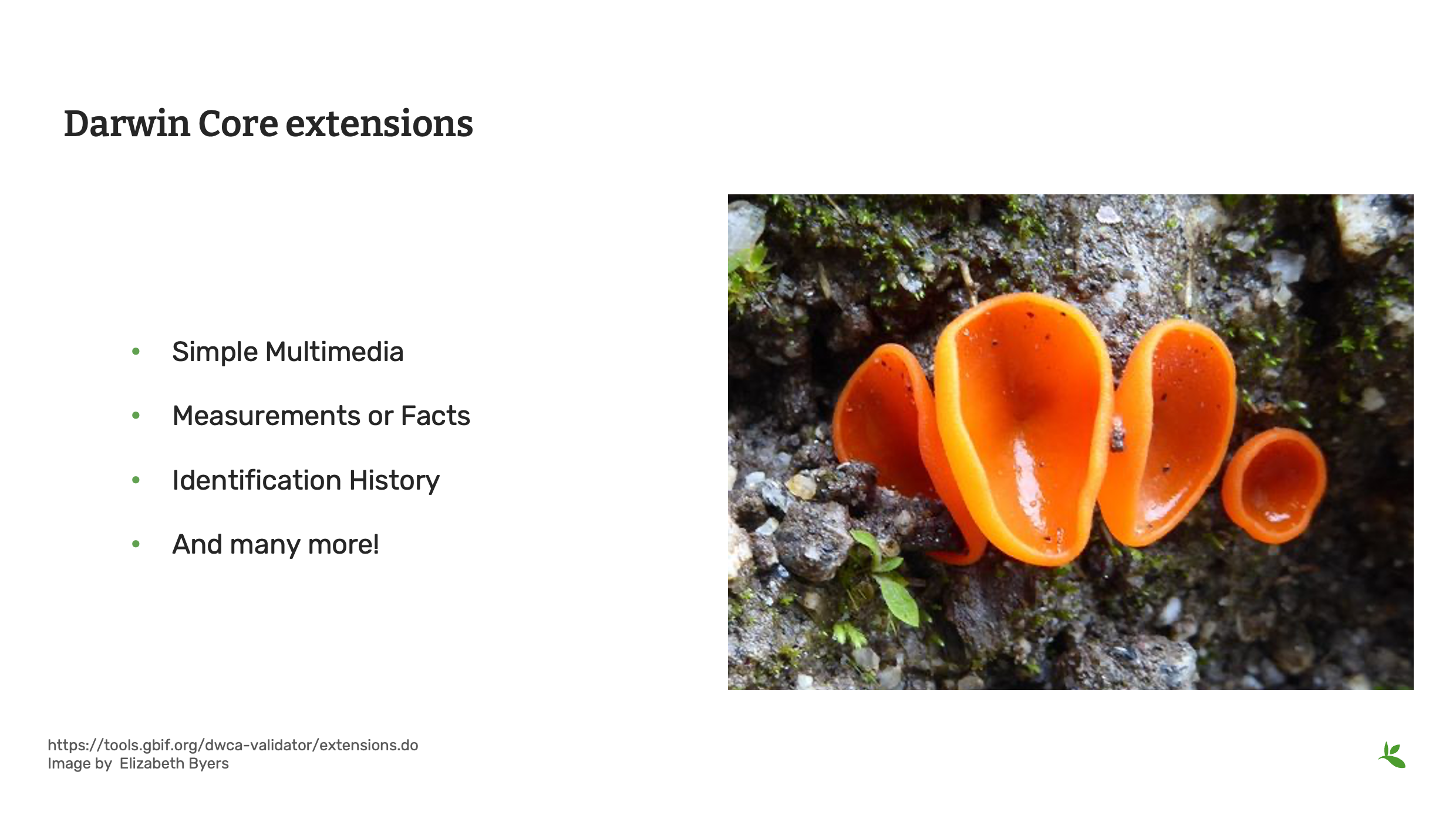
Diapositive 15 - Extensions du Darwin Core
En utilisant le Simple Darwin Core, vous découvrirez peut-être que vous avez d’autres données à partager mais que vous ne pouvez pas trouver les termes correspondants dans le DwC. Ces données peuvent être des images ou des fichiers sonores, ou peut-être êtes-vous responsable d’une collection de vertébrés et avez-vous compilé de nombreuses données sur le poids et la taille des spécimens. Ou même des informations historiques détaillées sur l’identification d’un taxon. Dans ce cas, vous vous tournerez vers les extensions du Darwin Core afin d’étendre les données de base en fournissant des fichiers supplémentaires qui correspondent aux données de base. Les extensions qui répondraient à vos besoins dans ces trois exemples sont les suivantes :
Simple Multimedia Measurements or Facts Identification History
Il existe de nombreuses autres extensions. Le GBIF tient à jour une liste de toutes les extensions approuvées et en projet sur son sous-site consacré aux outils.
Photo : Aleuria aurantia (Pers.) Fuckel Observé au Népal par Elizabeth Byers http://creativecommons.org/licenses/by-nc/4.0/
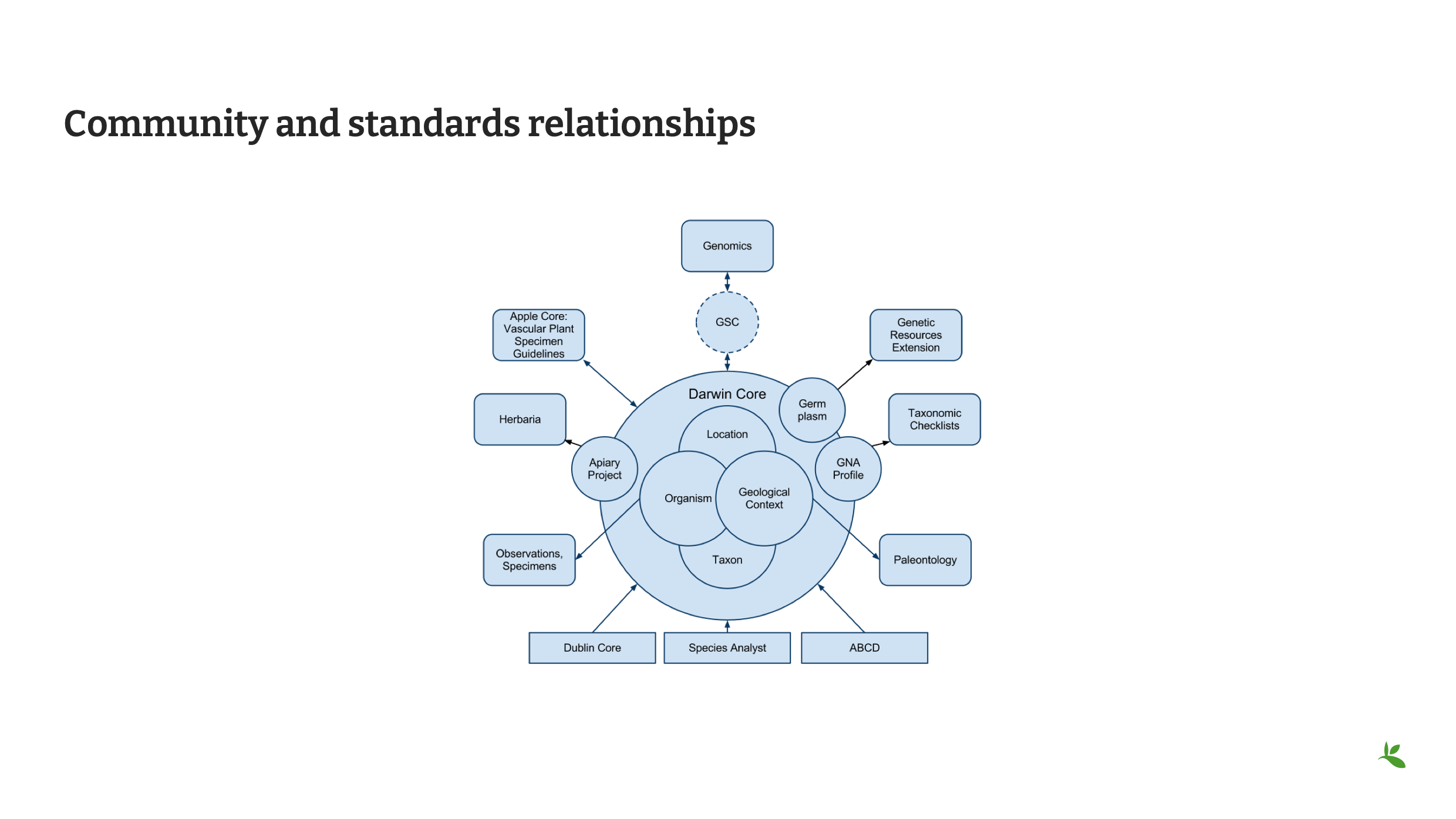
Diapositive 16 - Relations entre la communauté et les normes
Il existe de nombreuses couches dans notre communauté de l’informatique de la biodiversité. L’image montre ici les relations entre ces couches et où elles se recoupent avec le Darwin Core, ainsi que les extensions qui pourraient s’avérer nécessaires pour un partage complet des données.
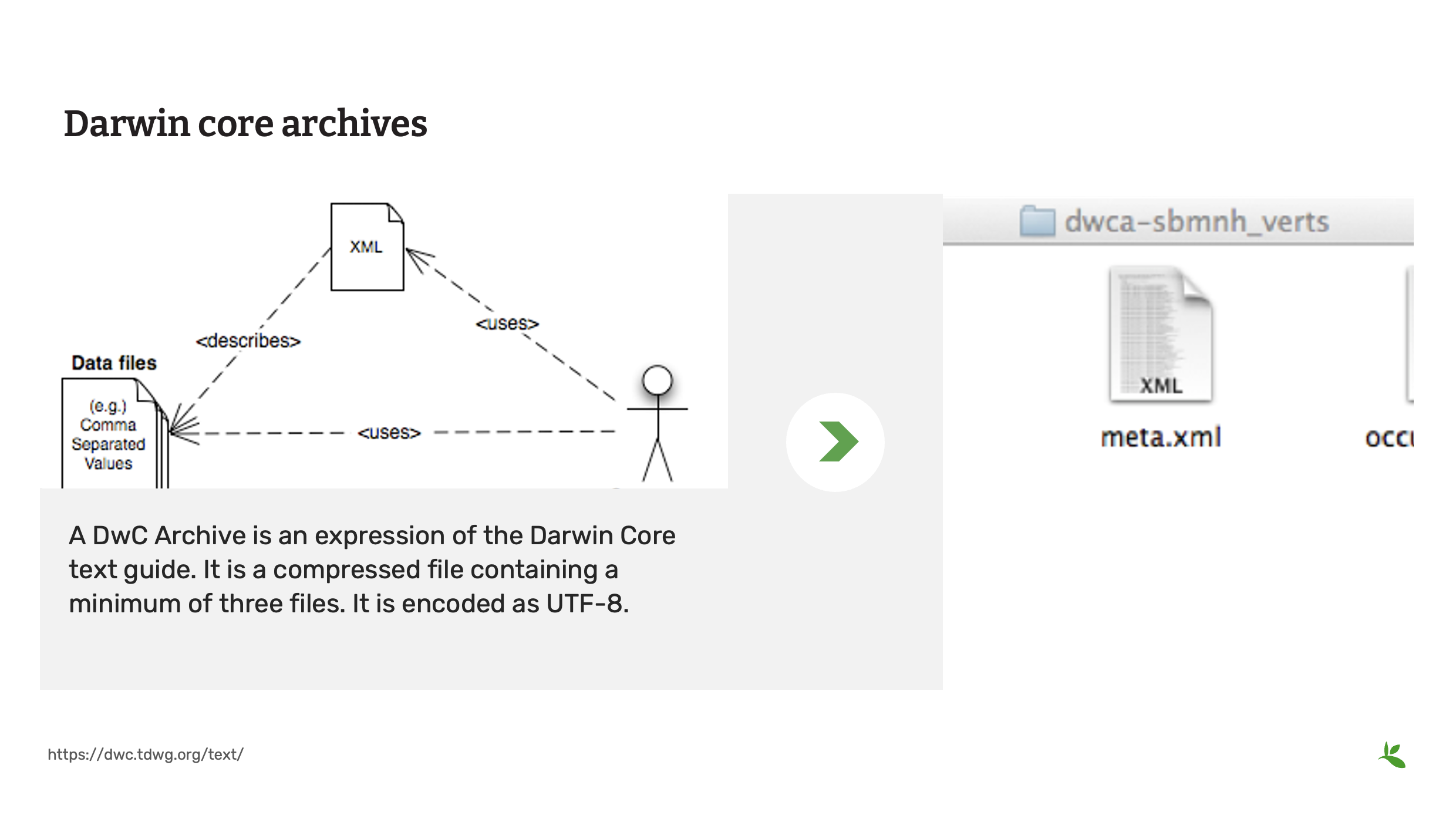
Diapositive 17 - Archive Darwin Core (DwC-A)
Les données partagées avec le GBIF sont actuellement soumises via une archive Darwin Core ou DwCA.
Un DwCA est une expression du guide textuel Darwin Core. Il s’agit d’un fichier compressé contenant au minimum trois fichiers. Il est encodé en UTF-8.
Dans cet exemple, ces trois fichiers sont :
Un fichier de données (occurrence.txt) conforme à la norme SIMPLEDWC au format CSV, dont la première ligne contient les noms des termes standard Darwin Core. Un fichier de métadonnées (meta.xml) au format XML contenant les informations techniques nécessaires à un ordinateur pour utiliser le fichier de données. Un fichier de métadonnées (eml.xml) au format XML contenant des informations explicatives sur les enregistrements contenus dans le fichier de données, afin d’indiquer à l’utilisateur si les données sont adaptées à son usage.
On peut obtenir une structure plus complexe en partageant plusieurs fichiers CSV liés afin d’enrichir les données. Ces fichiers sont liés au fichier principal par un identifiant unique. Dans un jeu de données d’occurrences, ces fichiers CSV sont liés par l’identifiant d’occurrence (occurrenceID).
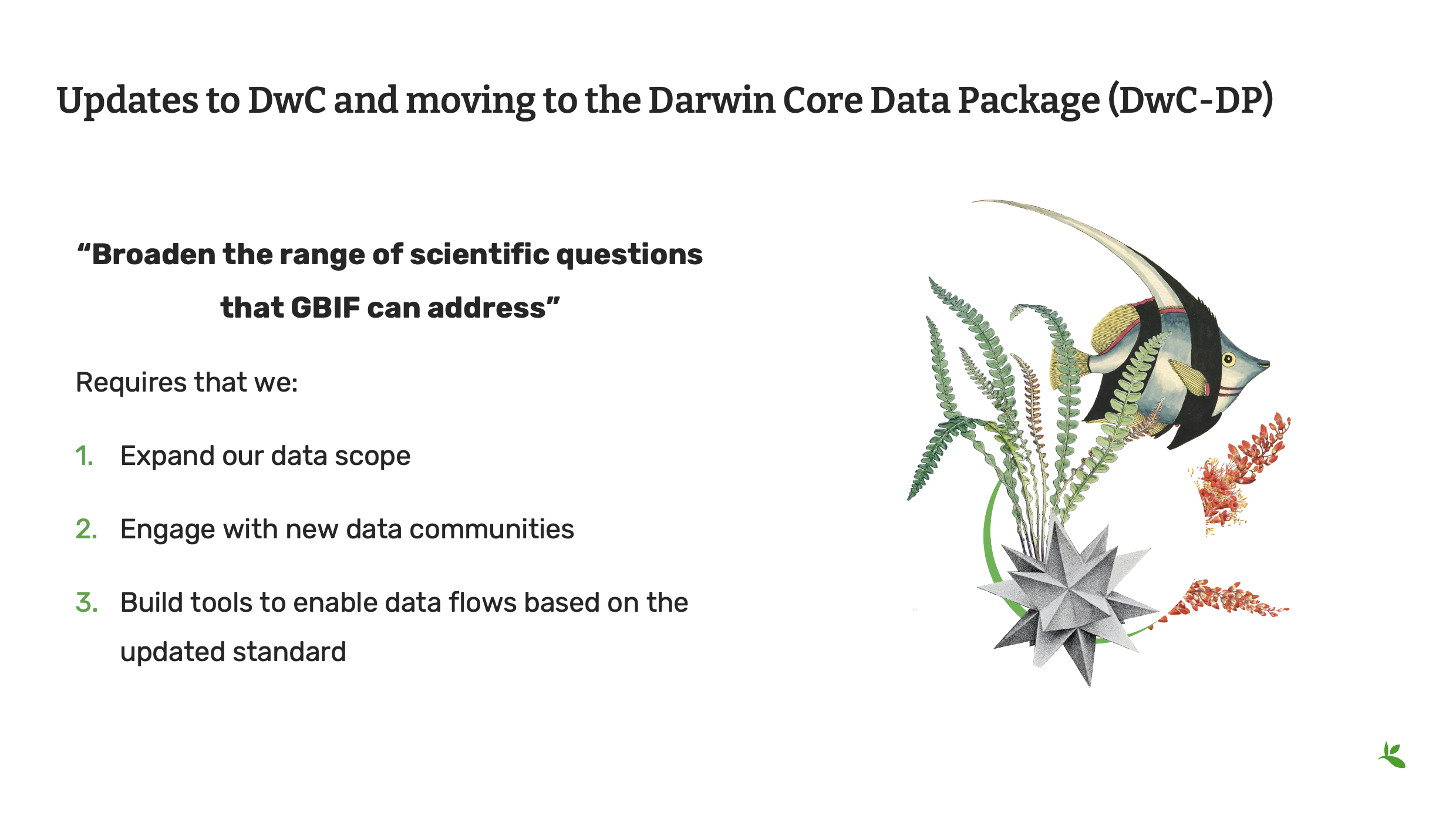
Diapositive 18 - Mises à jour du DwC et passage au Darwin Core Data Package (DwC-DP)
Bien que les archives Darwin Core aient été notre méthode de publication privilégiée depuis 2012, nous nous orientons vers un nouveau modèle appelé Darwin Core Data Package.
Le nouveau modèle vise à "élargir l’éventail des questions scientifiques que le GBIF peut aborder."
It will allow us to expand our data scope, engage with new data communities, and build tools to enable data flows based on the updated standard.
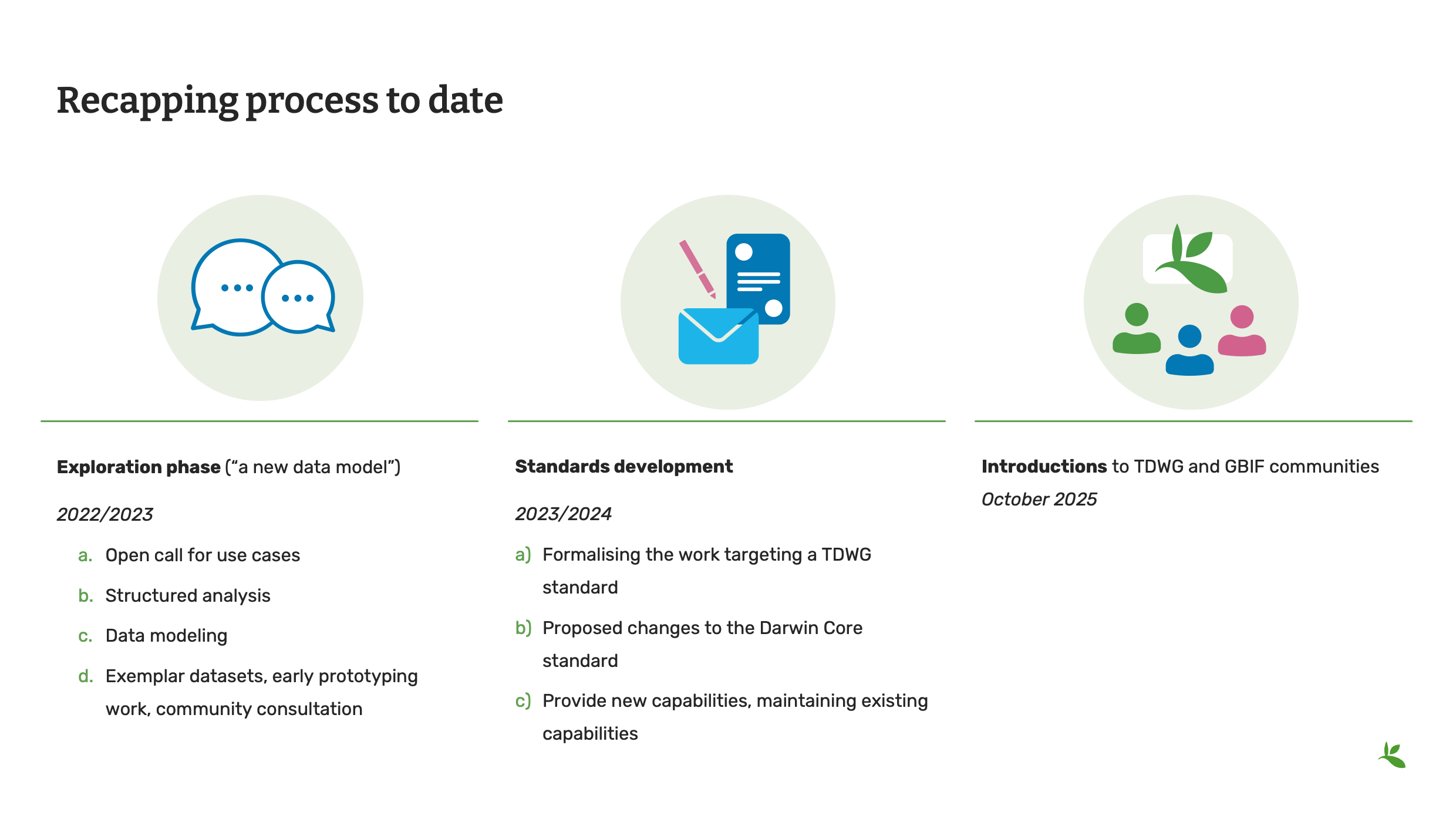
Diapositive 19 - Récapitulatif du processus à ce jour
La communauté travaille sur ce modèle depuis 2022 et les normes relatives à ce modèle sont en cours d’élaboration depuis 2023.
We are finally in the community review and ratification phase for the new terms and the new data package which was released in October of 2025. As you can see from this timeline, it takes a long time implement change to an established standard and it takes a dedicated community to see it through.
Diapositive 20 - Modifications proposées du Darwin Core
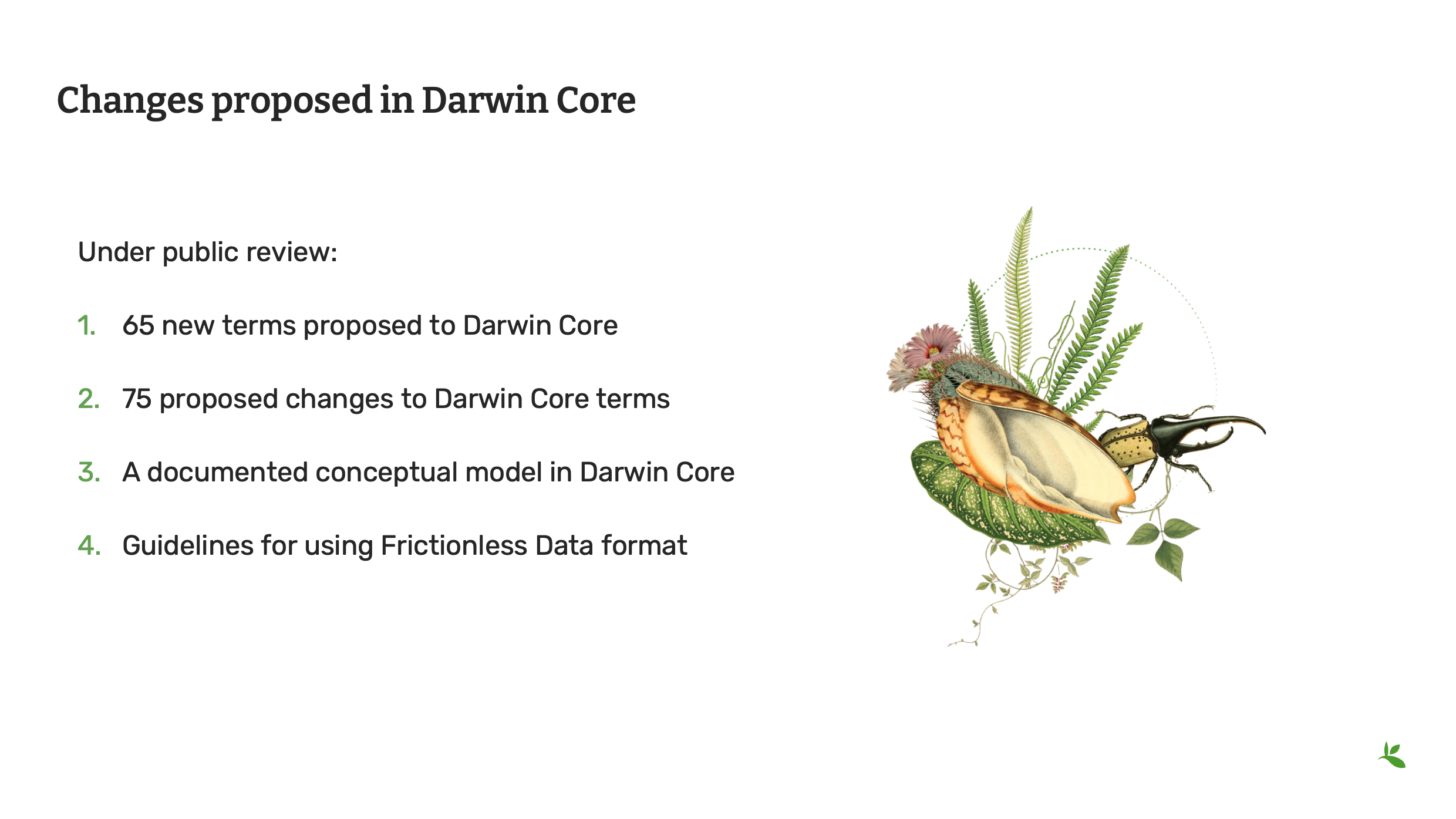
Les changements soumis à consultation publique comprennent :
65 nouveaux termes, 75 modifications proposées aux termes existants, un modèle conceptuel documenté pour les lignes directrices DwC relatives à l’utilisation du format de données sans friction (Frictionless Data Format)
Diapositive 21 - Une nouvelle DwC-A OU un roman épique DwC-DP ?
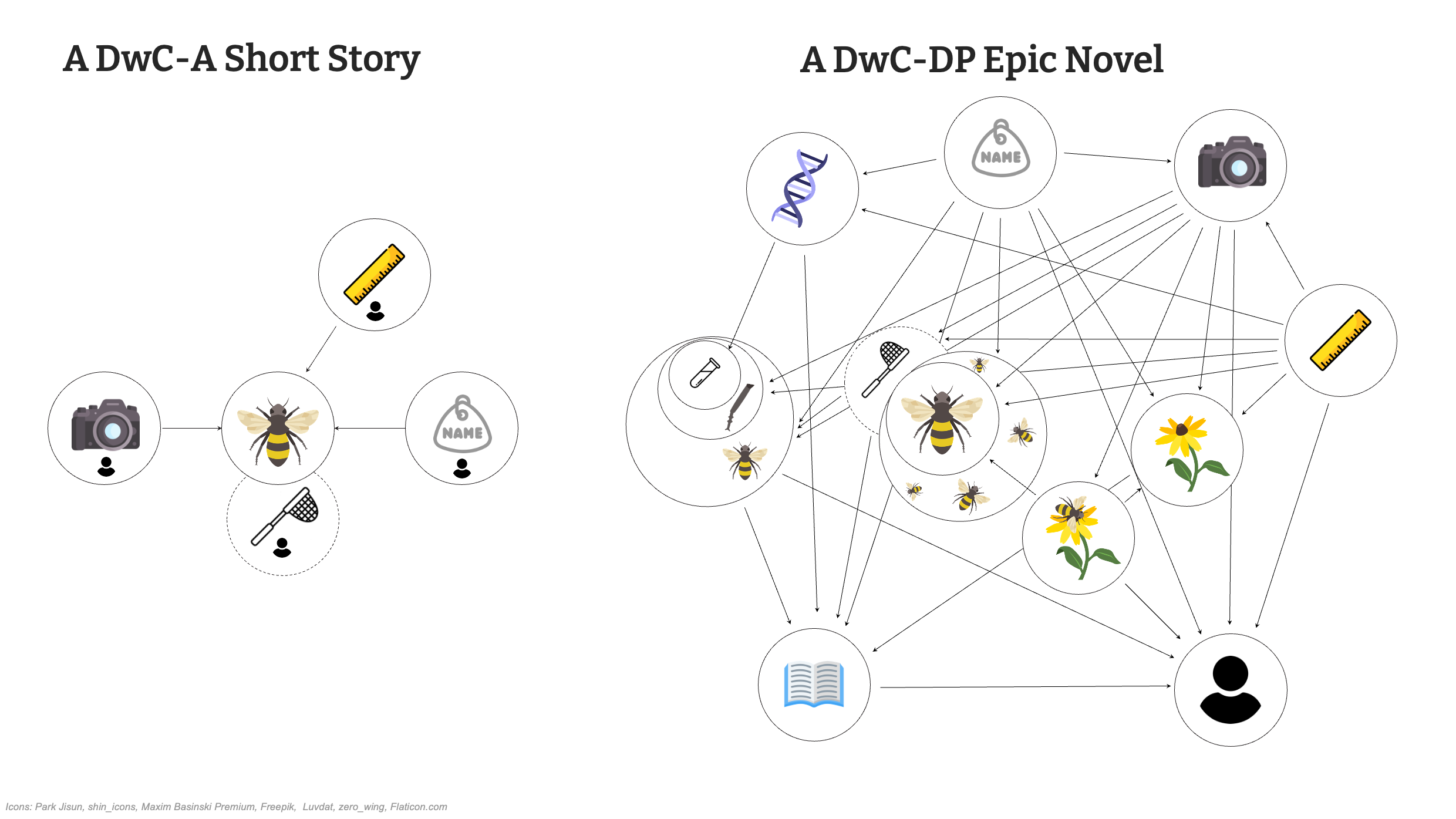
Le Darwin Core Data Package ouvre complètement les possibilités de partage de données, transformant une nouvelle des archives Darwin Core en un roman épique basé sur le Darwin Core Data Package.
À titre de comparaison, on peut raconter des histoires avec DwC-A ou DwC-DP, mais il est évident que l’éventail des efforts scientifiques qui peuvent être fidèlement retranscrites par DwC-DP est beaucoup plus vaste.
Abeille, fleur : Park Jisun ADN : Luvdat Livre : zero_wing Filet : shin_icons Personne : Maxim Basinski Tube à essai premium : Freepik Règle : Freepik Appareil photo : Freepik Identification : Freepik
Diapositive 22 - Dois-je vraiment faire tout ça ?
Tout cela peut paraître déroutant lorsque l’on découvre la mobilisation des données, mais nous tenons à vous informer que des changements sont à venir qui, selon la nature de vos données, pourraient s’avérer très intéressants pour vous.
Nous reconnaissons également que tout le monde n’a pas besoin de faire tout cela, surtout au sein d’un seul ensemble de données, et que les éditeurs pourront n’utiliser que ce dont ils ont besoin.
Pour le moment, concernant ce cours, nous nous concentrons sur la formation utilisant le noyau événement (event core), à propos duquel vous découvrirez plus de détails lors des prochaines sessions.
Une fois le processus de ratification terminé et lorsque nous serons prêts à ce que les éditeurs commencent à utiliser le Darwin Core Data Package, nous organiserons des événements communautaires virtuels pour compléter la formation.
Diapositive 23 - Pourquoi utiliser le Darwin Core ?
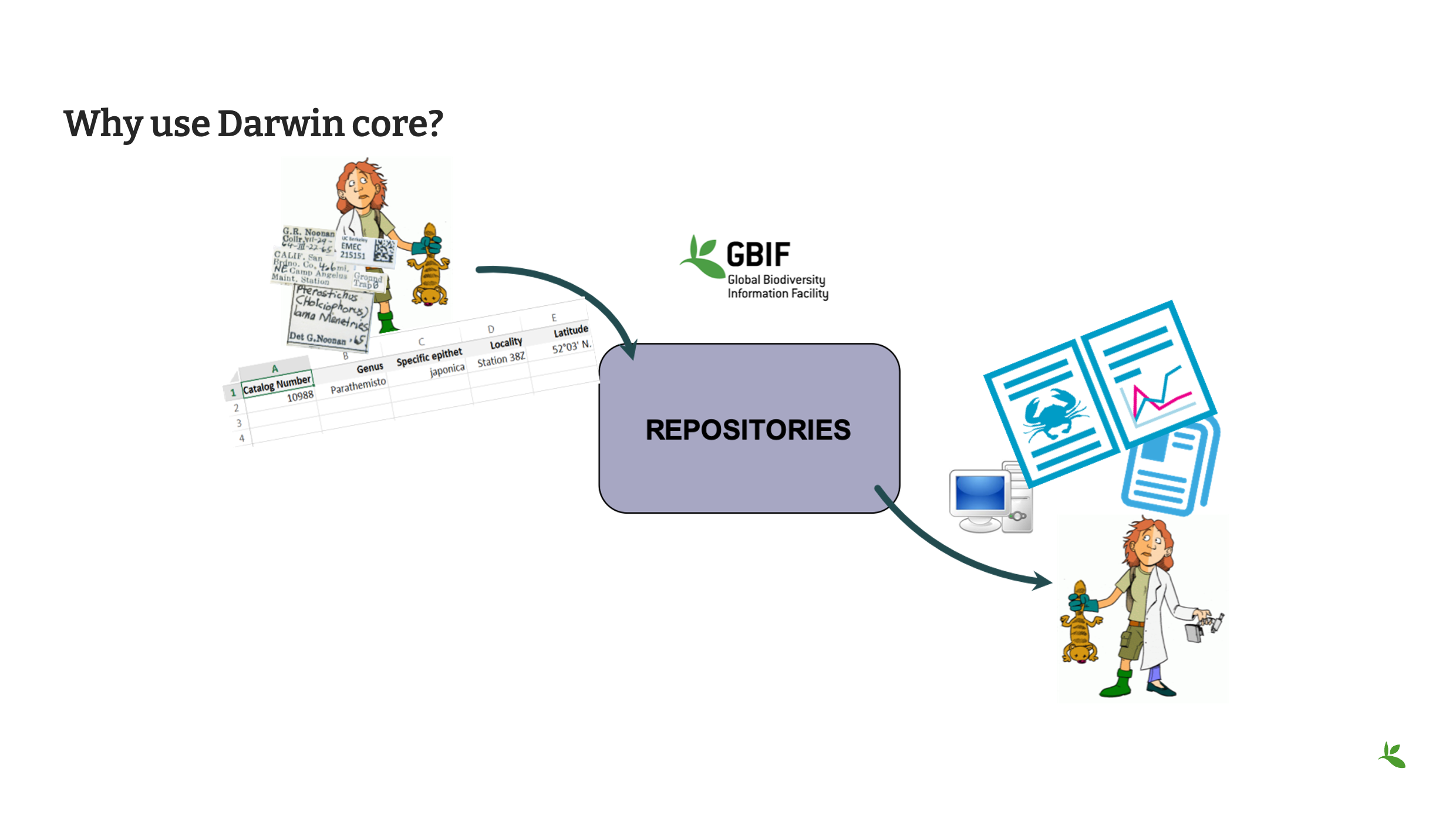
En conclusion, nous avons couvert ce qu’est le Darwin Core et nous espérons que vous avez commencé à comprendre pourquoi vous devriez l’utiliser.
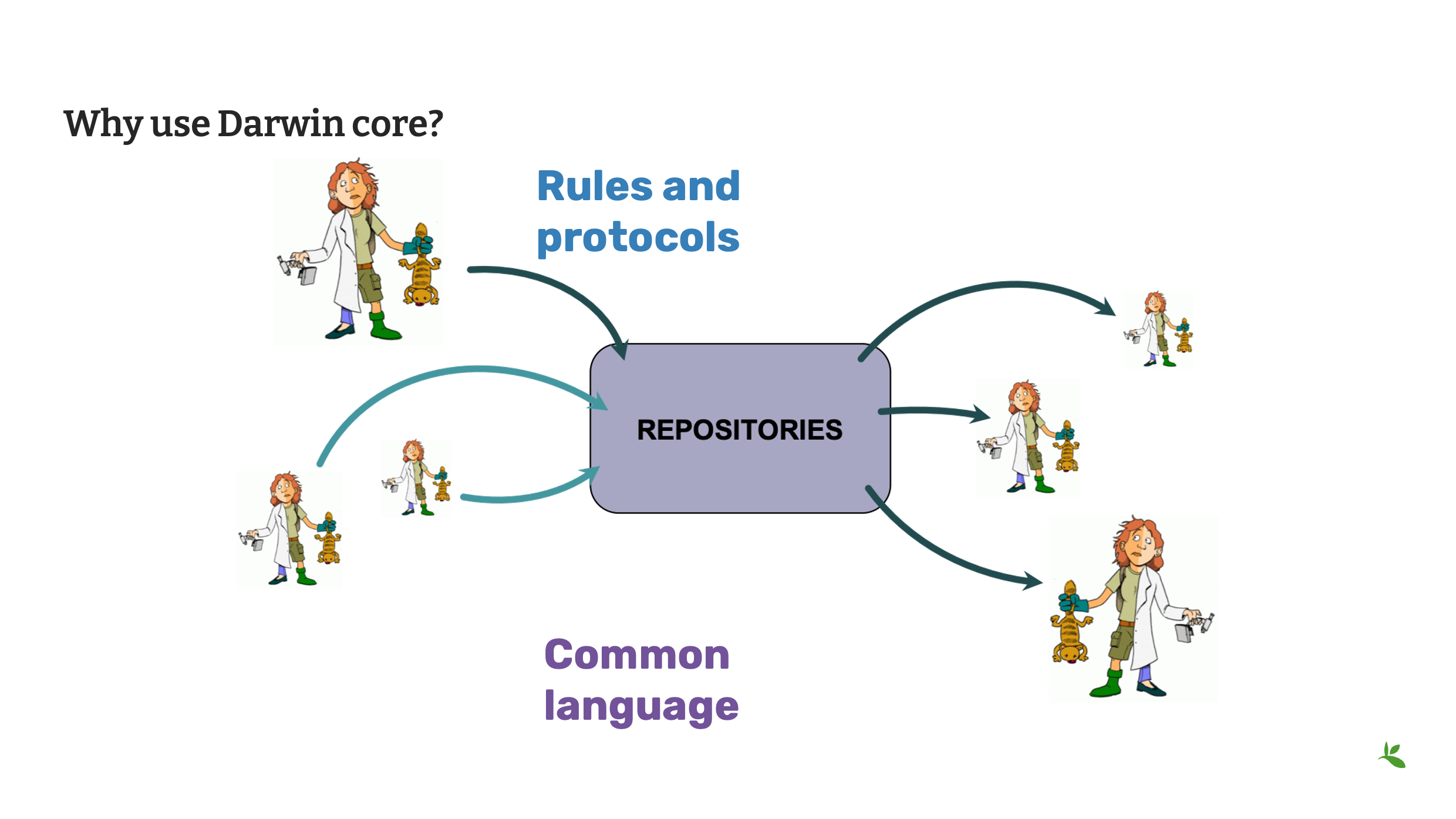
C’est une norme, et les normes sont une bonne chose ! Elles nous fournissent les règles et les protocoles nécessaires pour partager nos données avec les autres.
Le Darwin Core nous fournit également une langue commune. Comme nous l’avons vu dans la partie Fondations – Présentation de la documentation, les données sources peuvent être difficiles à exploiter lorsqu’on essaie de comparer les jeux de données. Les champs dans vos données sources peuvent être différents des champs dans des données source provenant d’une autre institution. Lorsque nous utilisons tous le Darwin Core pour partager nos données, nous comprenons que les données ont été partagées avec une langue commune.
Diapositive 24 - Pourquoi utiliser le Darwin Core ?
Et ce ne sont pas seulement les détenteurs de données qui comprennent ce langage commun, mais aussi les utilisateurs de données. Après tout, qu’y a-t-il de mieux qu’un utilisateur qui trouve un jeu de données adapté à son usage, partagé dans un langage commun, qui lui permet de faire de progresser la recherche scientifique ?

Diapositive 25 - Conclusion
Ce document fait partie d’une série de présentations utilisées dans le cadre du cours sur la mobilisation des données sur la biodiversité du GBIF. Le programme de mobilisation des données sur la biodiversité a été développé à l’origine dans le cadre du programme de développement de l’information sur la biodiversité financé par l’Union européenne. Cette présentation a été créée par Paula Zermoglio et John Wieczorek avec des contributions supplémentaires de Sharon Grant, Sophie Pamerlon, Laura Anne Russell, Cecilie Svenningsen et Dag Endresen. Cette présentation a été narrée par Vijay Barve. .
Exercice 1a
|
Pour cette activité, vous examinerez les noms de champs textuels et les associerez aux termes du Darwin Core |
-
Trouvez le terme du Darwin Core sur https://dwc.tdwg.org/terms/ qui correspond le mieux aux noms des champs.
-
Téléchargez UC-Practice-exercise-sheet_EN.docx pour fournir vos réponses.
Types de jeux de données GBIF pour les données primaires sur la biodiversité
|
Dans cette vidéo (08:16), vous découvrirez les types de données sur la biodiversité pouvant être partagées au sein du GBIF. Cette vidéo ne dispose pas encore de sous-titres. Si vous ne pouvez pas regarder la vidéo intégrée, vous pouvez la télécharger localement (MP4 - 28.8 Mo) Si vous préférez lire, vous trouverez la transcription sous la vidéo intégrée. |
Transcription de la présentation
Cliquez pour développer
Diapositive 1 - Types de jeux de données GBIF pour les données primaires sur la biodiversité
Dans cette présentation, nous examinerons les différents types de données qualifiées de « données primaires sur la biodiversité » et partagées au sein du GBIF. Ces données peuvent être complexes et d’origines diverses. Nous verrons comment les structurer selon l’une des différentes classes de données acceptées par le GBIF, conformément à la norme de partage de données Darwin Core utilisée au sein de la communauté GBIF.
Diapositive 2 - Niveaux de richesse des données pris en charge par le GBIF
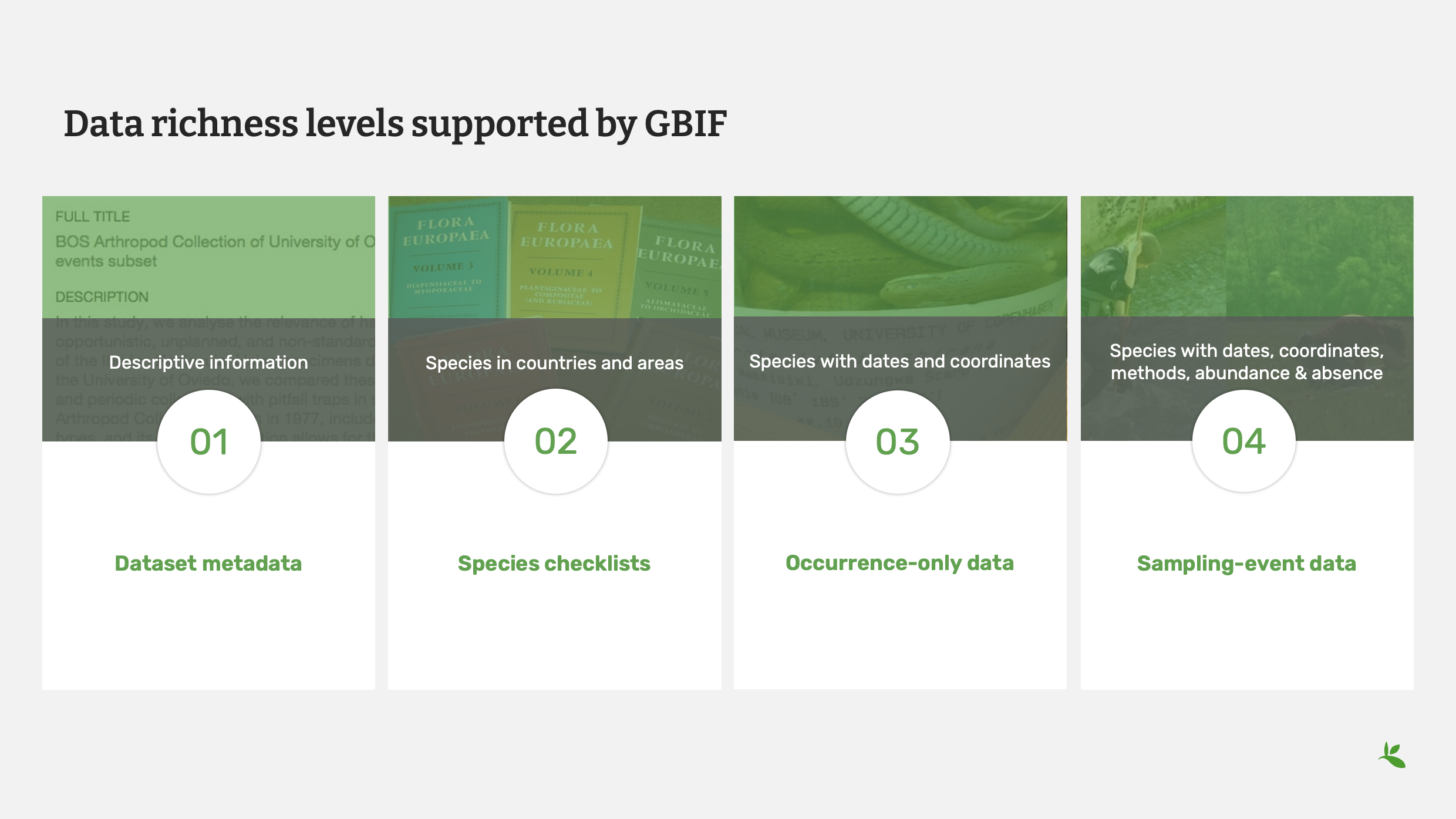
GBIF prend actuellement en charge quatre types de jeux de données :
Il s’agit tout d’abord des métadonnées des ensembles de données.
Il s’agit d’un ensemble de données qui vous permet de fournir des informations descriptives sur un ensemble de données. Vous pouvez utiliser ce type lorsque vos données n’ont pas encore été numérisées. Aucun fichier de données n’est publié avec ce type d’ensemble de données ; seules des métadonnées descriptives sont fournies.
Le deuxième type est celui des listes d’espèces.
Cela vous permet de partager des informations sur les espèces, notamment les pays et les régions où elles sont présentes.
Le troisième type est celui des données de type occurrence uniquement.
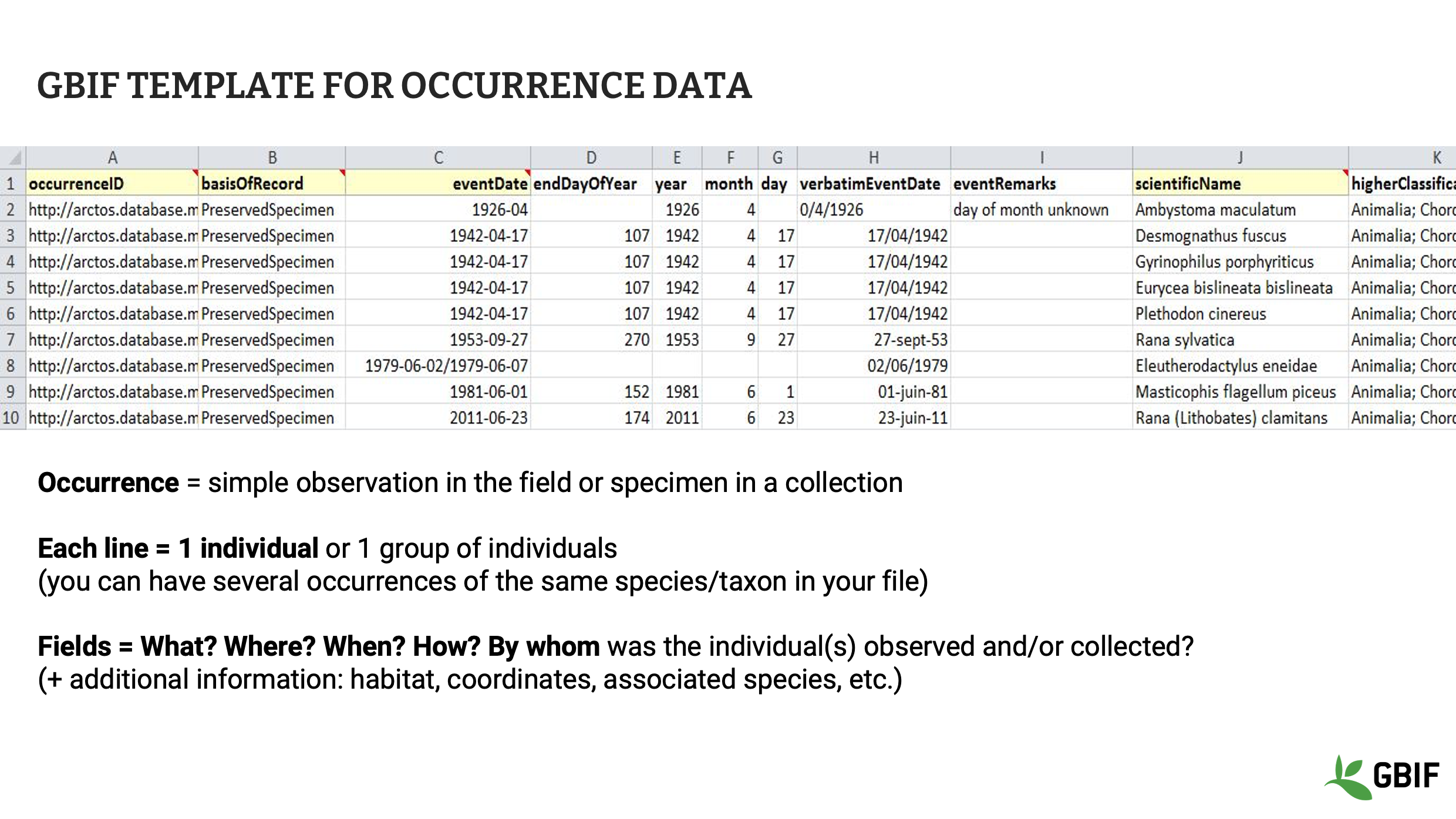
Ce type de jeu de données concerne les données qui comprennent des noms, des dates et des coordonnées – c’est-à-dire le quoi, le quand et le où de vos données.
Le dernier type est celui des données d’événements d’échantillonnage.
Ce type vous permet de partager encore plus de données. Vous pouvez partager des informations sur les espèces, avec les dates, les coordonnées, les méthodes, l’abondance et même l’absence.
Nous allons maintenant examiner plus en détail les types de jeux de données que sont les listes d’espèces, les occurrences et les événements d’échantillonnage.
Diapositive 3 - Données de liste d’espèces
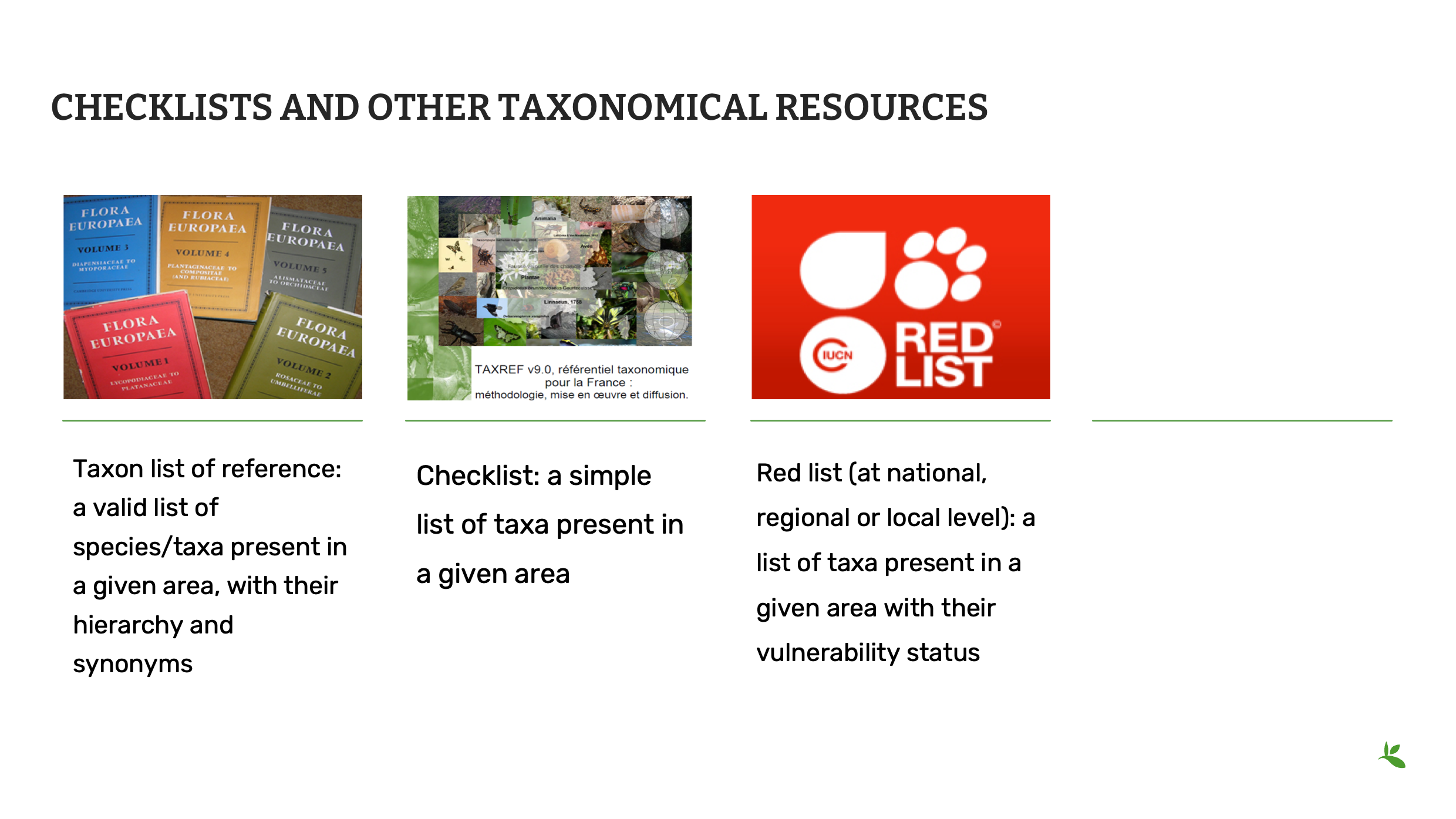
Les ensembles de données de type « liste d’espèces » fournissent un catalogue ou une liste d’organismes identifiés, ou taxons. Bien qu’ils puissent inclure des détails supplémentaires tels que les noms locaux des espèces ou les références des spécimens, ces « listes d’espèces » classent généralement les informations selon des critères taxonomiques, géographiques et thématiques, ou une combinaison de ces trois aspects. Par exemple, un ensemble de données répertoriant les mollusques des Seychelles inscrits sur la Liste rouge comporte des éléments distincts de taxonomie (le phylum Mollusca), de géographie (l’archipel des Seychelles) et de thème (les espèces jugées menacées par les experts de l’UICN). Les listes de contrôle servent de résumé rapide ou d’inventaire de référence des taxons dans un contexte donné.
Diapositive 4 - Modèle GBIF pour les données taxonomiques
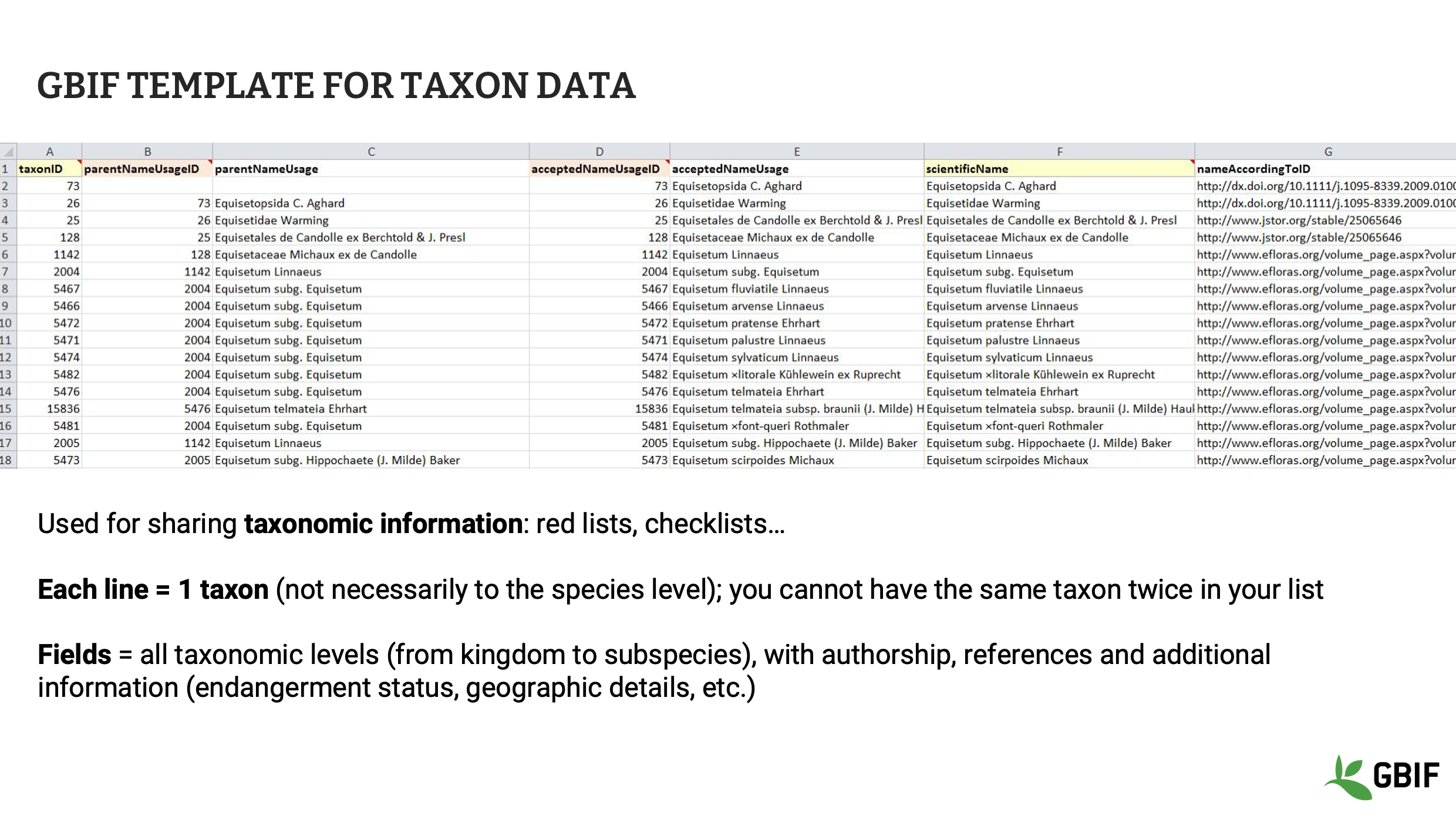
Le GBIF fournit aux éditeurs de données des modèles pour chaque type de jeu de données. Le modèle GBIF pour les listes d’espèces (données taxonomiques) permet de partager les informations relatives à chaque espèce ou taxon : identifiant, nom complet et autorité, liens de parenté avec d’autres taxons, informations géographiques, etc. Dans ce modèle, chaque ligne représente un taxon et un taxon ne peut apparaître qu’une seule fois dans le jeu de données (sinon, un doublon sera créé).
Diapositive 5 - Données d’occurrence
D’autres ensembles de données publiés sur GBIF.org présentent un niveau de détail suffisamment cohérent pour fournir des informations sur la localisation des organismes individuels dans le temps et dans l’espace ; en d’autres termes, ils attestent de la présence d’une espèce (ou d’un autre taxon) à un endroit précis à une date donnée.
Les ensembles de données sur les occurrences constituent le cœur des données publiées via GBIF.org ; parmi les exemples, on peut citer les spécimens et les fossiles des collections d’histoire naturelle, les observations des chercheurs sur le terrain et des citoyens scientifiques, ainsi que les données recueillies par des pièges photographiques ou des satellites de télédétection.
Les données d’observation contenues dans ces ensembles de données ne fournissent parfois que des informations générales sur la localisation, se limitant parfois à l’identification du pays, mais dans de nombreux cas, des emplacements plus précis et des coordonnées géographiques permettent une analyse détaillée et la cartographie de la répartition des espèces.
https://multimedia.agouti.eu/assets/6d65f3e4-4770-407b-b2bf-878983bf9872/file [Photo prise par un piège photographique]
Diapositive 6 - Occurrences de la littérature
Les données sur la biodiversité peuvent également être trouvées dans la littérature technique et scientifique : il est possible de compiler et de partager ce type de données au sein du GBIF, mais vous devriez être extrêmement prudent de ne pas partager des données en double (par exemple, un spécimen décrit dans un article scientifique pourrait déjà être présent au GBIF.org dans le jeu de données de sa collection)
En l’absence d’ensembles de données numérisés, les données sur la biodiversité peuvent être extraites et compilées à partir d’articles scientifiques, de thèses de doctorat ou de master, de rapports et d’autres documents. Contactez TOUJOURS le propriétaire de données d’abord lors de la compilation de données littéraires pour demander l’autorisation de les publier sur GBIF.
Diapositive 7 - Modèle GBIF pour les données d’occurrences
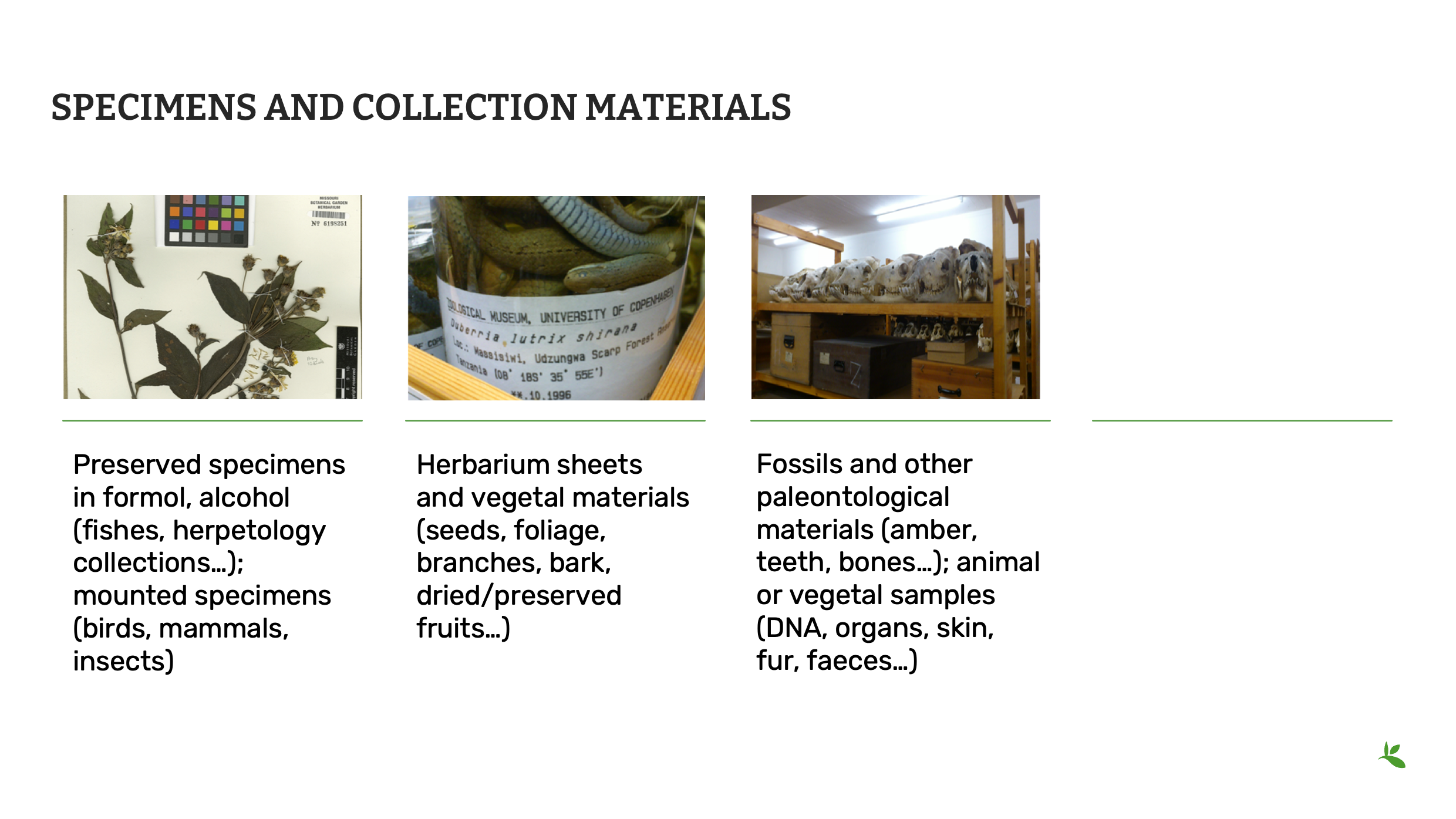
Les données d’occurrence représentent la classe de jeux de données GBIF avec le plus grand nombre d’enregistrements sur GBIF.org. Les collections, les observations sur le terrain et la littérature peuvent être partagées au sein du GBIF à l’aide de ce modèle, qui se concentre sur les spécimens individuels observés ou collectés. Dans ce type de jeux de données, plusieurs individus ou spécimens peuvent être enregistrés pour un seul taxon, aussi longtemps qu’ils ont chacun un identifiant unique. Les autres champs pour les données d’occurrence incluent où, quand, comment et par qui chaque occurrence a été observée et/ou collectée sur le terrain.
Diapositive 8 - Données relatives aux événements d’échantillonnage
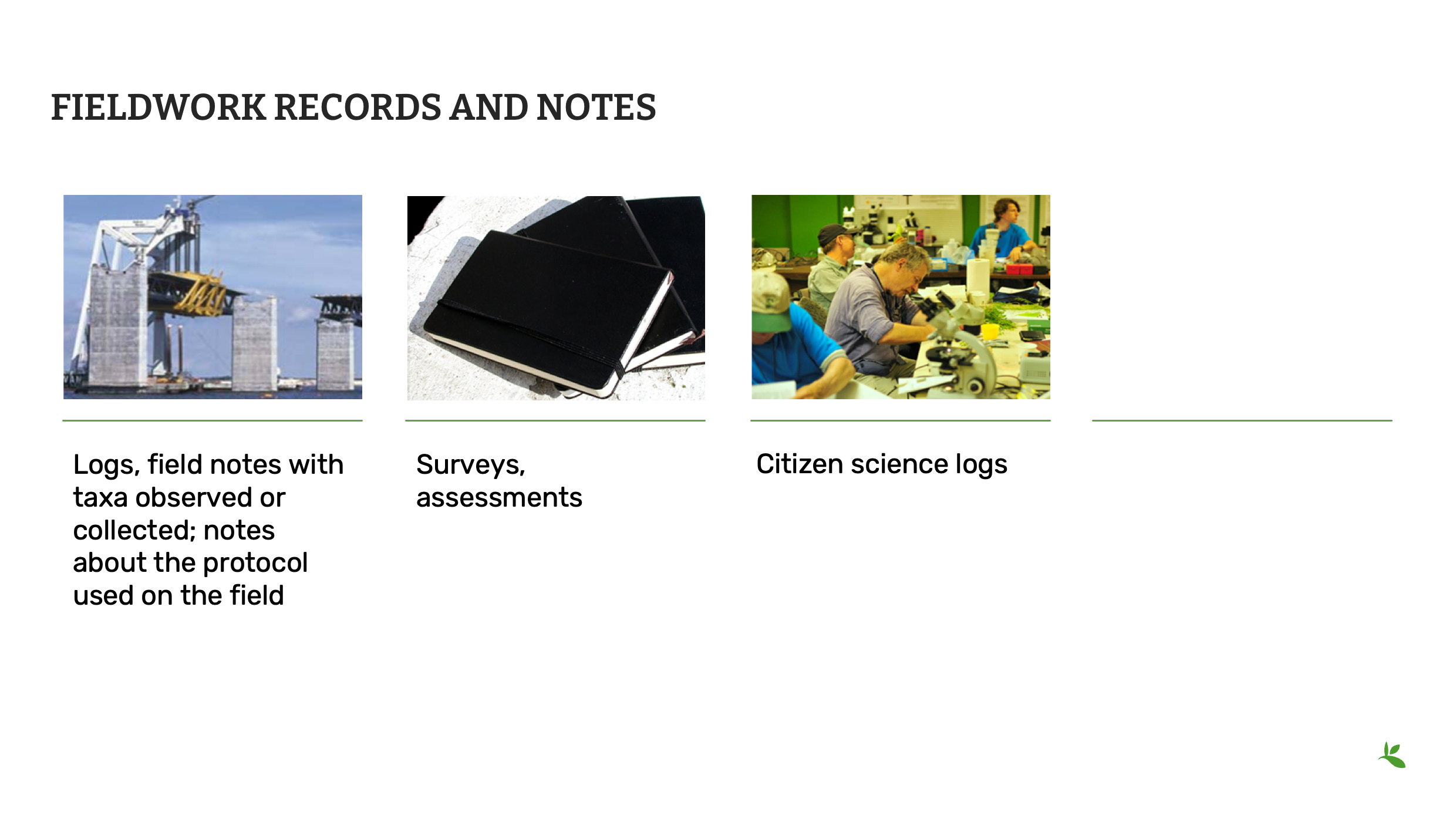
Les ensembles de données fournissent parfois des informations plus détaillées : non seulement ils attestent de la présence d’une espèce à un endroit et à une date donnés, mais ils permettent également d’évaluer la composition des communautés pour des groupes taxonomiques plus larges, voire l’abondance des espèces à différents moments et en différents lieux. Ces ensembles de données quantitatives ou issus d’évènement d’échantillonnages proviennent généralement de protocoles standard de mesure et de surveillance de la biodiversité, tels que les transects de végétation, les recensements d’oiseaux et les prélèvements en milieu d’eau douce ou marin.
En précisant les méthodes utilisées, les événements observés et l’abondance relative des espèces recensées dans un échantillon, ces ensembles de données facilitent les comparaisons avec des données recueillies selon les mêmes protocoles à des moments et en des lieux différents ; dans certains cas, ils permettent même aux chercheurs de conclure à l’absence d’espèces particulières sur certains sites.
Diapositive 9 - Modèle GBIF pour les données d’événement d’échantillonnage
Le modèle GBIF pour les données d’événement permet aux éditeurs de données de partager davantage d’informations sur le contexte d’une opération de collecte ou d’enregistrement de données sur la biodiversité, comme les pièges photographiques, les pièges à insectes, les relevés botaniques, les sites d’observation des oiseaux, etc. Sa structure est plus complexe que celle des ensembles de données taxonomiques et des ensembles de données d’occurrences, car elle implique au moins deux fichiers (par exemple, deux onglets dans un tableur) : l’un pour décrire les « événements » (par exemple, chaque piège) et l’autre pour décrire les spécimens ou les occurrences liés à chaque événement. Il peut y avoir des fichiers/onglets supplémentaires pour décrire des mesures ou des faits, ou pour fournir plus de détails concernant les protocoles d’échantillonnage.
Diapositive 10 - Types de jeux de données et exigences en matière de qualité des données
Le GBIF définit des critères de qualité des données afin de préciser les informations que vous devez fournir pour chaque catégorie de jeu de données. Cela ne signifie pas que les données ne seront pas indexées si certaines valeurs manquent, mais ces critères résument ce qui peut être considéré comme des informations pertinentes pour chaque catégorie. Vous pouvez bien sûr fournir davantage d’informations.
Certaines exigences sont obligatoires (comme l’occurrenceID, le taxonID ou l’eventID, selon le type de jeu de données), d’autres sont facultatives mais fortement recommandées (comme les coordonnées en degrés décimaux). Vous trouverez ces exigences sur GBIF.org.
Diapositive 11 - Comment choisir un type d’ensemble de données ?
Nous savons que le choix d’une catégorie de données peut prendre un certain temps, surtout si vous débutez dans la mise à disposition et le partage de données avec le GBIF. L’équipe d’assistance du GBIF a créé cet organigramme pratique, disponible sur le blog GBIF Data, si vous avez besoin d’aide pour faire votre choix.
Diapositive 12 - Réflexion
Afin de pouvoir partager des données avec le GBIF, il est important de bien comprendre les différences entre les catégories de jeux de données dès les premières étapes du processus de collecte et de gestion des données. Vous pouvez réfléchir à cette question en vous posant les questions suivantes :
Avec quel type de données travaillez-vous ?
Votre type de données est-il différent de ce que vous pensiez initialement ?
Comment les publieriez-vous sur GBIF ?
Diapositive 13 - Conclusion
Ce document fait partie d’une série de présentations utilisées dans le cadre du cours sur la mobilisation des données sur la biodiversité du GBIF. Le programme de mobilisation des données sur la biodiversité a été développé à l’origine dans le cadre du programme de développement de l’information sur la biodiversité financé par l’Union européenne.
Cette présentation a été initialement créée par Sophie Pamerlon, avec la contribution de Laura Anne Russell ainsi que des formateurs et mentors du GBIF. C’est moi, Laura Anne Russell, qui en ai assuré la narration.
Saisie, traitement et qualité des données
|
Dans cette vidéo (12:06), vous découvrirez les principes de la qualité des données appliqués à la saisie de données, notamment lors de la saisie de données provenant d’étiquettes de collecte, de carnets de terrain, de tableurs, etc. Si vous ne parvenez pas à visionner la vidéo intégrée, vous pouvez la télécharger localement. Cette vidéo ne dispose pas encore de sous-titres. (MP4 - 42 Mo) Si vous préférez lire, vous trouverez la transcription sous la vidéo intégrée. |
Transcription de la présentation
Cliquez pour développer
Diapositive 1 - Saisie, traitement et qualité des données
Cette présentation est basée sur les « Principes de qualité des données » de Arthur Chapman
Diapositive 2 - Structure
Au cours de cette présentation, nous allons explorer les principes de la qualité des données appliqués à la saisie des données, spécifiquement lors de la capture de données à partir des étiquettes de collecte, des cahiers de travail, des feuilles de calcul, etc.
Diapositive 3 - Développer un flux de travail pour le traitement et la qualité des données
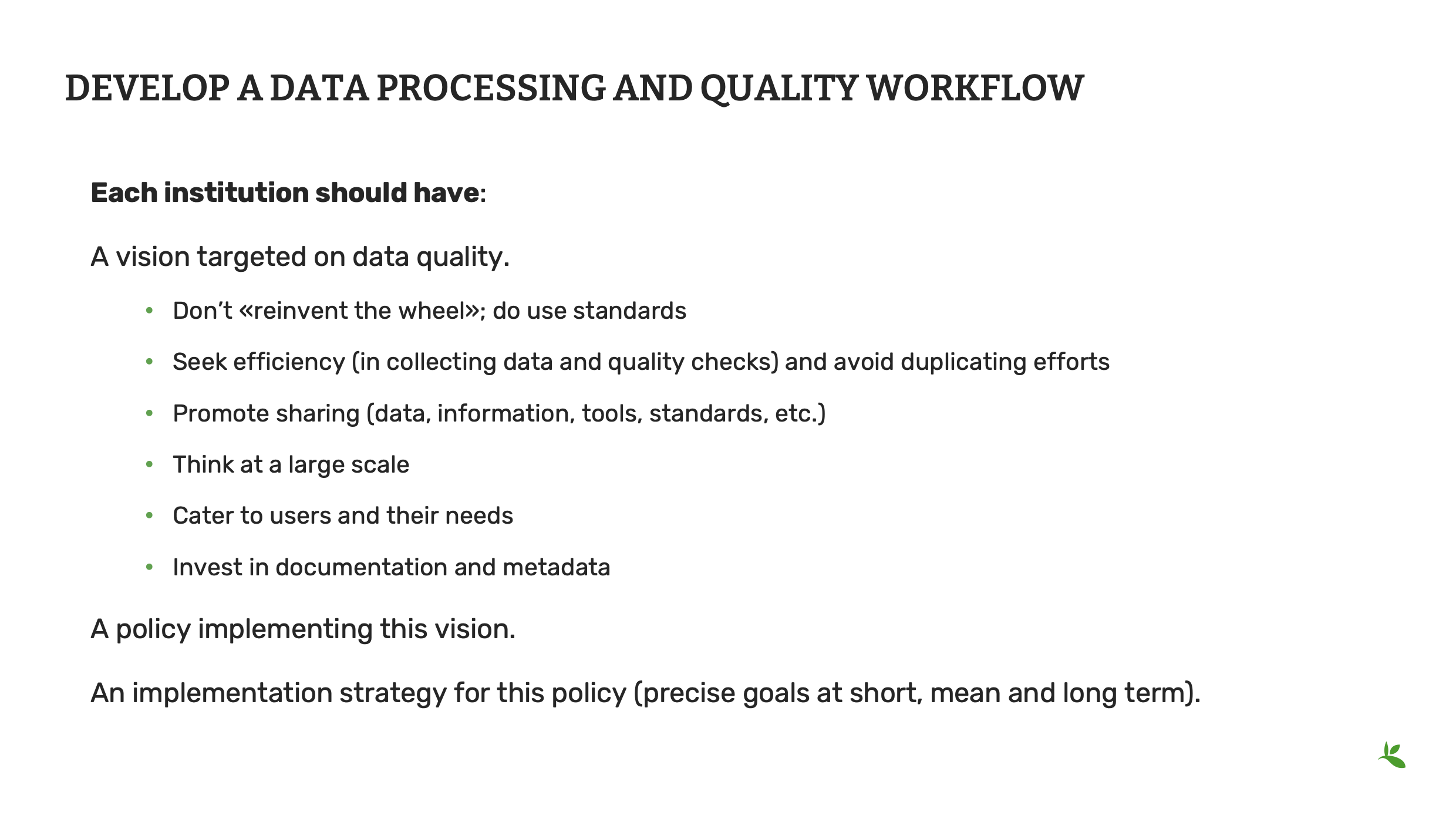
La qualité des données est essentielle à chaque étape du processus de mobilisation des données, en particulier lors des étapes de saisie des données.
Chaque personne impliquée dans la saisie des données a sa part de responsabilité en ce qui concerne la qualité des données, mais la plupart des décisions à ce sujet doivent être prises au niveau institutionnel.
Les mots clés sont : planification et documentation !
Comme indiqué dans la présentation de la documentation sur les fondements, utilisez les normes existantes et planifiez vos flux de travail en fonction de vos objectifs ; documentez tout ce que vous pouvez, à chaque étape, et partagez ou réutilisez autant que possible les documents, les données, les outils et les normes.
Diapositive 4 - Développer un flux de travail pour le traitement et la qualité des données
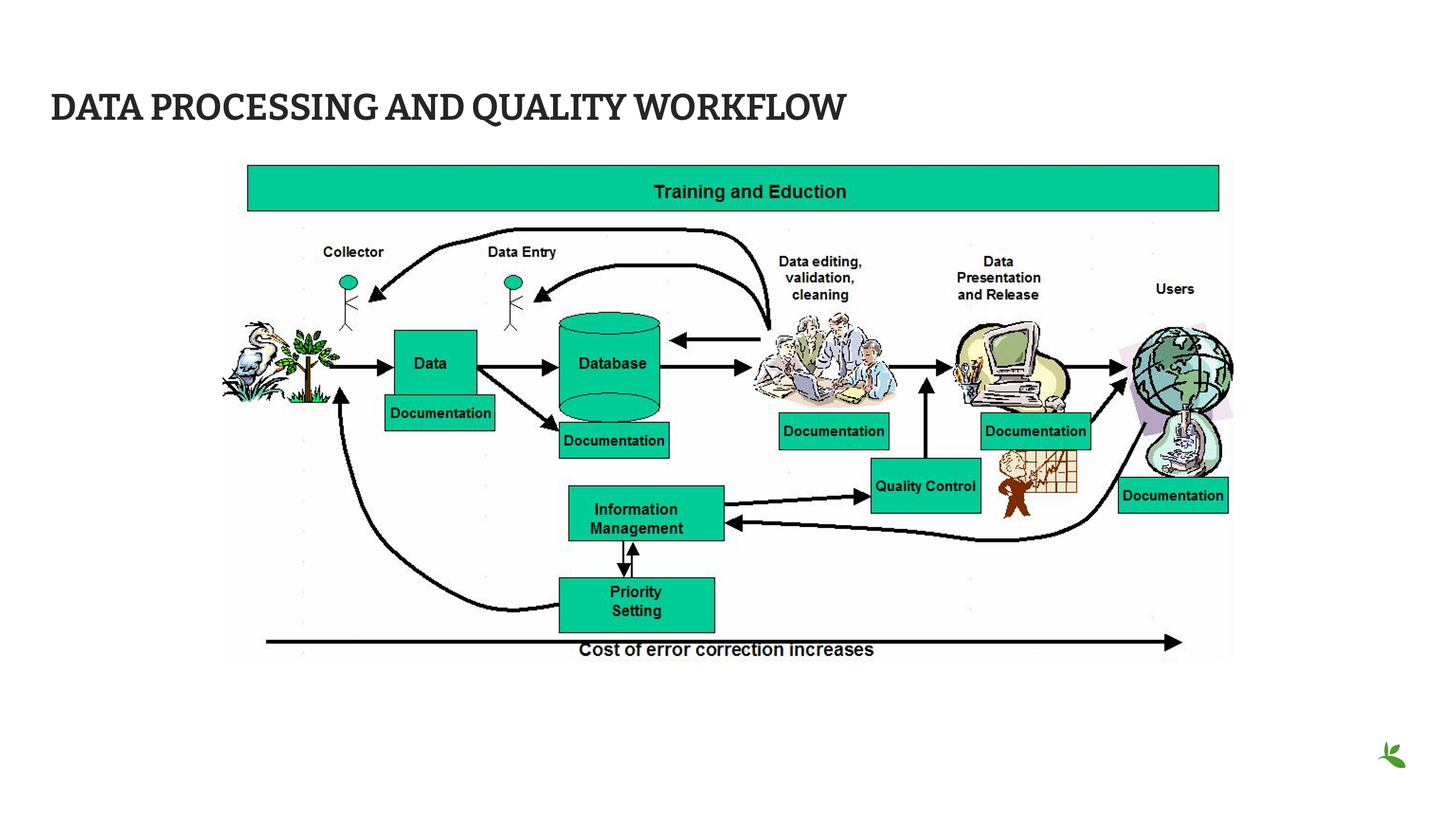
Il s’agit d’un exemple de flux de travail relatif à la qualité des données.
Ce flux de travail commence par la collecte des spécimens, passe à la saisie des données, puis au contrôle de la qualité, à la publication et enfin à l’utilisation.
La qualité des données n’est pas la seule responsabilité de la première personne du processus (ici, le collecteur) - elle est partagée à chaque étape et chaque personne du processus devrait être responsable de la qualité.
Une boucle de rétroaction fonctionnelle doit être mise en place pour vérifier, compléter, mettre à jour ou corriger les données.
C’est là que la documentation est essentielle : vous devez savoir qui était responsable de chaque étape du processus afin de valider les changements qui ont été apportés aux données (ou qui doivent être apportés aux données).
Diapositive 5 - Développer un flux de travail pour le traitement et la qualité des données
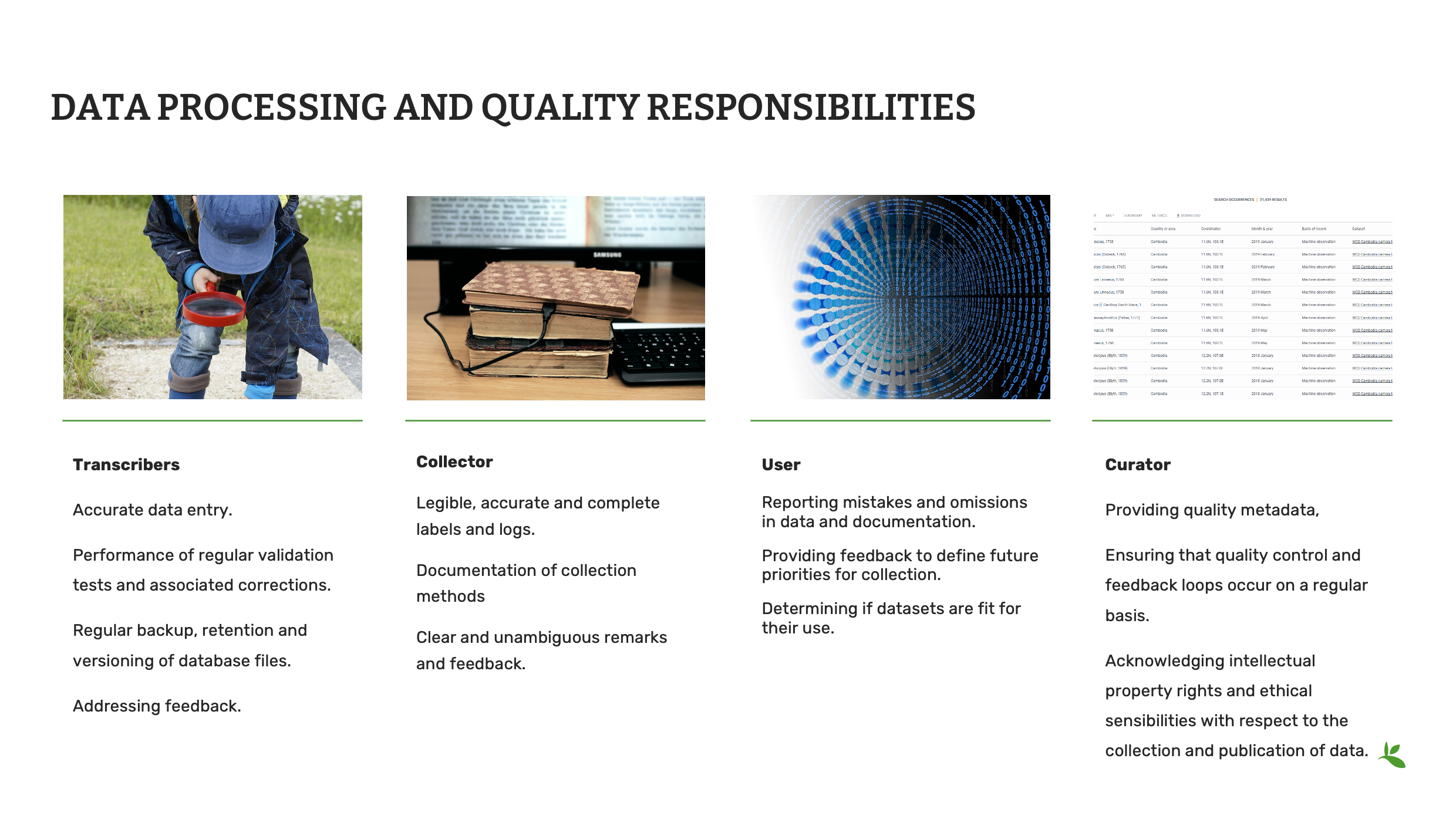
Dans cette vue simplifiée du flux de données, vous pouvez voir certaines des responsabilités en matière de qualité des données de chaque groupe de personnes impliquées.
Dans cet exemple, l’équipe chargée de la mobilisation peut être divisée entre les rôles de "transcripteurs" et de "conservateurs".
L’équipe de transcripteurs doit s’assurer que les données sont saisies et sauvegardées le mieux possible, tandis que le "conservateur" a la responsabilité ultime de veiller à ce que chaque équipe remplisse son rôle dans le processus.
Image du collectionneur : https://pixabay.com/fr/photos/d%C3%A9tective-loupe-regarde-un-788592/
Image de l’utilisateur : www.gbif.org (Résultat de la recherche du jeu de données WSC Cambodia camera trap dataset)
Photos du conservateur : https://pixabay.com/fr/photos/livres-livres-anciens-ordinateur-4802412/ & https://pixabay.com/fr/photos/donn%C3%A9es-ordinateur-internet-2899901/
Diapositive 6 - Structure
Une fois le flux de données mis en place, la saisie des données proprement dite peut commencer.
Dans les diapositives suivantes, nous allons explorer les différents types d’informations qui peuvent être obtenues à partir de spécimens ou d’observations sur le terrain, et nous verrons quelles sont les erreurs les plus courantes à éviter lorsque l’on traite chaque type d’information.
Les principaux thèmes abordés seront les suivants : informations taxonomiques, informations spatiales, informations sur les collections, informations descriptives.
Veuillez noter que chaque occurrence (chaque ligne de votre base de données ou de votre feuille de calcul) doit contenir des informations liées à ces quatre thèmes principaux afin d’être partagée et réutilisée en conséquence.
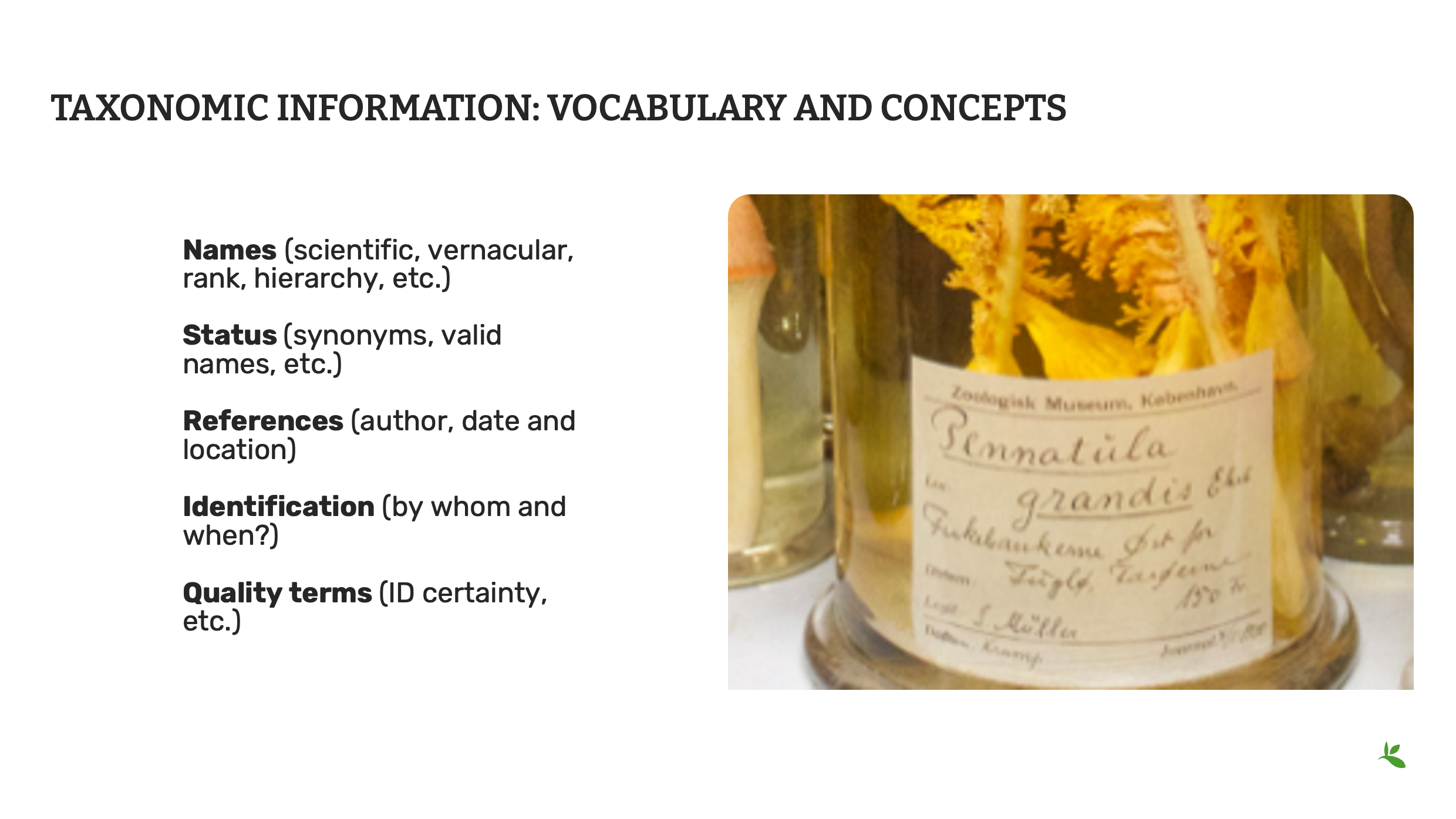
Diapositive 7 - Information taxonomique : vocabulaires et concepts
L’information taxonomique est un élément essentiel du processus de saisie des données.
Sans information taxonomique, un spécimen numérisé est inutile et ne peut être correctement interprété ou réutilisé.
Il convient de noter que le nom de l’espèce n’est pas le seul type d’information taxonomique pouvant être exploité dans le processus de saisie des données : parfois, le spécimen n’a pas été identifié jusqu’à l’espèce, et des niveaux taxonomiques plus élevés, tels que le genre ou la famille, sont toujours utiles pour les gestionnaires et les utilisateurs de données.
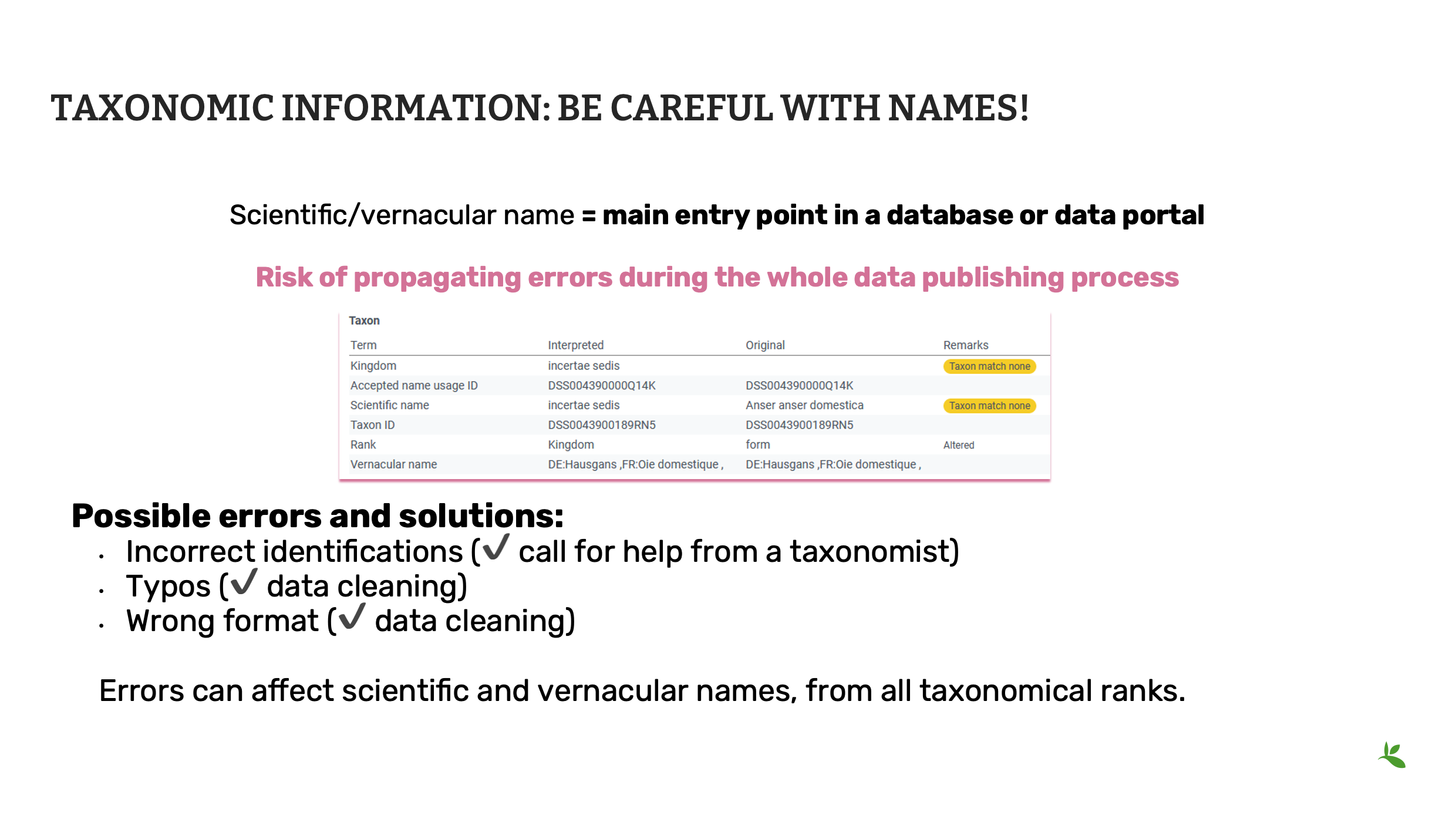
Diapositive 8 - Informations taxonomiques — attention aux noms!
La plupart du temps, le nom scientifique est le principal moyen de retrouver des données dans une base de données, un portail, un site web, un navigateur, etc.
Toute erreur d’orthographe ou d’autorité peut conduire à des requêtes erronées ou nulles, entravant ainsi la gestion et la réutilisation potentielle des données.
C’est pourquoi il est très important de vérifier toutes les catégories de noms scientifiques afin de corriger les erreurs et/ou les omissions.
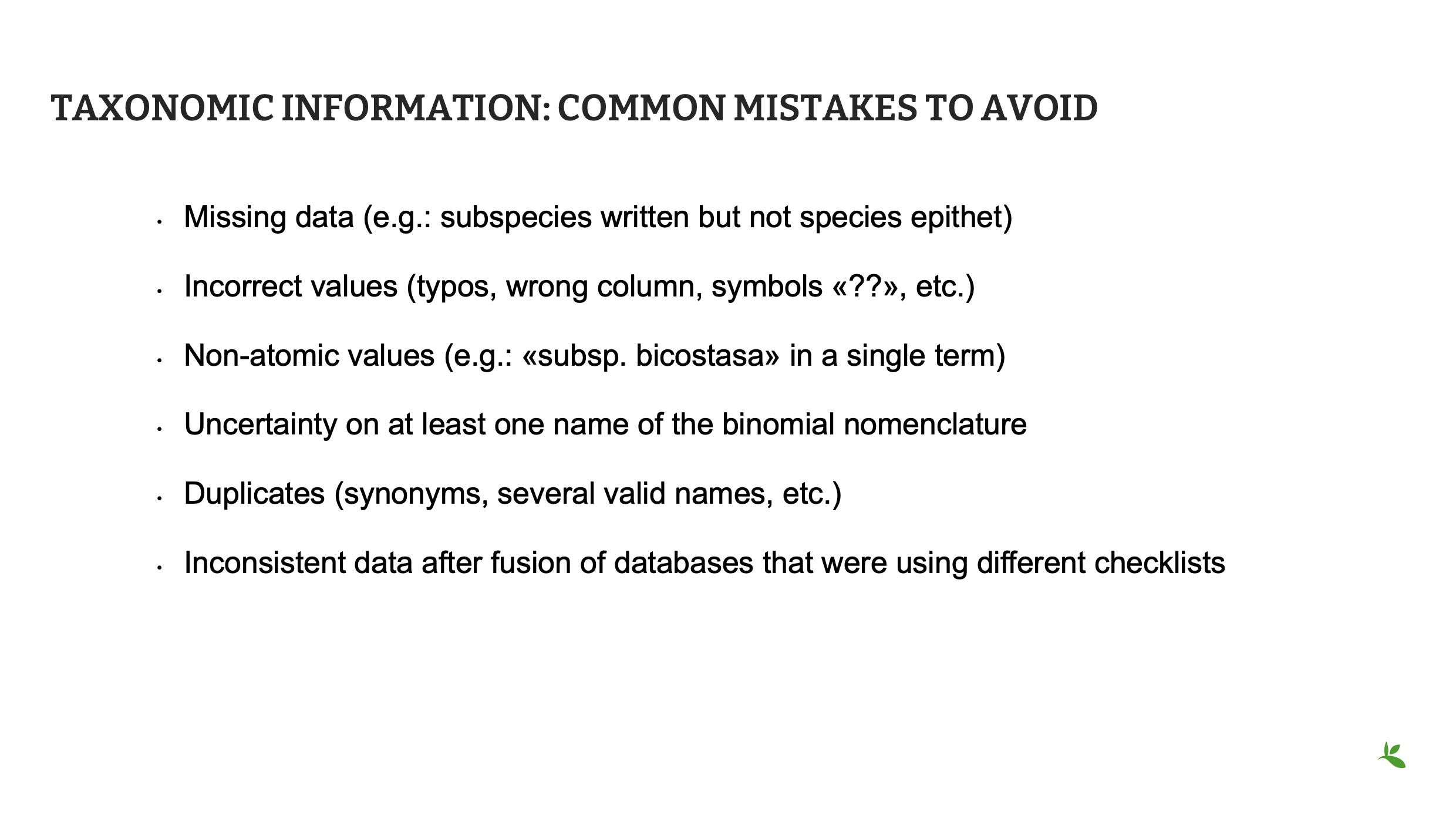
Diapositive 9 - Informations taxonomiques : erreurs communes à éviter
Les problèmes les plus courants concernant les informations sur les taxons sont les informations manquantes ou incohérentes, les valeurs incorrectes ou non atomiques, les doublons et l’incertitude.
Vérifiez toujours les définitions et les exemples des termes taxonomiques du Darwin Core pour éviter les erreurs de nomenclature : http://rs.tdwg.org/dwc/terms/index.htm
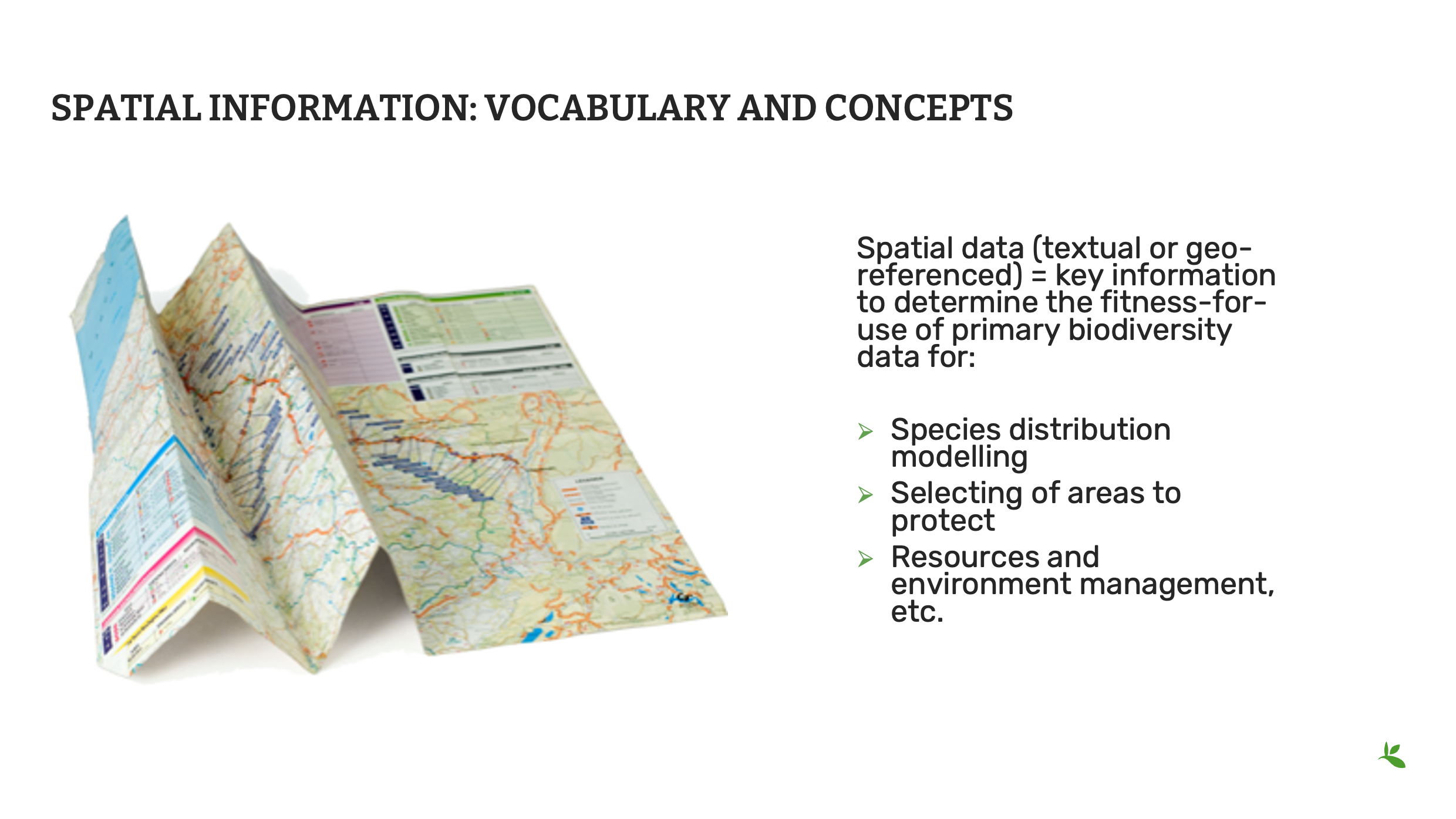
Diapositive 10 - Information taxonomique : vocabulaires et concepts
Les informations géographiques s’avèrent précieuses dans de nombreux contextes de réutilisation des données, tels que la modélisation des niches ou les études sur la répartition des espèces.
Bien qu’il soit difficile, voire impossible, de géolocaliser avec précision les collections ou les spécimens « anciens », il est recommandé de partager des coordonnées précises ou des informations textuelles lorsque cela est possible.
Les coordonnées doivent être enregistrées directement sur le terrain lorsque cela est possible, avec l’incertitude et le système de référence géodésique utilisé. Dans le cas contraire, utilisez des sources pertinentes et vérifiées pour géolocaliser vos données.
Il convient de noter que les coordonnées ou autres informations géographiques peuvent être généralisées ou ne pas être partagées du tout dans certains contextes, par exemple dans le cadre de la conservation d’espèces sensibles.
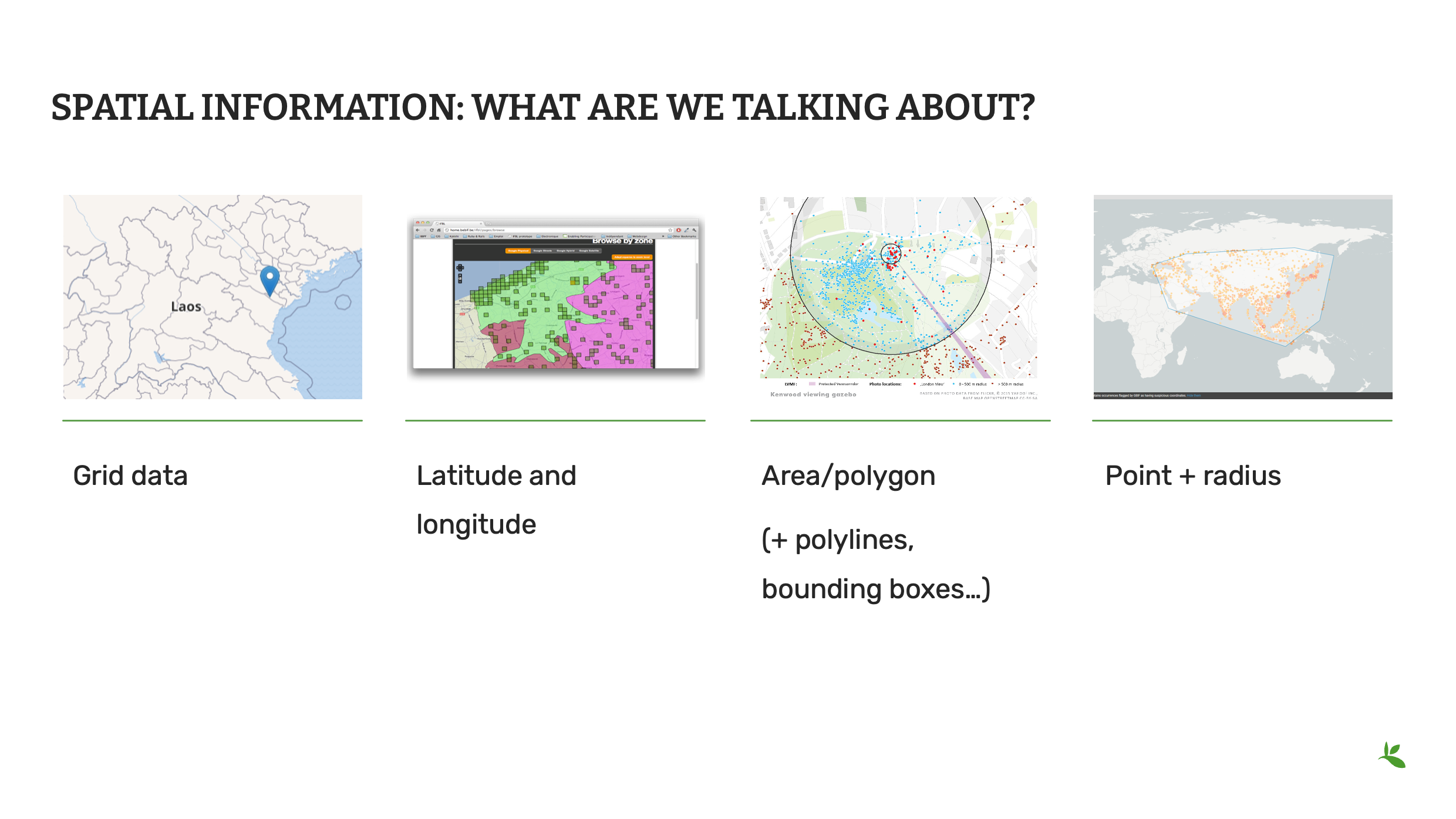
Diapositive 11 - Information spatiale : de quoi parlons-nous ?
Les informations spatiales peuvent se présenter sous de nombreux formats, et pas seulement sous la forme de coordonnées géographiques : les exemples incluent (mais ne sont pas limités à) des données de grille, des points+rayons ou des polygones.
Chacun d’entre eux est utile à partager afin de vérifier la cohérence des éléments géographiques (par exemple les coordonnées par rapport au code du pays, ou pour s’assurer qu’une localité donnée est cohérente avec les voyages d’un collectionneur).
Image de Point avec rayon : https://live.staticflickr.com/5820/23736048306_35dfd89c05_b.jpg

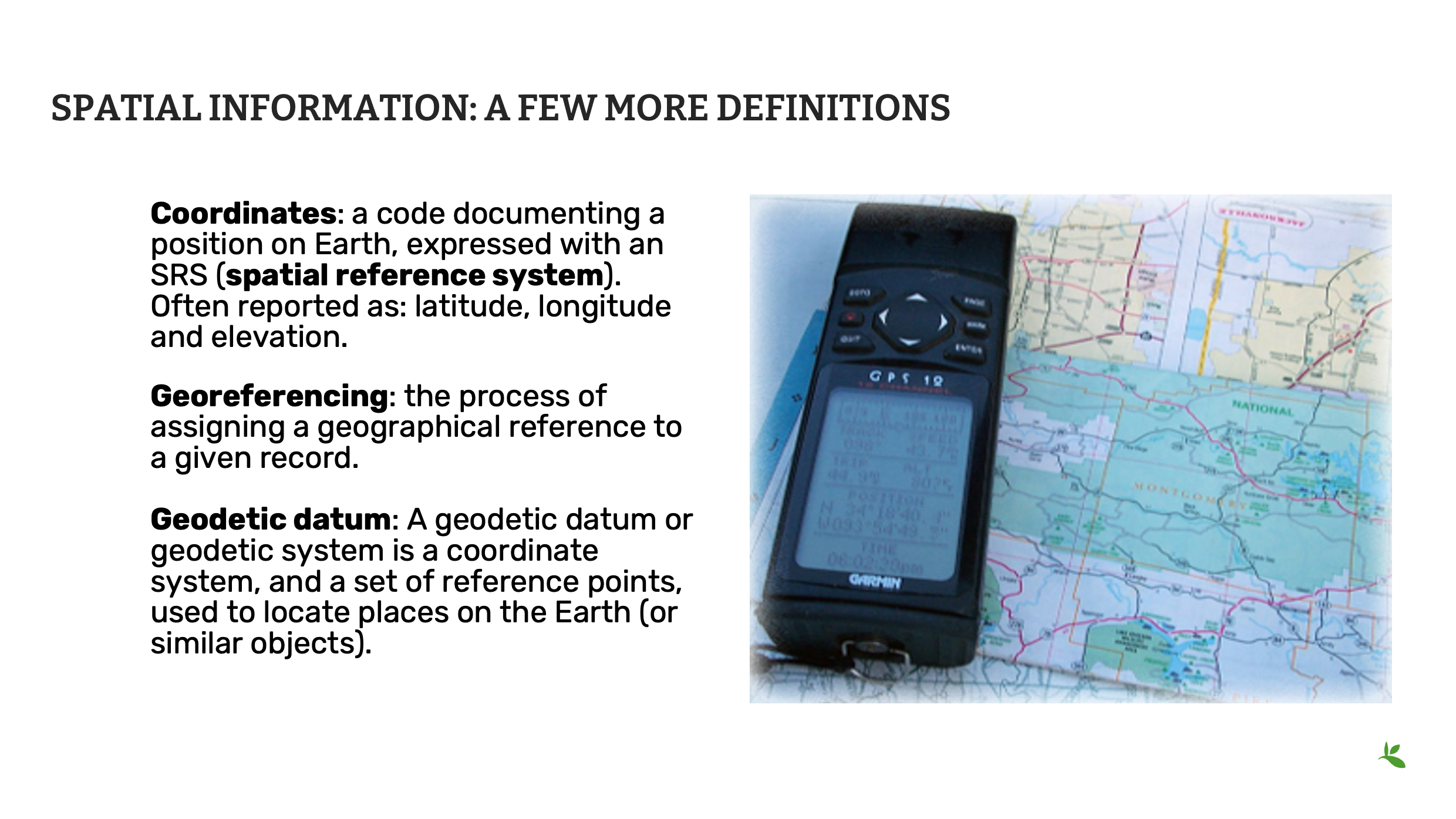
Diapositive 12 - Information spatiale : quelques définitions supplémentaires
Au sein du GBIF, il est recommandé de partager le système de référence géodésique utilisé pour dériver les coordonnées partagées (latitude et longitude décimales).
En l’absence d’un datum géodésique spécifique, GBIF déduira WGS84 par défaut.
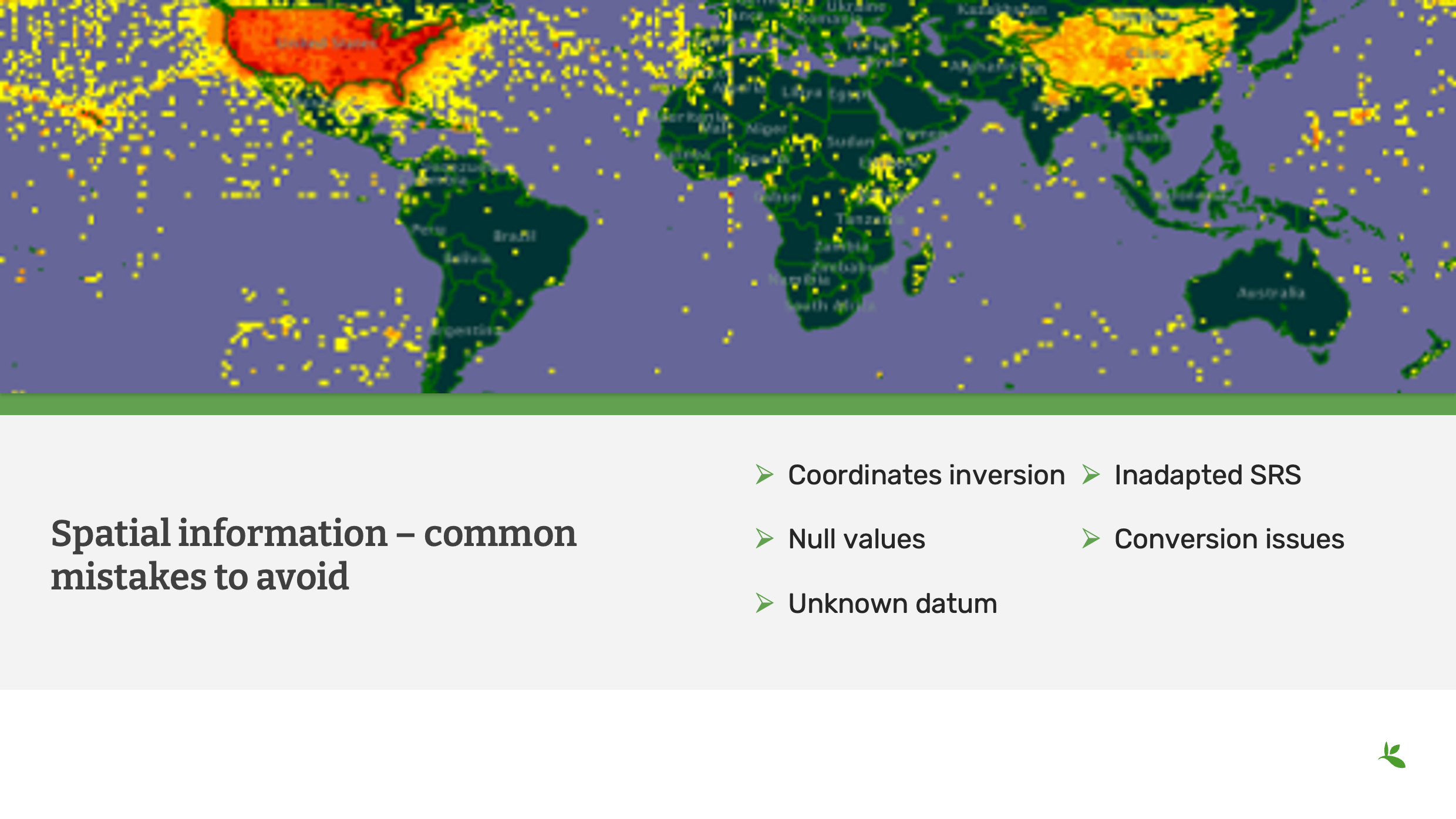
Diapositive 13 - Informations taxonomiques : erreurs communes à éviter
Cette diapositive montre une ancienne carte du GBIF présentant différents types de problèmes géographiques : le plus évident est un effet miroir entre les États-Unis et la Chine (coordonnées inversées),
Vous pouvez également remarquer une ligne artificielle le long du méridien de Greenwich où des valeurs '0' ont été mises dans le champ 'decimalLongitude', ainsi qu’une autre sur l’Équateur où des valeurs '0' ont été mises dans le champ 'decimalLatitude'.
L’indexation GBIF inclut désormais des vérifications géographiques automatiques entre les coordonnées et le code pays partagés dans le jeu de données. Les coordonnées peuvent être automatiquement inversées pour correspondre au pays.
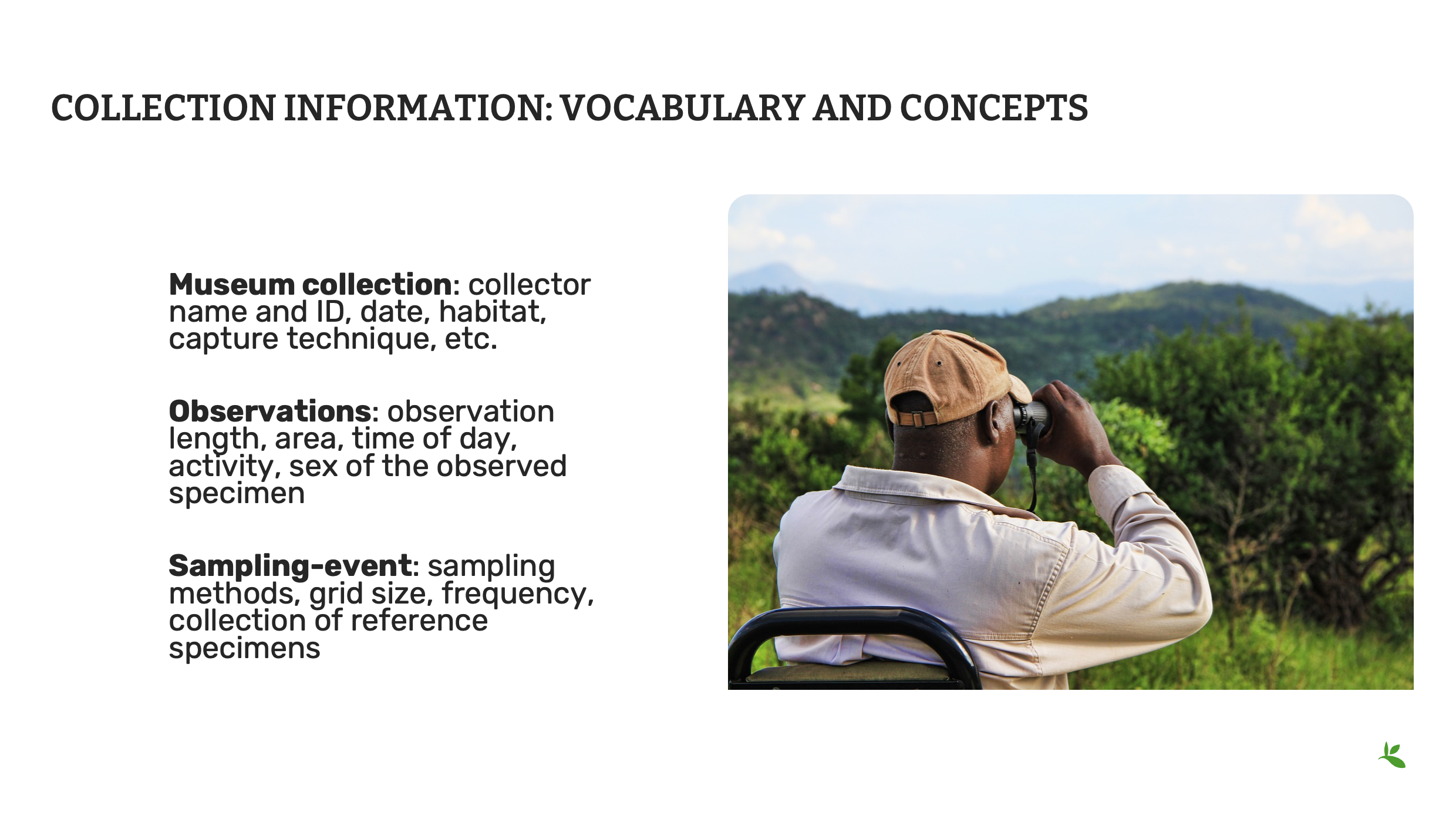
Diapositive 14 - Information taxonomique : vocabulaires et concepts
Les informations sur le contexte de la collecte de données ou de l’observation sont très utiles à partager afin de donner autant de détails que possible sur chaque événement.
Des informations telles que le nom du collecteur, le protocole de collecte ou d’observation, l’habitat et d’autres facteurs peuvent s’avérer importantes lors de la réutilisation des données, par exemple dans le cadre de la modélisation des niches écologiques.
Selon le type d’ensemble de données, d’autres informations peuvent également s’avérer pertinentes.
Diapositive 15 - Informations sur la collecte : ce qu’il faut garder à l’esprit
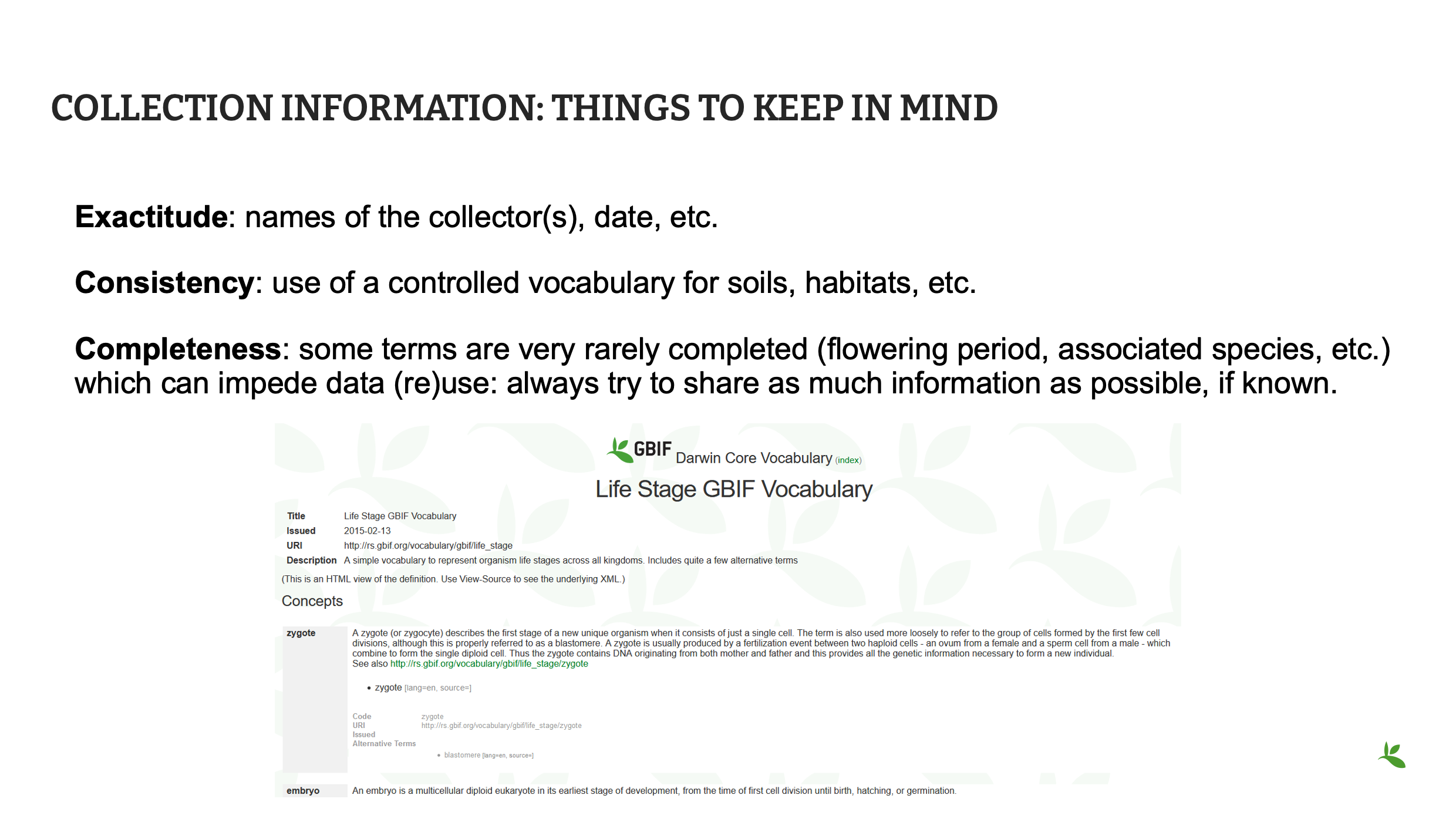
Les facteurs de qualité des données concernant les informations collectées sont principalement l’exactitude, comme le nom correct du collecteur, la cohérence, par exemple l’utilisation du même vocabulaire pour décrire les sols et les habitats, et l’exhaustivité, comme la fourniture de toutes les informations existantes sur la description d’une espèce donnée, y compris la période de floraison, la couleur des feuilles et les utilisations médicinales.
Dans le Darwin Core et dans l’IPT, vous trouverez des vocabulaires contrôlés recommandés pour certains domaines tels que le "lifeStage". Le groupe de travail sur les vocabulaires du TDWG s’efforce de promouvoir et d’améliorer la facilité d’utilisation des vocabulaires.
Diapositive 16 - Information taxonomique : vocabulaires et concepts
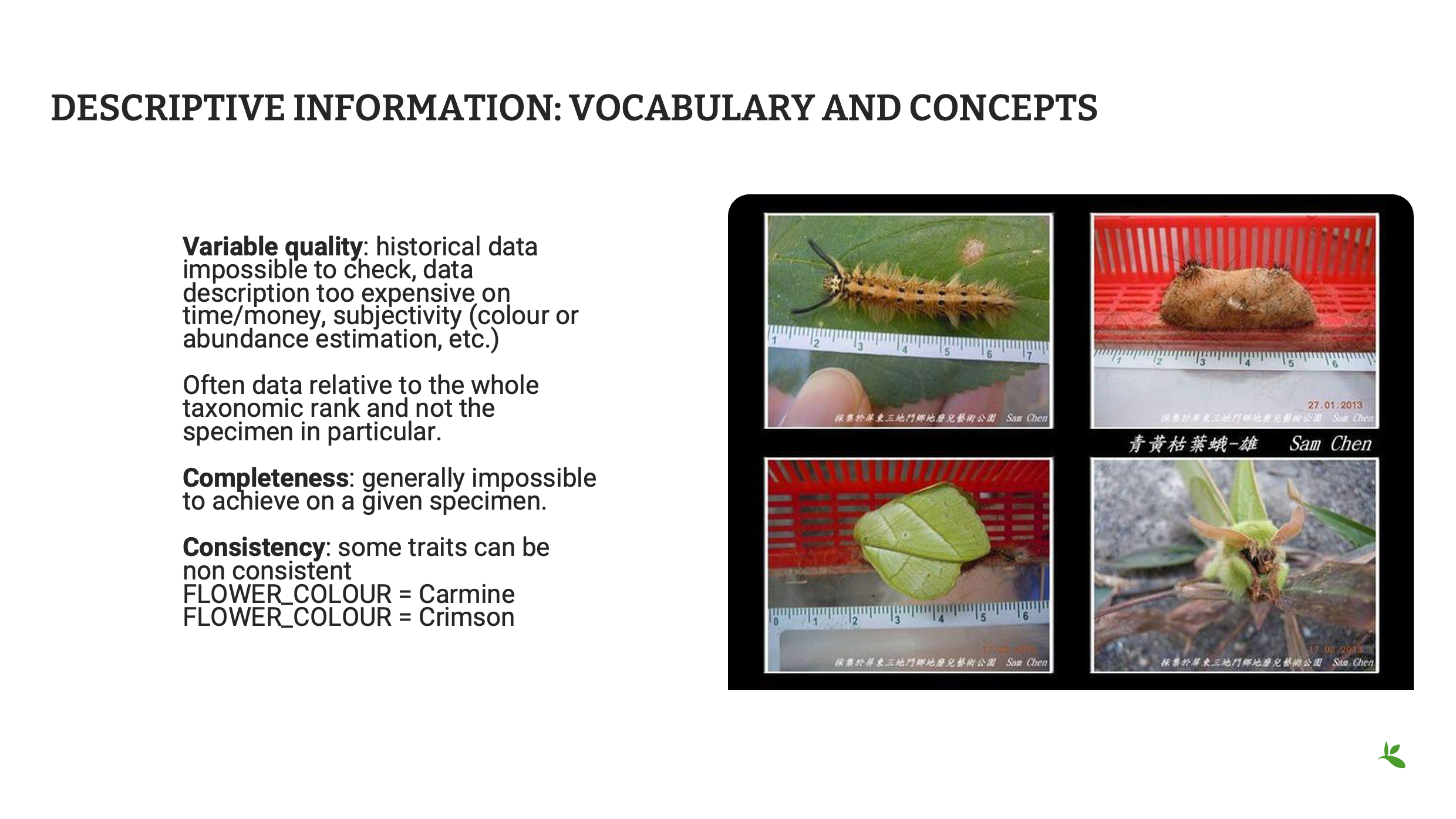
Gardez à l’esprit que les informations descriptives sont souvent incomplètes en raison d’une panoplie de facteurs.
Selon l’état de la collection, certaines étiquettes peuvent être incomplètes ou manquer d’informations essentielles ; l’exhaustivité (par exemple de la description d’une espèce) est souvent impossible à atteindre avec un seul individu ; et vous devez toujours vérifier la cohérence de votre base de données ou de votre feuille de calcul, par exemple dans les termes utilisés pour décrire les couleurs, afin d’éviter les informations redondantes.
Crédit image : Ensemble de données sur les occurrences de papillons de nuit à Taïwan recueillies sur les réseaux sociaux

Diapositive 17 - Résumé
Cette présentation s’est concentrée sur le thème de la qualité des données appliquée à la saisie des données ; en effet, il s’agit des étapes où il est crucial de s’assurer que toutes les informations relatives à chaque enregistrement sont correctement et complètement saisies, afin que les données soient aussi claires et compréhensibles que possible pour les futurs utilisateurs.
Cela n’est possible que si des décisions cohérentes sont prises au niveau institutionnel afin de créer un flux de travail solide pour la saisie et la gestion des données.
La chaîne de responsabilité concernant la qualité des données est alors répartie entre les personnes impliquées à chaque étape du processus, mais n’oubliez pas que les données peuvent toujours être améliorées et corrigées si des erreurs ou des omissions sont détectées à des stades ultérieurs.

Diapositive 18 - Conclusion
Ce document fait partie d’une série de présentations utilisées dans le cadre du cours sur la mobilisation des données sur la biodiversité du GBIF. Le programme de mobilisation des données sur la biodiversité a été développé à l’origine dans le cadre du programme de développement de l’information sur la biodiversité financé par l’Union européenne.
Cette présentation a été créée et narrée par Sophie Pamerlon avec des contributions supplémentaires des Coachs du BID et du BIFA, Mentors et Étudiants. La narration est par moi, Lily Shrestha.
Exercice 1c
|
Pour cette activité, vous réaliserez un exercice simulant la capture de données de l’analogique au numérique. Utilisez le site Darwin Core terms pour vous aider à prendre des décisions sur les données complémentaires nécessaires au projet et sur celles qui pourraient être partagées ultérieurement dans le cadre d’une publication. |
-
Télécharger UC-Practice-1-ForCapture-logs.zip. (939 KB). Le fichier compressé contient trois fichiers journaux de bord.
-
Téléchargez le modèle de feuille de calcul : UC-Practice-1-ForCapture-template.xlsx (27 KB) pour transcrire les observations enregistrées.
-
Utilisez la feuille d’exercice précédemment téléchargée pour donner vos réponses.
| vous devrez peut-être ajouter des champs à la feuille de calcul, car vous pourrez peut-être capturer plus d’informations à partir des étiquettes que ce qui était prévu dans le modèle. |